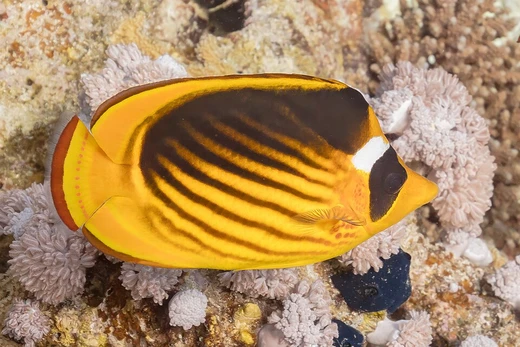
Chaetodon citrinellus
A quiet, citrine-streaked sentinel of the outer reef slope, grazing polyps in dappled light.

Chaetodon citrinellus is a small, predominantly citrine-yellow butterflyfish in the family Chaetodontidae, first described by Cuvier in 1831. It inhabits shallow coral reefs across the western Pacific and parts of the Indian Ocean, where it occupies the mid-water column above living coral and rubble (FishBase; Cuvier, 1831). As a zooplanktivore–corallivore generalist, it links reef invertebrate communities to higher trophic levels and contributes to the structural maintenance of coral assemblages through selective polyp grazing (Randall, 1998; Allen, 2006).
In the aquarium trade the species is marketed as the Citrine Butterflyfish or, less precisely, the Lemon Butterflyfish. It is valued for its compact size, calm demeanor, and uniform warm-yellow coloration, which distinguishes it from the more patterned congeners that dominate the Chaetodon hobby market (FishBase; WoRMS, accessed 2024).
- Family
- Chaetodontidae (WoRMS)
- Authority
- Cuvier, 1831 (FishBase)
- Common name
- Citrine Butterflyfish (FishBase)
- Distribution
- Western Pacific; parts of the Indian Ocean (FishBase)
- Habitat
- Shallow coral reefs, typically 2–25 m (FishBase; Allen, 2006)
- Diet
- Coral polyps, sponges, small benthic invertebrates (Randall, 1998)
Lore & Background
Cuvier's 1831 description placed C. citrinellus among the 'poissons-papillons' of the Indian and Pacific Oceans, noting its small stature and the uniform warm-yellow ground color that gives the species its specific epithet. Subsequent authors—Randall (1998), Allen et al. (2006)—confirmed the range as broadly Indo-Pacific with a western-Pacific core, and clarified that the species is most abundant on fore-reef slopes and outer-reef ledges rather than in lagoonal patches (FishBase; Randall, 1998).
Behaviorally, C. citrinellus is a shy, mid-water feeder that rarely exceeds 12 cm total length. It forages in pairs or small aggregations of three to six individuals, picking coral polyps, sponge tissue, and tiny crustaceans from the reef surface with its elongated, terminal mouth. Unlike the larger, more territorial Chaetodon species, it tolerates the presence of other small reef fish and is often observed hovering near the same coral heads as anthias and chromis (Allen, 2006; Randall, 1998).
The species is not currently listed as threatened by the IUCN, though localized overcollection for the ornamental trade and reef degradation are recognized pressures in parts of its range (FishBase; IUCN Red List, accessed 2024). Its small size and preference for structurally complex outer-reef habitat make it particularly vulnerable to the loss of live coral cover.
Reader's Guide
Size and body form. C. citrinellus reaches roughly 10–12 cm total length (FishBase; Randall, 1998), making it one of the smaller Chaetodon species. The body is laterally compressed, disc-shaped, with a moderately pointed snout and a terminal, slightly protrusile mouth adapted for picking polyps and sponge tissue. This contrasts with the larger, more elongate C. aureus (Golden Butterflyfish, ~15 cm) and the distinctly taller, more disc-like C. kleinii (Orange Butterflyfish, ~14 cm) (Allen, 2006).
Coloration. The ground color is a uniform warm citrine-yellow, slightly deeper on the dorsal surface and paler ventrally. A faint, thin black vertical bar passes through the eye, and the caudal peduncle may show a narrow dark stripe in some specimens (Cuvier, 1831; Randall, 1998). This plain, unpatterned yellow distinguishes it from the boldly barred C. decussatus and the white-and-yellow C. andamanensis, which is its closest look-alike but typically shows a more contrasting black eye-bar and a white subterminal caudal stripe (Allen, 2006).
Fins and locomotion. The dorsal fin has approximately 13 spines and 12–13 soft rays; the anal fin carries 3 spines and 12–13 soft rays (Cuvier, 1831; FishBase). The pectoral fins are long and translucent, used for precise hovering while feeding. Finnage is similar to C. andamanensis, but the overall smaller size and the absence of a prominent white caudal margin are reliable field marks (Randall, 1998).
Habitat and depth. Recorded from roughly 2 to 25 m on live-reef slopes, outer-reef ledges, and rubble patches over sand (FishBase; Allen, 2006). It is less common in sheltered lagoons than the more generalist C. andamanensis. Water clarity and the presence of intact Acropora or Pocillopora cover are strong correlates of its occurrence (Randall, 1998).
Key references: Cuvier, A. (1831). Description des poissons de la famille des Chaetodontes. In: Histoire naturelle des Poissons, vol. 11. Paris. / Randall, J.E. (1998). A revision of the butterflyfish genus Chaetodon. Smithson. Contrib. Zool. 594. / Allen, G.J. (2006). Reef Fishes of the Indo-Pacific. T.F.H. Publications.
Did You Know?
- Despite its plain yellow coloration, C. citrinellus is easily confused with C. andamanensis in the aquarium trade; the reliable field mark is the absence of a white subterminal stripe on the caudal fin in C.
- The species is a selective coral-polyp grazer, and its foraging has been observed to stimulate branching Acropora growth by removing encrusting algae and invertebrates from the coral surface (Randall, 1998).
More in Species Profile
Elsewhere in Diagonal butterflyfish
Spotted an error? Know more?
Reader corrections go straight into our review queue. Suggest an edit · How this site is sourced