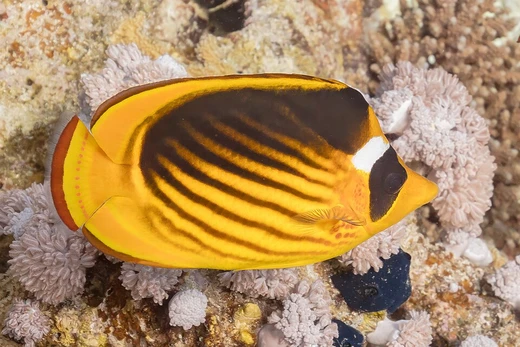
Manta alfredi
A gentle giant of the reef, sweeping the water column in silent, sweeping arcs.

Manta alfredi, commonly known as the reef manta ray, is a medium-sized member of the family Mobulidae that inhabits tropical and subtropical reef-associated waters across the Indo-Pacific and Atlantic. Distinguished from the larger oceanic manta (Manta birostris) by its smaller maximum size, more robust body, and preference for shallower, reef-adjacent habitats, M. alfredi occupies a unique ecological niche as a large, highly mobile zooplankton filter-feeder in coastal marine ecosystems.
As a keystone grazer of the water column, M. alfredi links pelagic plankton productivity to reef and nearshore food webs. Its predictable visits to cleaning stations, its role in nutrient transport between open water and benthic zones, and its status as a charismatic megafauna species make it a focal point of marine conservation, ecotourism, and behavioral ecology research.
- Common name
- Reef manta ray
- Scientific name
- Manta alfredi
- Family
- Mobulidae
- Diet
- Zooplankton (filter feeder)
- Iucn red list status
- Vulnerable
- Habitat
- Tropical and subtropical reef-associated waters (Indo-Pacific, Atlantic)
- Reproduction
- Viviparous (live birth)
Lore & Background
Manta alfredi was long lumped with the oceanic manta (M. birostris) as a single species, but morphometric and genetic work in the 2010s formalized the split, recognizing the reef-associated form as a distinct taxon. The reef manta is consistently smaller in maximum disc width, possesses a more deeply notched caudal peduncle, and shows a stronger affinity for inshore reef and seagrass habitats. This taxonomic clarification has sharpened conservation attention, because the two species face different threat profiles and occupy different management jurisdictions.
Ecologically, M. alfredi is a continuous filter-feeder: it swims with its mouth open, using its large, extendable cephalic fins (often called 'horns') to funnel dense clouds of zooplankton, small crustaceans, and fish larvae into its buccal cavity. The gill rakers then trap the prey while seawater passes through. Because the ray must keep moving to maintain flow over its gills, it is essentially a perpetual forager, covering considerable daily distances in search of productive water layers.
The species is also a social and site-faithful animal. Individuals return repeatedly to the same feeding aggregations, cleaning stations, and shallow bays, a behavior that has made certain reef sites—such as those in the Maldives, Indonesia, and the Caribbean—renowned for predictable manta encounters. This site fidelity, combined with its Vulnerable IUCN listing, has driven the establishment of marine protected areas and dive-tourism regulations specifically designed to reduce human disturbance while allowing observation.
Reader's Guide
Feeding sweep (field-observed, open water): A manta enters a productive zone—often a tidal channel or upwelling plume—and extends both cephalic fins forward, forming a funnel that directs a dense zooplankton cloud into its wide-open mouth. It maintains a steady, slow forward glide, never stopping, because gill flow depends on continuous movement. The ecological consequence is a sustained removal of mesozooplankton from the photic zone, transferring that carbon and nitrogen into the reef-associated food web via fecal pellets and mucus deposits on the benthos.
Cleaning-station visit (field-observed, benthic): The ray descends to a shallow reef flat or sandy patch, lowers its head, and holds still while cleaner wrasses (Labrini) and cleaner shrimp (Lysmata amboinensis) pick parasites and dead tissue from the gill slits, cephalic-fin bases, and ventral surface. The manta's stillness is voluntary and prolonged—sometimes several minutes. The consequence is reduced ectoparasite load, which supports the ray's long-term foraging efficiency and reduces secondary infection risk.
Group aggregation at a dive site (field-observed, coastal): Two to a handful of individuals converge on a known feeding or resting site, often at dawn or dusk. They circle in loose formation, occasionally breaching or 'slapping' the surface, then resume their sweep. The interaction is non-aggressive; no dominance hierarchy is apparent. The consequence is a concentrated pulse of nutrient deposition and a visible signal to smaller reef fish that a productive water layer is present, triggering secondary foraging activity.
Did You Know?
- Each Manta alfredi has a unique pattern of white spots and blotches on its ventral surface, functioning much like a human fingerprint for individual identification in long-term field studies.
- Despite its size and powerful pectoral 'wings,' the reef manta ray possesses no venomous stinger; it is a mobulid, not a dasyatid, and poses no envenomation risk to humans or prey.
- Manta alfredi is viviparous—females give birth to live young after an internal gestation—meaning no egg case or external brooding is involved in its reproductive cycle.
- Its cephalic fins, often called 'horns,' are not used in combat; they are highly modified pectoral-fin extensions that serve exclusively to funnel plankton into the mouth during continuous filter-feeding.
More in Behavior & Ecology
Elsewhere in Diagonal butterflyfish
Spotted an error? Know more?
Reader corrections go straight into our review queue. Suggest an edit · How this site is sourced