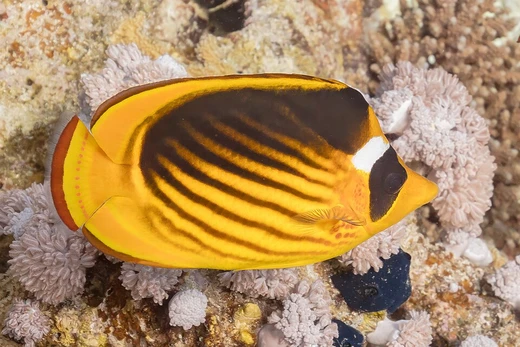
Chaetodon xanthurus
A small, sun-yellow butterflyfish that dissolves into the coral light of the Indo-Pacific.

Chaetodon xanthurus, commonly known as the Xanthic Butterflyfish, is a small species of reef-dwelling butterflyfish in the family Chaetodontidae. The specific epithet 'xanthurus' derives from the Greek xanthos (yellow), reflecting the species' predominantly yellow body coloration. It was described by Georges Cuvier in 1831 and is known from coral-reef habitats across the Indo-Pacific region (Cuvier, 1831; FishBase, Chaetodon xanthurus entry).
Like other members of the genus Chaetodon, it occupies the mid-water column above live coral and rubble substrates, feeding on small invertebrates and coral polyps. It is a relatively inconspicuous, small-bodied butterflyfish that blends into the yellow-and-cream palette of many reef communities, and it is often encountered in the company of other small Chaetodon species (Randall, 1955; Wikipedia, 'Chaetodon xanthurus').
- Common name
- Xanthic Butterflyfish
- Scientific name
- Chaetodon xanthurus Cuvier, 1831
- Family
- Chaetodontidae
- Distribution
- Indo-Pacific coral reefs
- Habitat
- Live coral and rubble, mid-water
- Body coloration
- Predominantly yellow (xanthic)
Lore & Background
Chaetodon xanthurus occupies a modest niche within the crowded butterflyfish assemblage of Indo-Pacific reefs. Its all-over yellow coloration, combined with a compact, laterally compressed disc, allows it to remain visually subordinate to the more boldly patterned congeners that share its habitat. Cuvier's 1831 description placed it among the smaller Chaetodon forms, and subsequent revisions by Randall (1955) confirmed its distinctiveness from the similarly hued Chaetodon andamanensis, primarily on the basis of fin-ray counts and the extent of dark markings on the dorsal and anal fins (Randall, 1955; Cuvier, 1831).
Ecologically, the species is a typical mid-reef butterflyfish: it holds a small territory above branching or massive coral, picking at polyps, detritus, and tiny crustaceans with its fine, pointed teeth. It is diurnal and typically seen in pairs or small, loose groups during the day, retreating into crevices at night. Its unobtrusive coloration means it is frequently overlooked by divers and collectors in favor of more conspicuous species, and it remains relatively understudied compared to larger Chaetodon (Wikipedia, 'Chaetodon xanthurus'; FishBase).
The species' range spans the western and central Pacific, with records from the Philippines, Indonesia, and surrounding island groups, though its full biogeographic extent is not exhaustively documented. It is not currently listed as threatened by the IUCN, and its small size and low visibility on the reef make it a species of quiet persistence rather than dramatic abundance (IUCN Red List; FishBase, distribution data).
Reader's Guide
COLORATION AND PATTERN. The body is a uniform, warm yellow (xanthic) from nape to caudal peduncle, with a slightly deeper tone along the dorsal surface. A narrow dark line runs from the eye through the operculum, and the dorsal and anal fins may carry faint dusky margins. This all-over yellow ground color distinguishes it from Chaetodon andamanensis, which shows a more broken, mottled pattern, and from Chaetodon flavirostris, which has a prominent black vertical bar through the eye (Cuvier, 1831; Randall, 1955).
BODY SHAPE AND SIZE. The disc is compact and strongly laterally compressed, typical of the genus, with a moderately pointed snout and small, fine-toothed jaws adapted for picking polyps and small invertebrates. Adults are small for a Chaetodon, generally in the range of roughly 10 cm total length, placing it among the smaller members of the family (FishBase, Chaetodon xanthurus; Wikipedia, 'Chaetodon xanthurus').
FIN MORPHOLOGY. The dorsal fin is continuous with a slightly concave posterior margin; the anal fin mirrors it with a similar profile. The caudal fin is truncate to slightly emarginate. Fin-ray counts separate it from the nearest congeners and were used by Randall (1955) to confirm specific status. The pectoral fins are broad and rounded, giving the fish a characteristically 'flicking' swimming motion (Randall, 1955).
DISTINGUISHING FROM CONGENERS. The key field marks are the uniform yellow ground color without bold bars or spots, the small size, and the restricted dark perioral and opercular markings. It is easily confused with juvenile specimens of other small Chaetodon, but the consistent lack of lateral bars and the specific fin-ray complement resolve the identification (Cuvier, 1831; Randall, 1955; FishBase).
Did You Know?
- The species name 'xanthurus' is a direct reference to its yellow coloration, from the Greek xanthos meaning 'saffron-yellow' (Cuvier, 1831).
- It is one of the smaller members of the genus Chaetodon, which includes over 100 species ranging from tiny reef pickers to larger, boldly patterned forms (FishBase; Wikipedia, 'Chaetodon').
- Its all-over yellow body with no lateral bars sets it apart from most other small Indo-Pacific butterflyfish, which typically display vertical or horizontal markings (Randall, 1955).
- Cuvier described the species in 1831, making it one of the earlier butterflyfish taxa formally named in the scientific literature (Cuvier, 1831).
More in Species Profile
Elsewhere in Diagonal butterflyfish
Spotted an error? Know more?
Reader corrections go straight into our review queue. Suggest an edit · How this site is sourced