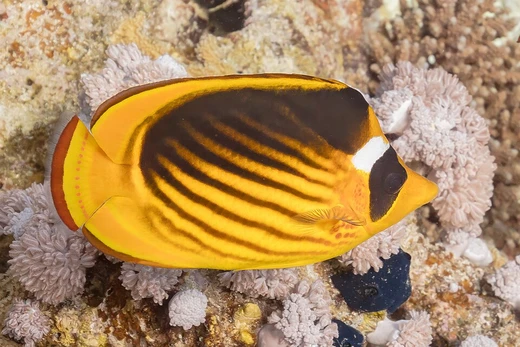
Labroides dimidiatus
A tiny blue-and-white barber whose daily work keeps an entire reef healthy.

Labroides dimidiatus, commonly known as the cleaner wrasse, is a small reef fish in the family Labridae native to the Indo-Pacific, ranging from the Red Sea and East African coast across to the central Pacific. It occupies a distinctive ecological niche as a professional ectoparasite remover: it establishes a fixed cleaning station on the reef where client fish of many species queue to have dead skin, mucus, and embedded parasites picked from their gills, fins, and bodies.
The species is a keystone of reef social ecology. Its cleaning service reduces parasite loads and disease transmission among client species, while the cleaner itself gains a reliable food supply. This mutualism is so central to reef dynamics that the loss of cleaner wrasses has been linked in field studies to measurable increases in parasite prevalence and shifts in community composition.
- Common name
- Cleaner wrasse
- Family
- Labridae (wrasses)
- Distribution
- Indo-Pacific, Red Sea to central Pacific
- Approximate adult length
- 10–12 cm
- Diet
- Ectoparasites, dead tissue, mucus; also algae and small invertebrates
- Sexual dimorphism
- Males noticeably larger than females
- Activity
- Diurnal; establishes fixed cleaning stations
Lore & Background
The cleaner wrasse's most studied behavior is the establishment and defense of a cleaning station. A male typically claims a conspicuous substrate—often a coral outcrop or rock face—and performs a rapid, undulating solicitation dance to attract passing fish. Clients approach, open their mouths and gill covers, and the cleaner probes with its slender snout, extracting leeches, copepods, and sloughed tissue. The interaction is ritualized: the cleaner pauses, resumes, and signals with quick lateral dashes that it is not a predator, a behavior first described in detail in field work in the 1960s and 1970s.
Remarkably, Labroides dimidiatus can distinguish between client species and predatory species that might swallow it mid-service. Field experiments have shown that the cleaner will refuse to enter the mouth of a known predator even when the predator mimics a client's approach. In some populations the cleaner also appears to recognize individual clients by their color pattern, offering preferential service to those that have not been observed 'cheating'—that is, taking live tissue rather than dead material.
The species is also subject to a well-documented temptation: the 'cheating' problem. When a client's skin is rich in mucus or small live invertebrates, the cleaner may take a larger bite of living tissue, gaining more calories in the short term but risking the client's future visits. This trade-off between immediate gain and long-term service revenue makes the cleaner wrasse a classic case study in the evolution of honest signaling and mutualism.
Reader's Guide
Cleaning-station solicitation. A client fish approaches within a few body-lengths of the station. The cleaner wrasse performs a rapid lateral zigzag, alternating between the client and the substrate, signaling non-aggressive intent. The client then opens its mouth or gill covers, and the cleaner probes with its pointed snout, extracting ectoparasites and dead tissue. The ecological consequence is a reduction in parasite load for the client and a reliable caloric intake for the cleaner.
Predator discrimination. A potential client enters the station's radius. The cleaner pauses its solicitation and assesses the approaching fish's coloration and body shape. If the fish matches a known predator species, the cleaner retreats to the substrate and does not enter the predator's mouth. This behavior, documented in controlled field experiments, prevents predation and preserves the station's function.
Cheating and its cost. While servicing a client with thick mucus or live invertebrate epifauna, the cleaner occasionally takes a larger bite of living tissue rather than picking individual parasites. In the field this is observed as a brief, deeper probe followed by the cleaner swallowing a visible chunk. The client may terminate the session early or avoid the station in subsequent visits, reducing the cleaner's future service revenue.
Territorial defense. A conspecific or another small wrasse approaches the station. The resident cleaner performs a pectoral-fin display, flaring its fins and advancing in short, rapid dashes. Intraspecific aggression is generally brief and non-lethal, but the resident maintains exclusive use of the station's immediate radius.
Note: Aquarium observations of cleaner wrasses 'cleaning' tank-mates are common in hobbyist literature, but the degree to which this replicates wild station behavior—especially predator discrimination and client recognition—remains poorly documented in captive settings.
Did You Know?
- Field experiments have shown that Labroides dimidiatus can refuse to service a predator species that mimics a client's approach, indicating species-level visual discrimination during the cleaning interaction.
- The cleaner's 'cheating'—taking live tissue instead of dead parasites—has been proposed as a model system for studying the evolution of honest signaling and the costs of deception in mutualisms.
- Removal of cleaner wrasses from experimental reef plots has been associated with higher parasite prevalence on remaining client fish, supporting their role as a keystone service provider.
- Males are substantially larger than females, and the larger size is thought to correlate with the ability to defend a cleaning station against intruders.
More in Behavior & Ecology
Elsewhere in Diagonal butterflyfish
Spotted an error? Know more?
Reader corrections go straight into our review queue. Suggest an edit · How this site is sourced