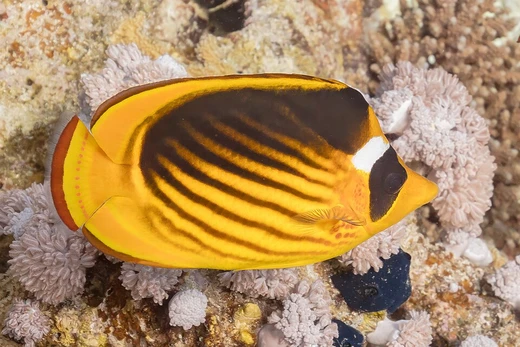
Chaetodon miliaris
A pocket-sized reef grazer whose body is dusted in millet-seed spots.

Chaetodon miliaris, commonly known as the Millet Butterflyfish, is a small reef-associated butterflyfish in the family Chaetodontidae. Its specific epithet 'miliaris' derives from the Latin for 'millet-seed,' a direct reference to the dense scattering of tiny pale spots that covers its dark body. First described by Cuvier in 1831, the species occupies a niche in shallow western Pacific coral reefs where it forages among branching corals and crevices.
As a small, relatively inconspicuous member of the butterflyfish assemblage, C. miliaris plays a modest but ecologically meaningful role: it grazes on microalgae, detritus, and small invertebrates embedded in reef substrate, contributing to the constant micro-cleaning of coral surfaces. Its compact size and preference for sheltered reef zones make it a species more often encountered by divers exploring lagoon flats and inner reef slopes than by open-water snorkelers.
- Common name
- Millet Butterflyfish
- Family
- Chaetodontidae
- Genus
- Chaetodon
- Original description
- Cuvier, 1831
- Distribution
- Western Indo-Pacific (Indonesia, Philippines, surrounding waters)
- Habitat
- Shallow coral reefs, lagoons, inner reef slopes
- Size class
- Small butterflyfish (approx. 6–7 cm SL)
Lore & Background
Chaetodon miliaris inhabits the sun-drenched shallows of the western Pacific, typically from the intertidal fringe down to roughly 10–15 m on lagoon and inner-slope reefs. It favours areas of mixed hard and soft coral cover where small crevices and overhangs provide daytime refuges. The species is generally observed in small groups or as a mated pair, hovering close to the substrate rather than patrolling the water column above the reef.
Its foraging behaviour is characteristic of smaller chaetodontids: the fish darts into coral branches, nudges loose particles with its small terminal mouth, and picks out microalgae, filamentous growth, and tiny epifaunal invertebrates. This grazing keeps micro-algal films in check on living coral surfaces, a service that, while individually small, is cumulative across the many individuals that share a reef patch.
The dense stippling of pale spots on a dark ground colour is thought to function as disruptive camouflage against the mottled texture of encrusted reef rock and dead coral rubble. In bright, shallow water the pattern breaks up the fish's outline, making it harder for both predators and prey to isolate the butterflyfish's body shape from the complex reef background.
Reader's Guide
BODY PATTERN — The defining feature of C. miliaris is the dense, even scattering of small, round, pale (white to cream) spots across a dark brownish-grey body. Each spot is roughly uniform in size, giving the 'millet-seed' appearance that earned the species its name. A dark ocular bar runs through the eye. This contrasts sharply with congeners such as C. kleinii (which shows a broad white lateral band) or C. decussatus (diagonal cross-hatching). Original description: Cuvier, 1831.
SIZE & BODY SHAPE — A small, laterally compressed butterflyfish reaching approximately 6–7 cm in standard length. The body is compact and deep-bodied relative to its length, with a small terminal mouth adapted for picking at substrate. This makes it noticeably smaller and more rounded than the elongate C. auriga or the larger C. trifasciatus found in the same waters.
DISTRIBUTION & DEPTH — Recorded from the western Indo-Pacific, with core localities in Indonesian and Philippine waters. It is a shallow-water species, most commonly observed on lagoon flats and inner reef slopes in well-lit areas. It is less commonly reported from deep outer-slope habitats where many other small chaetodontids are found.
DISTINGUISHING FROM CONGENERS — Among small western Pacific butterflyfish, C. miliaris is set apart by the combination of (1) its uniformly small, round, evenly distributed pale spots (not bands, bars, or cross-hatches), (2) its dark ground colour, and (3) its small overall size. C. kleinii has a prominent white lateral stripe; C. decussatus shows diagonal lines; C. reticulatus has a reticulated (net-like) pattern. None of these replicate the simple 'stippled' look of miliaris.
Did You Know?
- The specific name 'miliaris' is Latin for 'millet-seed,' a direct allusion to the tiny, uniform pale spots that cover the fish's dark body.
- Despite being a butterflyfish, C. miliaris is one of the smaller members of the genus, reaching only about 6–7 cm, which keeps it in the same size class as many damselfishes.
- Its dense stippling is thought to serve as disruptive camouflage, breaking up the body outline against the mottled texture of encrusted reef rock and dead coral rubble.
- The species was described by Cuvier in 1831, placing it among the earlier butterflyfish species catalogued during the first wave of systematic marine ichthyology.
More in Species Profile
Elsewhere in Diagonal butterflyfish
Spotted an error? Know more?
Reader corrections go straight into our review queue. Suggest an edit · How this site is sourced