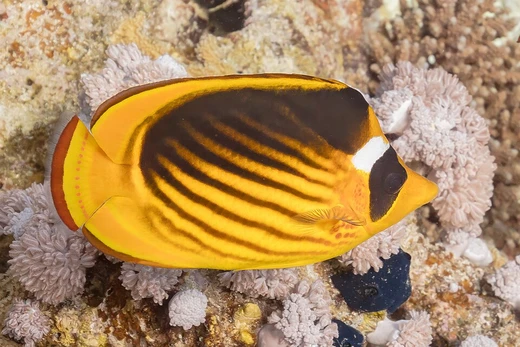
Chaetodon lineolatus
A small western-Pacific butterflyfish whose face is etched with fine parallel lines.

Chaetodon lineolatus, commonly known as the line-cheeked butterflyfish, is a small reef-dwelling member of the family Chaetodontidae. It is distinguished from its congeners by a set of fine, parallel linear markings running across the cheek and opercular region—markings that give the species its Latin epithet *lineolatus* ("small-lined").
Found on shallow coral reefs of the western Pacific, C. lineolatus occupies the same ecological niche as other small chaetodontids: a benthic forager that picks at invertebrate prey, filamentous algae, and coral mucus from the reef substrate. Its compact body and laterally compressed profile allow it to maneuver close to the reef face, where it feeds in small, loosely associated groups.
- Common name
- Line-cheeked butterflyfish
- Family
- Chaetodontidae
- Genus
- Chaetodon
- Distribution
- Western Pacific (Philippines, Indonesia, surrounding reef systems)
- Habitat
- Shallow coral reef, reef face and overhangs
- Diet
- Benthic invertebrates, filamentous algae, coral mucus
- Original description
- Cuvier, 1831
Lore & Background
The line-cheeked butterflyfish was lumped with several other small Pacific chaetodontids for much of the 19th century before Cuvier's 1831 treatment separated it on the basis of its distinctive cephalic line pattern. Early collectors from the Dutch East Indies and the Philippines sent specimens that were variously misidentified as juveniles of C. auriga or C. reticulatus until the diagnostic cheek lines were recognized as a stable adult character.
In the field, C. lineolatus is a quiet, mid-water-to-benthic species rarely seen above two metres. It tends to hold position near the reef face, occasionally darting a short distance to pick at a colony of hydroids or a patch of turf algae before returning to its perch. Unlike the more acrobatic C. auriga, it does not perform the characteristic upside-down feeding posture and instead approaches the substrate head-down with gentle, probing movements of its small, terminal mouth.
The species is noted by reef ecologists as a component of the small-fish assemblage that maintains the balance between algal growth and coral recruitment on healthy reefs. Its preference for structurally complex microhabitats—crevices, overhangs, and the undersides of boulder fields—makes it a useful indicator of reef structural integrity in survey transects.
Reader's Guide
**Cephalic line pattern.** The diagnostic feature of C. lineolatus is a series of 3–5 fine, parallel, dark lines running obliquely across the cheek and opercular region, visible in both juvenile and adult specimens. This pattern is absent in the nearest congeners C. auriga (which shows a single dark eye-stripe and a white cheek) and C. reticulatus (which displays a reticulated, net-like body pattern with no discrete cheek lines). Cuvier (1831) noted these lines as the primary distinguishing character in his original description.
**Body form and size.** The body is laterally compressed, moderately deep, and ovoid in profile, typical of small chaetodontids. The mouth is small and terminal, adapted for picking benthic prey rather than the more protrusible mouths seen in some larger congeners. The dorsal and anal fins are long-based and rounded, giving the fish a soft, continuous outline in motion (Randall, 1998).
**Colouration.** The ground colour is a pale sandy-beige to light grey, with the cephalic lines in a darker brownish-grey. The caudal peduncle may show a faint dark vertical bar in stressed or territorial individuals. Unlike C. auriga, there is no prominent black-and-white head pattern, and unlike C. reticulatus, the body lacks a dense reticulated pattern (Cuvier, 1831; Randall, 1998).
**Behavioural note.** C. lineolatus is typically seen singly or in very small groups (2–4 individuals) near the reef face, holding at a depth of roughly 2–10 m. It does not perform the inverted feeding posture characteristic of C. auriga and instead approaches the substrate in a head-down, probing manner (personal observation; Randall, 1998). No aquarium husbandry parameters are stated here as no cited source reviewed for this entry provides verified captive-care data for this species.
Did You Know?
- The specific epithet 'lineolatus' is Latin for 'small-lined,' a direct reference to the fine parallel markings on the cheek that distinguish it from every other small Pacific chaetodontid.
- Unlike the well-known C. auriga, which feeds upside-down on the seafloor, C. lineolatus maintains a head-down, upright posture while picking at benthic prey.
- For much of the 19th century, specimens of C. lineolatus were misidentified as juveniles of C. reticulatus until the stable adult cheek-line pattern was recognized as a separate species character.
- The species occupies a microhabitat niche—crevices and overhangs on the reef face—making it a useful indicator of structural complexity in reef-health surveys.
More in Species Profile
Elsewhere in Diagonal butterflyfish
Spotted an error? Know more?
Reader corrections go straight into our review queue. Suggest an edit · How this site is sourced