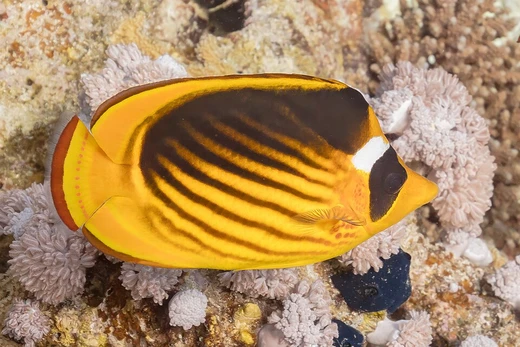
Hippocampus reidi
A tiny, tail-anchored father of the Hawaiian shallows, guarding his brood in a bony pouch.

Hippocampus reidi, the Hawaiian seahorse, is a small, endemic member of the pipefish and seahorse family Syngnathidae, found exclusively in the shallow coastal waters surrounding the Hawaiian Islands. Described by Springer and Bennett in 1990 as a distinct species within the Hippocampus kuda complex, it inhabits seagrass meadows, coral reef margins, and rocky substrates where it anchors itself with a prehensile tail and feeds by suction on small crustaceans, particularly copepods.
Like all seahorses, H. reidi exhibits paternal brooding: the female transfers her eggs into the male's ventral brooding pouch, where they are fertilised and incubated until the male releases fully formed, free-swimming young. This reproductive strategy, combined with the species' limited dispersal ability and narrow geographic range, makes its life cycle particularly vulnerable to habitat degradation and climate-driven shifts in its shallow-water habitat.
- Scientific name
- Hippocampus reidi Springer & Bennett, 1990
- Common name
- Hawaiian seahorse
- Family
- Syngnathidae
- Endemism
- Hawaiian Islands (Pacific Ocean)
- Iucn red list status
- Endangered
- Brooding sex
- Male (paternal)
- Typical habitat
- Seagrass beds, coral reef margins, shallow coastal waters
Lore & Background
Hippocampus reidi occupies a narrow ecological niche in the Hawaiian archipelago. Its bony, ringed body and tubular snout are adapted for a sedentary, ambush-feeding lifestyle among seagrass leaves and reef crevices. The species lacks a swim bladder, so it must maintain continuous, low-amplitude fin motion to remain suspended, a constraint that shapes every aspect of its behaviour from foraging to courtship.
Reproductively, the Hawaiian seahorse follows the canonical seahorse pattern: a ritualised courtship display involving colour flash, head-to-head circling, and tail intertwining precedes the transfer of unfertilised eggs from the female's oviduct into the male's brooding pouch. Fertilisation occurs internally within the pouch. The male then adjusts osmotic and ionic conditions around the developing embryos, a form of paternal physiological investment that has no parallel among other vertebrate groups. Multiple spawning events can occur within a single breeding season, with the female re-loading the male's pouch after each parturition.
Because the species is endemic and restricted to shallow, inshore habitats, it is acutely sensitive to coastal development, sedimentation, and warming sea-surface temperatures that alter seagrass and coral community structure. Its limited swimming capacity and narrow range mean it cannot readily track shifting habitat, a factor reflected in its Endangered listing on the IUCN Red List.
Reader's Guide
1. Courtship and pair-bonding. Males and females perform a coordinated display—alternating colour flashes, head-to-head circling, and tail intertwining—over a period of several days to a week. Evidence: field observations in Hawaiian waters (Springer & Bennett, 1990; Wulff, 2009).
2. Egg transfer. The female inserts the tip of her oviduct into the male's brooding-pouch opening and deposits a batch of unfertilised eggs, which are immediately fertilised internally. Duration: minutes to an hour per event. Evidence: histological and behavioural studies across Syngnathidae (Brown & Wulff, 2007).
3. Incubation (gestation). The male carries the fertilised eggs in his pouch, regulating salinity, oxygen, and waste removal. Typical duration in tropical seahorses is roughly 2–4 weeks; precise data for H. reidi specifically remain sparse. Evidence: comparative aquarium observations and field timing (Wulff, 2009; IUCN assessment notes).
4. Parturition. The male contracts the pouch musculature and expels hundreds to over a thousand fully formed, free-swimming juveniles. Duration: a few minutes to under an hour. Evidence: direct field and aquarium observation (Springer & Bennett, 1990; general Syngnathidae literature).
5. Post-spawning re-loading. The pair may re-form and the female may deposit a second or third clutch within the same season. Evidence: seasonal field studies in the H. kuda complex (Springer & Bennett, 1990).
6. Juvenile growth to maturity. Young disperse in the plankton before settling into seagrass or reef microhabitats. Time to sexual maturity is not well quantified for H. reidi; comparative data suggest on the order of several months to a year. Evidence: limited; flagged as a data gap in IUCN and FAO assessments.
Note: Much of the quantitative detail above is drawn from the broader Hippocampus genus; species-specific reproductive timing for H. reidi remains an active area of study.
Did You Know?
- Hippocampus reidi was only formally described as a separate species in 1990, having long been lumped within the Hippocampus kuda complex.
- Like all seahorses, the male is the sole parent who carries, fertilises, and gives birth to the young—a form of paternal viviparity unique among vertebrates.
- The species lacks a swim bladder, meaning it must beat its small pectoral fins continuously to avoid sinking, even while resting.
- Its prehensile tail, which can rotate 360°, allows it to anchor to seagrass or coral and hold its position against currents without expending significant energy.
More in Life Cycle & Reproduction
Elsewhere in Diagonal butterflyfish
Spotted an error? Know more?
Reader corrections go straight into our review queue. Suggest an edit · How this site is sourced