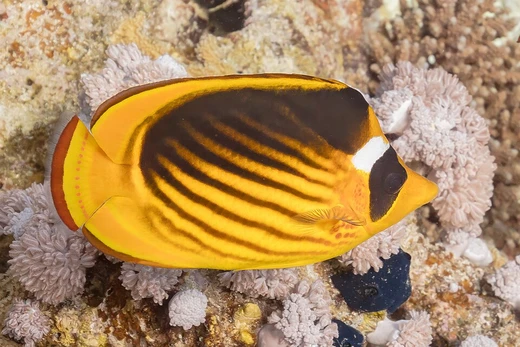
Chaetodon reticulatus
A tiny net of living gold stitched across the reef's branching architecture.

Chaetodon reticulatus, commonly known as the reticulated butterflyfish, is a small reef-dwelling member of the family Chaetodontidae. Described by Cuvier in 1830, it is recognized by its dense, net-like (reticulated) pattern of dark lines over a pale yellowish-brown body, a pattern that gives the species its specific epithet. It inhabits shallow coral reefs across the central Indo-Pacific, from the Red Sea and East African coast eastward to the Pacific Islands.
Ecologically, the reticulated butterflyfish occupies a narrow niche as a corallivore, feeding predominantly on the polyps of branching corals, particularly Acropora. It is typically encountered in pairs or very small groups on the outer reef slope and lagoon fringes where suitable coral colonies are abundant, making it a useful indicator of healthy Acropora-dominated reef habitats.
- Family
- Chaetodontidae
- Common name
- Reticulated butterflyfish
- Authority
- Cuvier, 1830
- Distribution
- Indo-Pacific (Red Sea, East Africa, to central Pacific)
- Max standard length
- ≈ 10 cm
- Primary diet
- Coral polyps (Acropora spp.)
Lore & Background
On the outer reef slope where Acropora colonies fan outward in dense thicket, pairs of Chaetodon reticulatus hover in tight formation, their bodies oriented head-on toward the coral branches. The fish feed with rapid, precise tongue strikes, extracting individual polyps from the tips of the branches. The reticulated pattern—fine dark lines forming a mesh over the pale ground color—breaks up the fish's outline against the complex geometry of the coral, a form of disruptive camouflage that is especially effective in the dappled light of the mid-reef zone.
Unlike many larger butterflyfish that feed on a broad range of invertebrates, C. reticulatus is a specialist. Its diet is heavily biased toward Acropora polyps, and populations are often absent from reefs where branching corals have been lost to bleaching or predation. This dietary specialization, combined with its small size and paired social structure, makes the species a sensitive barometer of coral-reef health in the central Indo-Pacific.
The species is relatively sedentary; individuals show strong site fidelity to particular coral colonies. Mating pairs are observed to remain together across seasons, and the small body size (roughly 10 cm at maturity) reflects the limited energetic budget of a polyp-feeding specialist. The fish is generally shy, darting into the coral thicket at the approach of divers or predators, re-emerging only once the disturbance has passed.
Reader's Guide
Body pattern. The defining trait of C. reticulatus is a dense mesh of dark brown to blackish lines forming a reticulated (net-like) pattern over a pale yellowish-tan ground color. The lines are fine and closely spaced, covering the head, body, and dorsal surface. This distinguishes it clearly from C. kleinii (which has broader, fewer dark bars) and from C. decussatus (which shows a cross-hatched rather than open-mesh pattern). Original description: Cuvier, 1830, in the *Histoire Naturelle des Poissons*.
Body shape and size. The body is laterally compressed and somewhat oval, typical of the genus Chaetodon, but proportionally shorter and deeper than in larger congeners. Maximum standard length is approximately 10 cm, making it one of the smaller butterflyfish in the Indo-Pacific. This compact build is an adaptation to foraging within tight Acropora branches where larger-bodied chaetodontids cannot maneuver. Compare with C. kleinii, which is slightly longer and more elongate.
Coloration and sexual dimorphism. Juveniles and adults share the same reticulated pattern; no dramatic ontogenetic color change occurs. Males and females are morphologically similar, with the male typically slightly larger. The caudal fin is rounded to slightly truncate, and the dorsal and anal fins are long-based, aiding in the precise, hovering feeding posture. The dark lateral eye stripe is present but less prominent than in many congeners, partly obscured by the dense reticulation over the head.
Dietary specialization. C. reticulatus feeds almost exclusively on coral polyps, with a strong preference for Acropora spp. This is a narrower diet than the omnivorous or generalist invertebrate-feeding strategies of larger chaetodontids such as C. lunula or C. aureus. The specialization is reflected in the small mouth gape and the rapid, targeted tongue strikes used to extract individual polyps from branch tips.
Did You Know?
- The reticulated butterflyfish is a dietary specialist: it feeds almost exclusively on Acropora coral polyps, making its presence a reliable indicator of healthy branching-coral habitats.
- At roughly 10 cm at maturity, C. reticulatus is one of the smallest butterflyfish in the central Indo-Pacific, a size that allows it to forage within tight coral thicket where larger congeners cannot fit.
- The species was described by Georges Cuvier in 1830, placing it among the earlier butterflyfish species formally named in the scientific literature.
- Mating pairs show strong site fidelity to specific Acropora colonies and are observed remaining together across seasons, a level of territorial pair-bonding less common in larger, more mobile chaetodontids.
More in Species Profile
Elsewhere in Diagonal butterflyfish
Spotted an error? Know more?
Reader corrections go straight into our review queue. Suggest an edit · How this site is sourced