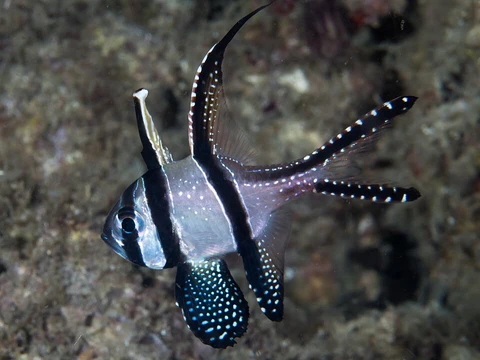
Batui
A narrow-reef corridor where Sulawesi's endemics find their last address.

Batui is a coral-reef distribution area on the northern coast of Sulawesi, Indonesia, situated in the Sulawesi Sea. It forms part of a broader biogeographic corridor that stretches from the Banggai Islands in the south to the Gorontalo Strait to the north, a zone repeatedly identified in the fisheries and conservation literature as a hotspot of narrow-range endemism within the Coral Triangle.
As a distribution record, Batui anchors the known range of several reef-associated taxa whose populations are restricted to the inshore and offshore reefs of this arc of Sulawesi. The site is referenced in regional biodiversity inventories and dive-ecology surveys as a representative stop between the more heavily studied Banggai reefs and the Gorontalo coastal system, giving it a bridging role in understanding how endemism is partitioned across the Sulawesi Sea.
- Location
- North Sulawesi, Indonesia
- Sea
- Sulawesi Sea
- Biogeographic region
- Coral Triangle – Sulawesi Sea sub-basin
- Habitat type
- Coral reef (inshore to offshore)
- Nearest major island group
- Banggai Islands (to the south)
- Endemism context
- Narrow-range species of the Sulawesi Sea
Lore & Background
The reefs around Batui sit at the northern terminus of a chain of volcanic and karstic islands that fringe the Sulawesi Sea. Unlike the open-ocean atolls of the central Pacific, these reefs are embedded in a complex of straits, bays, and seamounts that create strong local current regimes and fine-scale temperature gradients. Marine-biogeographers have long noted that the Sulawesi Sea acts as a semi-enclosed basin: species that colonize it from the Pacific or the Indian Ocean often find their range truncated by the island chains, producing a signature of stunted, locally endemic lineages.
The Banggai Islands, roughly 300 km to the south, are the type-locality for a suite of reef fish and invertebrate species described over the past three decades. Batui, sharing the same oceanographic shelf and the same volcanic substrate lineage, hosts populations of several of these taxa as well as a few that appear to be restricted to the northern Sulawesi coast. The result is a distribution pattern in which a single species may be known from only two or three named sites separated by a few hundred kilometres of open water—a pattern that conservation planners describe as a 'string of beads' with very little redundancy.
Dive-ecology surveys and regional fisheries assessments that pass through the Gorontalo–Batui corridor consistently flag the reefs as structurally intact but logistically under-sampled relative to the Banggai sites. The practical effect is that the Batui record in any given species' distribution list often reads as a single locality, making it both a point of wonder and a caution: if that one reef is degraded, the entire known population of a narrow endemic may be at risk.
Reader's Guide
The Banggai Islands, a scattered chain of volcanic and karstic islets in the southern Sulawesi Sea, form the heartland of this distribution. Reefs here are typically found on the leeward (eastern) faces of the islands, where wave energy is moderated and fine carbonate sand accumulates in shallow lagoons. Depths range from the intertidal zone down to roughly 30 m on the outer wall, with the richest structural complexity concentrated between 8 and 20 m. Substrate is a mosaic of living Porites, Acropora, and Pocillopora frameworks over a basaltic or limestone foundation, interspersed with rubble fields and sandy troughs that shelter juvenile fish and invertebrates.
Moving northward, the same reef architecture reappears along the Gorontalo–Batui coast of Sulawesi. Here the substrate shifts subtly: more volcanic sand, more exposed bommies, and a higher proportion of plate and encrusting corals that tolerate the slightly stronger current through the Gorontalo Strait. The associated reef structure is less lagoon-protected than in the Banggai, favouring open-wall and drop-off habitats where the reef edge plunges into deeper water within a few metres of the shallow shelf.
What makes this distribution a point of wonder is its narrowness. A species whose entire known range fits within a few hundred kilometres of Sulawesi Sea coastline—anchored by the Banggai type-locality and capped at the northern end by a single site like Batui—represents an evolutionary experiment running on a single thread. The reefs are beautiful, structurally rich, and biologically diverse, but the endemism they harbour is fragile in a way that open-ocean species simply are not. Protecting the corridor between the Banggai and Batui is, in effect, protecting the only road a lineage has.
Did You Know?
- The Sulawesi Sea is a semi-enclosed basin bounded by island chains, and marine biogeographers treat it as a natural laboratory for studying how geographic isolation drives narrow-range endemism in reef organisms.
- The Banggai Islands are the type-locality for a well-known suite of reef-fish species described in the 1990s and 2000s, many of which are found nowhere else in the Indo-Pacific.
More in Distribution
Elsewhere in Banggai cardinalfish
Spotted an error? Know more?
Reader corrections go straight into our review queue. Suggest an edit · How this site is sourced