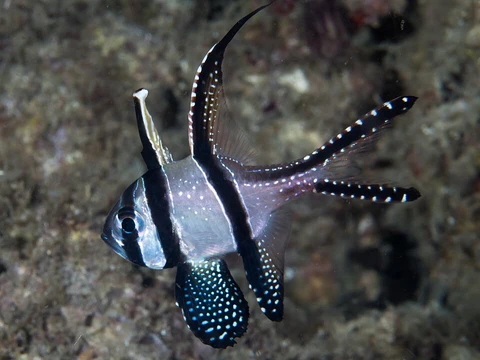
Apogonidae
Small, large-eyed sentinels of the reef's twilight hours.

Apogonidae is a family of small, predominantly reef-associated marine fishes commonly known as cardinalfishes. Distributed across tropical and subtropical waters of the Atlantic, Indian, and Pacific Oceans, the family encompasses a diverse assemblage of species recognizable by their large, forward-facing eyes, small terminal mouths, and often vivid red, orange, or bicolored coloration. Many members are crepuscular or nocturnal, emerging from crevices and under overhangs after dark to feed on small crustaceans and zooplankton drifting through the water column.
Within reef ecosystems, cardinalfishes occupy a niche as both predators of tiny invertebrates and prey for larger reef fish, contributing to the trophic web that sustains coral communities. Their relatively small body size, often under 15 cm, and their tendency to shelter in tight spaces make them a familiar, if understated, component of shallow-water biodiversity.
- Common name
- Cardinalfishes
- Taxonomic rank
- Family
- Order
- Gobiiformes
- Habitat
- Tropical and subtropical marine, primarily reef and lagoon
- Distribution
- Atlantic, Indian, and Pacific Oceans
- Typical size
- Mostly under 15 cm total length
- Activity pattern
- Crepuscular to nocturnal in many species
Lore & Background
Cardinalfishes have long been noted by divers and naturalists for their striking eye-to-head ratio, an adaptation that suits their crepuscular foraging lifestyle. In the low light of a reef after sunset, a cluster of Apogon or Ostorhinchus species hovering near a bommie presents a constellation of dark orbs against translucent fins, a sight that has made them a favorite subject of underwater photographers and a recognizable element in the public imagination of reef life.
The family's diversity is concentrated in the Indo-Pacific, where the greatest number of genera and species occur. Coral reefs, rocky lagoons, and seagrass beds all support apogonid populations, and many species show a preference for specific microhabitats—under overhangs, within anemone tentacles, or among branching Acropora. This habitat specificity, combined with their small range, means that local degradation of a single reef structure can eliminate an entire population.
Taxonomically, Apogonidae has undergone revision as molecular phylogenetics clarified relationships among genera that were once lumped under broad morphological definitions. The family now sits firmly within Gobiiformes, sharing deep evolutionary affinities with gobies and their relatives, and its members retain the generalized percomorph body plan while specializing in the rapid, short-burst swimming that characterizes life among the tight architecture of a coral reef.
Reader's Guide
The specific epithet 'kauderni' honors the Swedish naturalist Rudolf Kaudern, whose 1928 fieldwork and specimen collections in Southeast Asian waters provided the material for the formal description. Naming a taxon after a collector is a long-standing practice in ichthyology, and 'kauderni' follows the Latin genitive convention to credit the individual whose material made the description possible.
Pterapogon is a small, distinctive genus within Apogonidae, comprising only a handful of species. Its members are set apart by a combination of body proportions, fin-ray counts, and color patterning that distinguish them from the more numerous Apogon and Ostorhinchus. Their restricted distributions and specialized microhabitat use make them particularly vulnerable to localized habitat loss.
The common name 'cardinalfish' draws on the bird—the cardinal—whose brilliant red plumage mirrors the dominant coloration of many apogonid species. In the broader reef community, cardinalfishes fill the ecological role of small, benthic-associated predators that bridge the gap between planktonic feeders and larger piscivorous fish, and their presence is often taken as an indicator of a healthy, structurally complex reef.
Did You Know?
- Many cardinalfish species are male-brooders: the male carries fertilized eggs in his buccal cavity or, in some genera, in a specialized structure, while the female's role ends at spawning.
- The family's large eyes are an adaptation to low-light foraging; some species can detect polarized light to locate prey in near-darkness.
- Pterapogon species are among the smaller members of Apogonidae, often reaching only a few centimeters in total length.
- Apogonidae is placed within the order Gobiiformes, linking cardinalfishes evolutionarily to gobies, dragonets, and their relatives.
More in Classification
Elsewhere in Banggai cardinalfish
Spotted an error? Know more?
Reader corrections go straight into our review queue. Suggest an edit · How this site is sourced