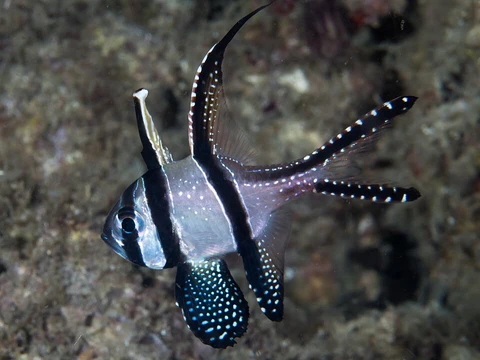
Pseudanthias squamipinnis
A blue-and-coral sentinel of the outer reef, shifting sex as the tide of life demands.

Pseudanthias squamipinnis, commonly known as the Japanese anthias or scalefin anthias, is a small reef fish in the family Serranidae (subfamily Anthiinae). First described by Temminck and Schlegel in 1844, it is a protogynous hermaphrodite: individuals begin life as orange-red females and some later transition to the vivid blue, red-marked male phase. Males are larger and more conspicuously colored than females.
The species inhabits the outer slopes of coral reefs across the western Pacific, from Japan through the Philippines, Indonesia, and to the northern Great Barrier Reef. It occupies a mid-water niche above the reef crest, where it feeds on small planktonic crustaceans and other drifting invertebrates. Its restricted depth range and dependence on live coral structure make it a sensitive indicator of reef health.
- Family
- Serranidae (Anthiinae)
- Common name
- Japanese anthias / Scalefin anthias
- Distribution
- Western Pacific: Japan, Philippines, Indonesia, northern Australia
- Sexual system
- Protogynous hermaphrodite
- Habitat
- Outer coral-reef slopes, mid-water above reef crest
- Diet
- Planktonic crustaceans, small drifting invertebrates
Lore & Background
In the anthias subfamily, Pseudanthias squamipinnis represents a classic example of the 'mid-water' ecological guild: rather than hovering tightly over the coral substrate like many damselfishes, it patrols the open water column just above the reef face, snapping at plankton that the current delivers. Males establish small territories along the reef edge, their electric-blue bodies flashing crimson along the fins and a distinctive red stripe through the eye, while females form loose aggregations in the same zone, their warm orange coloration blending with the surrounding water.
The species is distributed across a broad but fragmented arc of the western Pacific. Populations in the Philippines and Indonesia tend to be more numerous on healthy outer slopes, whereas in Japan and the northern Great Barrier Reef the fish is less abundant and more depth-restricted. Its dependence on structurally complex live coral for spawning and juvenile shelter ties its population dynamics directly to the condition of the reef itself.
In the aquarium trade, P. squamipinnis has long been valued for its striking coloration and active swimming, but its sensitivity to handling and its need for open swimming space above a well-established reef make it a species that rewards careful husbandry. It is not a 'hardy' reef fish in the way some tangs or wrasses are; it reflects the health of the ecosystem that produced it.
Reader's Guide
Pseudanthias squamipinnis is assessed as Least Concern by the IUCN Red List, reflecting its broad (if patchy) distribution across the western Pacific and the absence of a single catastrophic threat. However, 'Least Concern' should not be read as 'secure.' The species is range-limited to healthy outer-reef slopes, and populations in any one locality are small and slow to recover from localized damage such as bleaching events or sedimentation.
The principal anthropogenic pressure is collection for the ornamental aquarium trade. While precise annual export figures for this single species are not consistently reported in CITES or FAO statistics, it is regularly included in mixed anthias and serranid shipments from the Philippines, Indonesia, and Japan. Because the fish is collected by hand or small nets on the reef face, even modest harvest rates can deplete local aggregations, particularly where the population is already small.
Conservation-relevant actions are straightforward: enforce no-take zones on outer-reef slopes in core range countries, improve post-capture handling to reduce mortality in the trade pipeline, and monitor reef condition as a proxy for anthias population health. The species does not require a single hero-species campaign; it needs the reef it lives on to remain intact.
Did You Know?
- Pseudanthias squamipinnis is a protogynous hermaphrodite: every individual starts life as a female, and some later change to the blue male phase, meaning the 'male' you see was once orange.
- Unlike many reef fish that hover over the substrate, this anthias feeds in the open water column above the reef, catching plankton delivered by the current.
- The species was described in 1844 by Temminck and Schlegel, making it one of the earlier anthias species formally named in Western science.
- Males and females differ not only in color (blue vs. orange-red) but also in size, with males growing noticeably larger than females of the same population.
More in Conservation
Elsewhere in Banggai cardinalfish
Spotted an error? Know more?
Reader corrections go straight into our review queue. Suggest an edit · How this site is sourced