Lateral line
A fish's invisible sixth sense, reading the ocean's faintest ripple along its flank.

The lateral line is a distributed sensory system running along the flank of virtually all fish, from the operculum to the caudal peduncle. It consists of a chain of mechanosensory organs called neuromasts, housed within either open pores or enclosed bony canals, that transduce minute water displacements, pressure gradients, and low-frequency vibrations into neural signals. Functionally, it extends the fish's ability to 'feel' its immediate hydrodynamic environment in ways that vision and the inner ear alone cannot provide.
In marine ichthyology the lateral line is both a physiological organ and a taxonomic landmark: the number of scales above and below the lateral line, the presence or absence of pored versus canal segments, and the branching pattern of cephalic lateral-line canals are routinely used to distinguish species within otherwise similar genera. No single marine species can be fully described without reference to its lateral-line morphology.
- Type
- Mechanosensory system (neuromast array)
- Distribution
- All teleosts, elasmobranchs, and some aquatic amphibians
- Primary function
- Detection of water displacement, pressure change, and low-frequency vibration
- Structural units
- Neuromasts (superficial and canal types) containing hair cells
- Taxonomic use
- Scale counts above/below the line; canal vs. pore pattern; cephalic branching
- Analogous system
- Vestibular apparatus (shared hair-cell transduction mechanism)
Lore & Background
The lateral line evolved in early vertebrates as a complement to the inner ear, exploiting the same hair-cell transduction machinery but extending it outward into the water column. Where the ear senses acceleration of the body itself, the lateral line senses the *medium*—the pressure wavefronts generated by a swimming neighbour, a closing jaw, or a shifting current. In schooling teleosts such as sardines or mackerel, this allows individuals to maintain precise inter-fish spacing and turn in unison within milliseconds, a coordination that vision, with its inherent latency, could not achieve.
Morphologically, the system is remarkably plastic. In pelagic species the lateral line is often a single, unbroken pored canal running the full length of the body, optimised for long-range detection of approaching predators. In demersal and reef-associated fish, the canal may fragment into isolated pores or merge with cephalic canals that trace the jaw, orbit, and preopercle, giving the head a dense lattice of sensory input. Cartilaginous fishes such as sharks and rays possess a comparable but structurally distinct lateral-line system, with neuromasts set in dermal grooves rather than bony canals.
In aquarium and field ichthyology the lateral line is a practical diagnostic: a broken or absent lateral line in a captive fish signals osmotic or mechanical stress, while the precise count of lateral-line scales remains one of the most reliable characters for separating congeneric species in revisionary taxonomy.
Reader's Guide
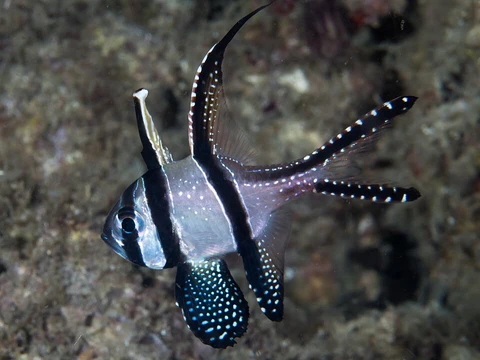
The eye catches it first as a faint, slightly raised ridge running the full length of the flank, just below the mid-lateral scale row—subtly paler or more silvery than the surrounding chromatophore field, like a hairline seam in the body wall. Unlike the diffuse iridescence of a typical reef teleost, this line is discrete: a single, unbroken channel that does not branch along the trunk.
Running a fingertip (in a preserved specimen) along the ridge reveals a row of minute, evenly spaced pores, each roughly the diameter of a pinhead, set into the dermal bone. These are the openings of the pored lateral-line canal. The spacing between pores is regular—about one scale-width apart—giving the line a beaded, almost crenellated texture when viewed under raking light at low magnification.
Toward the head the canal becomes more complex: it loops around the anterior edge of the operculum, sends a short branch forward beneath the eye (the preorbital canal), and another along the jaw margin. In contrast to the smooth, uninterrupted trunk canal, these cephalic segments are shorter, more irregularly pored, and often partially obscured by the preopercular and subopercular bones.
Scale texture immediately above and below the line is identical to the rest of the body—cycloid, smooth, with a fine annular striation—so the lateral line is not a change in scale type but a change in *canal architecture* beneath the scales. The key visual cue is the pore row itself: a single, unbroken, evenly pored line from operculum to caudal peduncle, with no gaps, no doubling, and no ventral continuation.
Did You Know?
- The lateral line and the inner ear share the same hair-cell transduction mechanism; in a sense, a fish 'hears' with its skin as much as with its ears.
- In schooling fish, lateral-line input can trigger a coordinated turn in under 50 milliseconds—far faster than a visual reaction loop.
- Taxonomists routinely count the number of scales above and below the lateral line to separate species that are otherwise nearly identical in colour and shape.
- Some blind cavefish have lost their eyes but retain a fully functional, often enlarged, lateral-line system as their primary sensory channel.
More in Description
Elsewhere in Banggai cardinalfish
Spotted an error? Know more?
Reader corrections go straight into our review queue. Suggest an edit · How this site is sourced