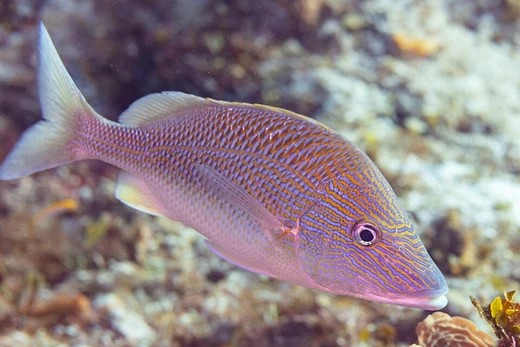
Sailfin snapper
A monotypic snapper with blue stripes and a black tail spot.
Last updated
The sailfin snapper (Symphorichthys spilurus), also called the blue-lined sea bream or blue-lined sea perch, is a marine ray-finned fish in the snapper family Lutjanidae. It lives in the Indo-Pacific region and is the only species in its genus.
German-born British ichthyologist Albert Günther first described it in 1874 as Symphorus spilurus, based on a specimen from Palau. In 1967, Australian marine scientist Ian Stafford Ross Munro moved it to its own genus, Symphorichthys, which is one of two genera in the subfamily Paradicichthyinae. The genus name refers to its earlier placement in Symphorus, and the species name spilurus combines the Greek words for "spot" and "tail," referring to the large black blotch on the upper part of the adult's caudal peduncle.
Description
This fish has a deep, laterally compressed body with a rounded head profile, angular forehead, and steep snout. Its mouth reaches to the front edge of the eye, and there is no notch or bump on the preoperculum. The upper jaw has a row of small, flattened teeth, while the lower jaw has about three rows; both jaws also have an outer row of short conical teeth that are slightly larger. There are no vomerine teeth.
The dorsal fin has 10 spines and 14–18 soft rays, and the anal fin has 3 spines and 8–11 soft rays. At least one of the front soft rays in both fins extends beyond the membrane as a long filament. The pectoral fins are long, sometimes reaching past the anus, and have 16 rays. The tail fin is slightly forked.
The fish can grow up to 60 cm (24 in) in total length, but 50 cm (20 in) is more common. Its body is yellowish with blue horizontal stripes along the sides. A large black spot with a pale border sits on the upper caudal peduncle, and there is an orange bar over the eye and another behind the head. Juveniles are pale grey with a wide black stripe bordered in white running from the snout to the tail's rear edge, and their dorsal and anal fin filaments are yellowish.
Distribution and habitat
The sailfin snapper is found in the eastern Indian Ocean and western Pacific Ocean. In the Indian Ocean, it occurs near the Rowley Shoals and Broome, Western Australia. In the Pacific, its range extends east to Tonga and Fiji, north to the Ryukyu Islands, and south to New Caledonia and the Great Barrier Reef. It has also been recorded near the Mentawai Islands off western Sumatra and off the west coast of Thailand.
Scientific classification
- KingdomAnimalia
- PhylumChordata
- ClassActinopterygii
- DivisionTeleostei
- OrderAcanthuriformes
- FamilyLutjanidae
- GenusSymphorichthys
- SpeciesSymphorichthys spilurus
Named by (Günther, 1874)
Sources: Wikipedia taxobox: Sailfin snapper (CC BY-SA 4.0) · differs from this box at order: WoRMS AphiaID 282914 (CC BY 4.0)
Conservation status
Least Concern (LC)
- LC▲ this species
- NT
- VU
- EN
- CR
- EW
- EX
Source: IUCN Red List assessment · GBIF copy of the Red List category
How big is it?
Largest length in the source, 0.6 m, next to a 1.8 m person.
Diagram: drawn by Codexery, schematic shapes to scale (not a likeness). Length: Wikipedia: Sailfin snapper
Where the sailfin snapper has been recorded
Each dot is a place where the species has been observed and reported (124 records, half-degree grid) — not a modelled range. 3 inland records left out (institution coordinates). 1 isolated far-off record not drawn.
Map: drawn by Codexery. Data: GBIF occurrence search (records CC0 / CC BY) · Natural Earth basemap (public domain) · place coordinates: Wikipedia (CC BY-SA 4.0)
Ranked in
More in Snappers
Elsewhere in Snappers and Grunts
Test yourself
Three questions drawn from this entry’s sources. Pick an answer to check it.
Answers checked against the source article
Sources
Compiled from Wikipedia and the sources listed below. Text from Wikipedia is available under CC BY-SA 4.0; this entry is adapted from it.
- Wikipedia: Sailfin snapper (CC BY-SA 4.0).
- Classification: the source article's taxobox; compare WoRMS, the World Register of Marine Species (CC BY 4.0).
- Conservation status: IUCN Red List assessment.
- Occurrence records: GBIF (CC0 / CC BY). Basemap: Natural Earth (public domain).
- Word definitions: the , each quoted from its Wikipedia article.
Spotted an error? Know more?
Reader corrections go straight into our review queue. Suggest an edit · How this site is sourced