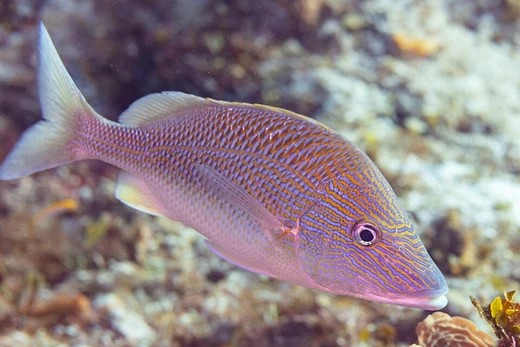
Pinjalo pinjalo
A snapper with a wide Indo-Pacific distribution and modest size.
Last updated
Pinjalo pinjalo, called the pinjalo, is a marine ray-finned fish in the snapper family Lutjanidae. Its range covers the Indian and Western Pacific Oceans, extending from the Red Sea east to Papua New Guinea, and from Taiwan and the Philippines south to Mozambique, the Persian Gulf, and parts of Australia.
Taxonomy
The species was first formally described in 1850 by Dutch scientist Pieter Bleeker, who named it Caesio pinjalo based on a specimen from Batavia (now Jakarta) on Java. The specific name comes from the Malay term ikan Pinjalo, the local name for this fish near the type locality. When Bleeker later created the genus Pinjalo, he proposed Pinjalo typus as the type species, but that name was invalid; Caesio pinjalo became the type species through tautonymy.
Description
The pinjalo has a moderately deep body with a steep forehead and a convex area between the eyes. Its eye is relatively large, about as wide as or wider than the snout, and has an adipose eyelid. The snout is short and pointed, and the small mouth reaches only to the front of the eye. The jaws hold a single row of small, conical teeth, with larger ones at the front and an inner band of bristle-like teeth.
The dorsal fin has 10 spines and 13 to 15 soft rays, while the anal fin has 3 spines and 8 to 10 soft rays. Both dorsal and anal fins have scaly sheaths at their bases. The long pectoral fins extend to the anus and have 18 rays. The caudal fin is slightly notched.
Upper body color is greyish to pinkish-grey, fading to silvery pink or silvery-white below. The dorsal and caudal fins are pinkish to pinkish-yellow with darker edges, while the pelvic and anal fins are yellowish. These colors can either quickly fade or intensify. Maximum total length is 80 cm (31 in), though 30 cm (12 in) is more typical.
Distribution and habitat
This species lives at depths of 15 to 100 m (49 to 328 ft) on coral and rocky reefs, both coastal and offshore, as well as on outer reef slopes. It is a schooling fish that feeds mainly on benthic and planktonic invertebrates. Otherwise, its biology is poorly known.
Fisheries
Artisanal fisheries in many parts of its range, especially in Asia, catch the pinjalo using gill nets, handlines, traps, and bottom trawls. It is sold fresh or preserved as salted fish.
Scientific classification
- KingdomAnimalia
- PhylumChordata
- ClassActinopterygii
- DivisionTeleostei
- OrderAcanthuriformes
- FamilyLutjanidae
- GenusPinjalo
- SpeciesPinjalo pinjalo
Named by (Bleeker, 1850)
Close relatives
Other species of Pinjalo with a Codexery entry.
- Pinjalo lewisi Pinjalo lewisi
Sources: Wikipedia taxobox: Pinjalo pinjalo (CC BY-SA 4.0) · differs from this box at order: WoRMS AphiaID 218506 (CC BY 4.0)
Conservation status
Least Concern (LC)
- LC▲ this species
- NT
- VU
- EN
- CR
- EW
- EX
Source: IUCN Red List assessment · GBIF copy of the Red List category
How big is it?
Largest length in the source, 0.8 m, next to a 1.8 m person.
Diagram: drawn by Codexery, schematic shapes to scale (not a likeness). Length: Wikipedia: Pinjalo pinjalo
Where the pinjalo pinjalo has been recorded
Each dot is a place where the species has been observed and reported (212 records, half-degree grid) — not a modelled range. 14 inland records left out (institution coordinates).
Map: drawn by Codexery. Data: GBIF occurrence search (records CC0 / CC BY) · Natural Earth basemap (public domain) · place coordinates: Wikipedia (CC BY-SA 4.0)
Ranked in
More in Snappers
Elsewhere in Snappers and Grunts
Test yourself
Three questions drawn from this entry’s sources. Pick an answer to check it.
Answers checked against the source article
Sources
Compiled from Wikipedia and the sources listed below. Text from Wikipedia is available under CC BY-SA 4.0; this entry is adapted from it.
- Wikipedia: Pinjalo pinjalo (CC BY-SA 4.0).
- Classification: the source article's taxobox; compare WoRMS, the World Register of Marine Species (CC BY 4.0).
- Conservation status: IUCN Red List assessment.
- Occurrence records: GBIF (CC0 / CC BY). Basemap: Natural Earth (public domain).
- Word definitions: the , each quoted from its Wikipedia article.
Spotted an error? Know more?
Reader corrections go straight into our review queue. Suggest an edit · How this site is sourced