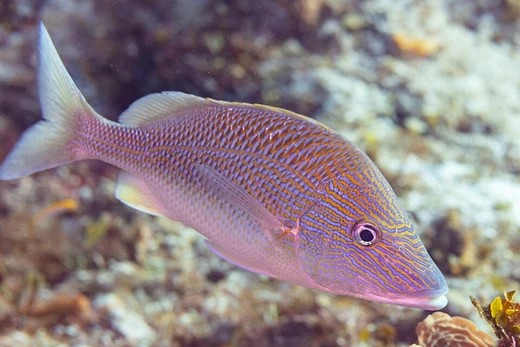
Japanese snapper
A blue-bodied snapper valued as a food fish in Japan.
Last updated
The Japanese snapper (Paracaesio caerulea) is a marine fish from the snapper family Lutjanidae, found in the Western Pacific Ocean. Its body is slender and fusiform, with large eyes and a convex area between them. The jaws are equal in length and lined with bristle-like teeth, and the snout is short. The pectoral fins are long, reaching the anus, and the caudal fin may be slightly forked or lunate.
The dorsal fin has 10 spines and 10 soft rays, while the anal fin has 3 spines and 8 soft rays; both fins lack scales. The upper body and sides are blue, fading to whitish or silvery on the belly. The dorsal and caudal fins are light yellow, and the other fins are whitish or translucent. This species reaches a maximum total length of 50 cm, though 30 cm is more typical.
The fish was first formally described in 1934 by Japanese zoologist Masao Katayama, who named it Vegetichthys caeruleus. The type specimen came from the Tokyo Fish Market, possibly caught near Hachijō-jima in the Izu Islands. The specific name caerulea means "blue," referring to its dominant color.
The Japanese snapper lives in the western Pacific, off southern Japan, Taiwan, and the Chesterfield Islands of New Caledonia. It inhabits rocky substrates at depths greater than 100 meters. Spawning off Japan is thought to occur from April to September.
This fish is an important food species, often sold fresh in markets. Fishermen catch it with handlines and bottom longlines. In Japan, it is called aodai and is used in sushi and sashimi, as well as sautéed, broiled, deep fried, or prepared in miso soup.
Scientific classification
- KingdomAnimalia
- PhylumChordata
- ClassActinopterygii
- DivisionTeleostei
- OrderAcanthuriformes
- FamilyLutjanidae
- GenusParacaesio
- SpeciesParacaesio caerulea
Named by (Katayama, 1934)
Close relatives
Other species of Paracaesio with a Codexery entry.
- Paracaesio xanthurus
Sources: Wikipedia taxobox: Japanese snapper (CC BY-SA 4.0) · differs from this box at order: WoRMS AphiaID 278684 (CC BY 4.0)
Conservation status
Data Deficient (DD)
Data Deficient: there is not enough information to place this species on the risk scale.
Source: IUCN Red List assessment · GBIF copy of the Red List category
How big is it?
Largest length in the source, 0.5 m, next to a 1.8 m person.
Diagram: drawn by Codexery, schematic shapes to scale (not a likeness). Length: Wikipedia: Japanese snapper
Where the japanese snapper has been recorded
Each dot is a place where the species has been observed and reported (60 records, half-degree grid) — not a modelled range. 4 inland records left out (institution coordinates).
Map: drawn by Codexery. Data: GBIF occurrence search (records CC0 / CC BY) · Natural Earth basemap (public domain) · place coordinates: Wikipedia (CC BY-SA 4.0)
More in Snappers
Elsewhere in Snappers and Grunts
Test yourself
Three questions drawn from this entry’s sources. Pick an answer to check it.
Answers checked against the source article
Sources
Compiled from Wikipedia and the sources listed below. Text from Wikipedia is available under CC BY-SA 4.0; this entry is adapted from it.
- Wikipedia: Japanese snapper (CC BY-SA 4.0).
- Classification: the source article's taxobox; compare WoRMS, the World Register of Marine Species (CC BY 4.0).
- Conservation status: IUCN Red List assessment.
- Occurrence records: GBIF (CC0 / CC BY). Basemap: Natural Earth (public domain).
- Word definitions: the , each quoted from its Wikipedia article.
Spotted an error? Know more?
Reader corrections go straight into our review queue. Suggest an edit · How this site is sourced