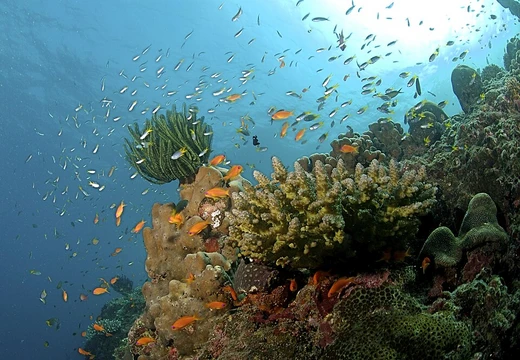
Raja Ampat Islands
Archipelago in the Coral Triangle with the richest marine biodiversity on earth.

Raja Ampat—the Four Kings—is an archipelago sitting just south of the equator, off the northwest tip of New Guinea’s Bird’s Head Peninsula in Indonesia’s Southwest Papua province. More than 1,500 tiny islands, cays, and shoals cluster around four main landmasses: Misool, Salawati, Batanta, and Waigeo, plus the smaller Kofiau. This archipelago belongs to the Coral Triangle, a Southeast Asian sea zone that holds the planet’s richest marine biodiversity. Its waters teem with thousands of marine species, from tiny cleaner shrimp and camouflaged pygmy seahorses up to massive cetaceans and whale sharks.
Since 2024, Raja Ampat has been part of Southwest Papua province (formerly West Papua). Most of the islands make up the Raja Ampat Regency, created in 2004 when it split from Sorong Regency. The regency covers about 70,000 square kilometers of land and sea; the land area is 8,034.44 square kilometers, and the 2020 census counted 64,141 people, with an official mid-2022 estimate of 66,839. This does not include the southern half of Salawati Island, which belongs to the Salawati Selatan and Salawati Tengah districts of Sorong Regency. Starting in 2019, illegal mining—especially for nickel—has threatened the islands’ natural conservation, drawing widespread public criticism in Indonesia.
People first visited Raja Ampat more than 50,000 years ago, based on archaeological finds. Back then, Misool and Salawati were connected to New Guinea, while Waigeo and Batanta formed a single island called Waitanta. Excavations at Mololo Cave show early inhabitants processed tree resins and hunted native animals. Around 3,500 to 3,000 years ago, pottery-making communities arrived, likely bringing Austronesian languages.
The name “Raja Ampat” (raja meaning king, empat meaning four) comes from a local myth: a woman found seven eggs. In one version, she was Boki Tabai, daughter of Al-Mansur of Tidore and wife to Gurabesi. Three eggs hatched into kings who settled the main islands; a fourth hatched and went to Waigama, later moving to Kalimuri on Seram. Another version says the fifth egg became a woman named Pin Take, who washed up on Biak, married Manar Makeri, and gave birth to Gurabesi. The sixth egg hatched into a spirit, and the seventh never hatched—it turned to stone and is worshipped as a king in Kali Raja on Waigeo.
Quick Facts
- Native Name
- Kepulauan Raja Ampat / (Indonesian) · Kalano Muraha, Kolano Nguraha / (Tidore) · Kalana Fat / (Ma'ya)
- Archipelago
- Melanesia
- Total Islands
- 612
- Major Islands
- Misool / Salawati / Batanta / Waigeo
- Country
- Indonesia Indonesia
- Country Admin Divisions Title
- Province
- Country Admin Divisions
- Southwest Papua
- Population
- 66,839
- Population As Of
- mid 2022 estimate
Facts from the source article.
Lore & Background
Archaeological evidence indicates that the Raja Ampat Islands were first visited by humans over 50,000 years ago. At that time, Misool and Salawati were connected to New Guinea, while Waigeo and Batanta formed an island called Waitanta. Pottery-making communities moved into the area about 3500–3000 years ago and may have brought Austronesian languages. The name 'Raja Ampat' (Raja meaning king, empat meaning four) comes from local mythology about a woman who found seven eggs; three hatched into kings who occupied the islands, with other eggs producing a woman, a spirit, and a stone worshipped as a king. Historically, the 'four' kingdoms were Waigeo, Salawati, Sailolof, Misool, and Waigama, though locally Waigama is not considered one of the Raja Ampat, and Sailolof is not considered one by Tidore.
The first recorded European sighting and landing was by Portuguese navigator Jorge de Menezes in 1526. Islam arrived in the 15th century through contacts with the Bacan Sultanate, and during the 16th and 17th centuries, the Sultanate of Tidore had close ties with the islands, leading to Islam becoming firmly established. Raja Ampat was considered part of the Sultanate of Tidore, and after the Dutch invaded Maluku, it was claimed by the Netherlands. English explorer William Dampier gave his name to Dampier Strait, and in 1759, Captain William Wilson named Pitt Strait after his vessel. Since 2024, the archipelago is part of Southwest Papua province, and most islands constitute the Raja Ampat Regency, separated from Sorong Regency in 2004.
Reader's Guide
Raja Ampat is considered the global epicentre of tropical marine biodiversity and is referred to as 'The Crown Jewel' of the Bird's Head Seascape. The region contains more than 600 species of hard corals, about 75% of the world's known species, and more than 1,700 species of reef fish. Endangered and rare marine mammals such as dugongs, whales (blue, pygmy blue, Bryde's, Omura's, sperm), dolphins, and orcas occur here, along with endangered whale sharks. The area's massive coral colonies and relatively high sea surface temperatures suggest its reefs may be relatively resistant to threats like coral bleaching and disease. The high marine diversity is strongly influenced by its position between the Indian and Pacific Oceans, facilitating larval exchange. Raja Ampat's coral diversity, resilience, and role as a source for larval dispersal make it a global priority for marine protection. The Raja Ampat Marine Recreation Park was designated in 2009, and in 2025 the islands were designated a UNESCO biosphere reserve. However, from 2019 onwards, natural conservation has been endangered by illegal mining (e.g., nickel), which has caused widespread criticism from the Indonesian public. The crown-of-thorns starfish, which eats corals, has proliferated due to increasing nitrogen from human waste, and local divers have been injecting them with a 10% vinegar solution to reduce populations.
Did You Know?
- The name 'Raja Ampat' comes from a local myth about a woman who found seven eggs, three of which hatched into kings.
- The region contains about 75% of the world's known species of hard corals, with over 600 species recorded.
- In 2025, the islands were designated as a biosphere reserve by UNESCO.
More in Coral Reefs, Part 2 1-24
Spotted an error? Know more?
Reader corrections go straight into our review queue. Suggest an edit · How this site is sourced