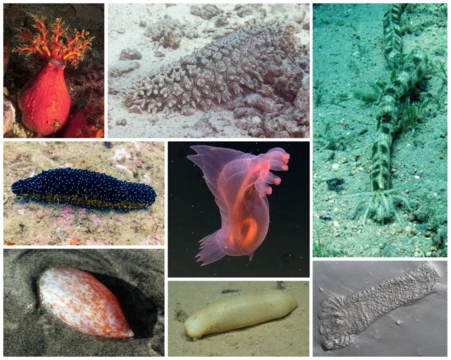
Sea Cucumbers and Brittle Stars, Part 3
42 entries in the Sea Cucumbers and Brittle Stars, Part 3 compendium.
Holothuria mexicanaA sediment-feeding sea cucumber used as a bioindicator for metal pollution.Holothuria parvulaA golden sea cucumber that reproduces by splitting in half.Holothuria pervicaxA sea cucumber known for its inability to survive in captivity.Holothuria poliA Mediterranean sea cucumber with white-tipped tubercles and anti-Lessepsian migration.Holothuria scabraSandfish is the most harvested sea cucumber for beche-de-mer.Holothuria spiniferaA tropical sea cucumber fished for beche-de-mer and studied for aquaculture.Holothuria stellatiA brown sea cucumber with debated subspecies and small ossicles.Holothuria thomasiLargest western Atlantic sea cucumber, camouflaged until 1980.Holothuria tubulosaType species of genus Holothuria, found in the Mediterranean and eastern Atlantic.Holothuria whitmaeiBlack teatfish, a high-value sea cucumber in Pacific beche-de-mer trade.Noble sea cucumberA warty, burrowing sea cucumber of the western Atlantic.Apostichopus japonicusA temperate sea cucumber harvested for food across East Asia.Apostichopus parvimensisA Pacific sea cucumber with warty skin and nocturnal habits.AstichopusA monotypic genus of fast-moving Caribbean sea cucumbers.California sea cucumberA solitary nocturnal scavenger found from Alaska to Baja California.Isostichopus badionotusA large Atlantic sea cucumber with dark dorsal warts.Isostichopus fuscusA Critically Endangered sea cucumber harvested unsustainably for East Asian cuisine.Parastichopus regalisA sea cucumber hosting pearlfish in its respiratory tree.StichopusA genus of sea cucumbers valued for food and traditional medicine.Stichopus chloronotusA widespread Indo-Pacific sea cucumber of least concern.Stichopus herrmanniA large, commercially harvested sea cucumber of the Indo-Pacific.Stichopus nasoA tropical sea cucumber with erect tubercles and dual activity patterns.Thelenota ananasA large, slow-growing sea cucumber with pointed teats and tube feet.Thelenota anaxA large, commercially harvested sea cucumber with medicinal uses.Thelenota rubralineataA large, red-lined sea cucumber of Indo-Pacific coral slopes.Ophiocoma echinataA large brittle star with coordinated locomotion and no brain.Ophiocoma scolopendrinaIntertidal brittle star with unique surface-film feeding behavior.Ophiocomella alexandriA banded, spiny brittle star from the eastern Pacific.Ophiomastix venosaBrittle star with club-shaped spines, found in Indo-Pacific coastal waters.Ophiomastix wendtiiA color-changing brittle star with crystal-arm vision.AmphiuridaeA large, diverse family of burrowing brittle stars found worldwide.Histampica haimaensisA beige brittle star from the Haima cold seep.OphiotrichidaeBrittle stars with delicate, translucent, thorny spines.Ophiactis savignyiA widespread brittle star that reproduces both sexually and by fragmentation.Ophiopholis aculeataA circum-polar brittle star with twisted arms and mass spawning events.Ophionereis reticulataA reticulated brittle star with unique tube-foot locomotion.Ophionereis schayeriLargest common brittle star near Sydney, filter-feeder, bioluminescent.Ophiura albidaA brittle star found in the north-eastern Atlantic and Mediterranean.Ophiura ophiuraA brittle star found on sandy seabeds around northwestern Europe.Ophiura sarsiiA cold-water brittle star abundant in Arctic and Sub-Arctic seas.Gorgonocephalus arcticusA basket star with coiled arms like the Gorgon's serpents.Gorgonocephalus eucnemisA basket star with branching arms, found in northern seas.
Browse Sea Cucumbers and Brittle Stars, Part 3 in the interactive codex →