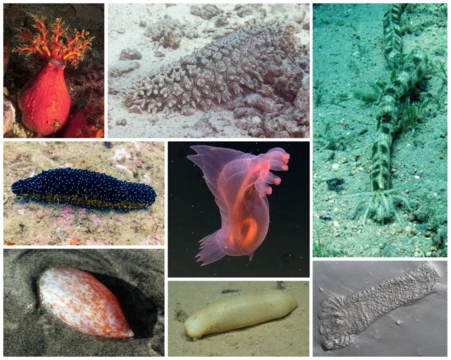
Apostichopus parvimensis
A Pacific sea cucumber with warty skin and nocturnal habits.

Apostichopus parvimensis, commonly known as the warty sea cucumber, is a Pacific species of sea cucumber found from the Baja California Peninsula, Mexico, to Monterey Bay, California, USA. It is notable for its warty appearance and its ability to expel internal organs when threatened.
Quick Facts
- Genus
- Apostichopus
- Species
- parvimensis
Facts from the source article.
Lore & Background
The warty sea cucumber has a soft, cylindrical body with red-brown to yellowish leathery skin and numerous grey spots, giving it its common name. It possesses an endoskeleton just below the skin, with the mouth and anus on opposite ends. The mouth is surrounded by ten retractable tentacles used for feeding, and five rows of tube feet extend from the mouth to the anus. It is found mainly in low energy environments from the intertidal zone down to 30 m, though it can occur as deep as 60 m. Only scattered individuals were reported north of Point Conception, California.
Reader's Guide
Apostichopus parvimensis is a solitary nocturnal animal. When threatened, it can expel its internal organs through its anus and grow new ones. It has separate sexes, and eggs are fertilized externally. Spawning usually takes place in November, and each female can produce thousands of eggs. After fertilization, a larva forms which metamorphoses into a sea cucumber after a few weeks. Its significance lies in its distinctive warty appearance and its defensive autotomy, a notable survival adaptation among sea cucumbers.
Frequently Asked Questions
Who is Apostichopus parvimensis?
It is a Pacific sea cucumber commonly called the warty sea cucumber, instantly recognizable by its bumpy, textured skin. It lives along the North American Pacific coast, spanning from the Baja California Peninsula in Mexico up to Monterey Bay, California.
What are Apostichopus parvimensis's signature abilities?
Its most dramatic trait is defensive evisceration: when threatened, it can fling out its own internal organs to distract a predator and escape. It also wields ten retractable feeding tentacles around its mouth, giving it a distinctly alien look when extended.
Where does Apostichopus parvimensis live and how deep can it be found?
It occupies the intertidal zone and typically stays within 30 meters (about 98 feet) of the surface, though records push that to 60 meters (200 feet). Its body can grow to roughly 30–40 centimeters, making it one of the larger sea cucumbers in its range.
How does Apostichopus parvimensis reproduce?
It is a broadcast spawner that releases its gametes into the surrounding water during a single annual window in November. Like other holothurians, it moves and breathes using five longitudinal rows of tube feet running along its body.
Why is Apostichopus parvimensis a fan favorite among sea-cucumber enthusiasts?
Its combination of a strikingly warty exterior, nocturnal foraging behavior, and the dramatic organ-ejection defense makes it one of the most visually memorable species in the family. Fans also appreciate that it is a purely Pacific endemism, tying it to the familiar Baja-to-California coastline.
More in Sea Cucumbers and Brittle Stars, Part 3 1-24
Spotted an error? Know more?
Reader corrections go straight into our review queue. Suggest an edit · How this site is sourced