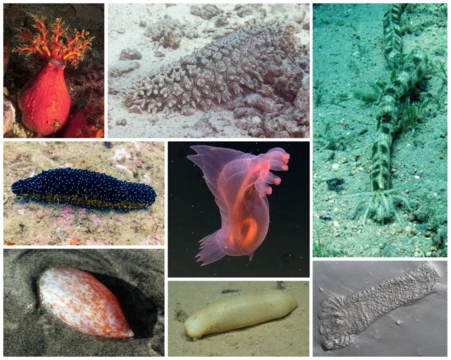
Isostichopus fuscus
A Critically Endangered sea cucumber harvested unsustainably for East Asian cuisine.

The brown sea cucumber, *Isostichopus fuscus*, belongs to the family Stichopodidae and lives in the eastern Pacific. German biologist Hubert Ludwig first described it in 1875. Its thick, spineless skin makes it easy to eat, which has driven unsustainable fishing for export to East Asia, leading the IUCN to classify it as Critically Endangered.
This species ranges along the Pacific coast from Mexico (including the Gulf of California) through Central America down to northern Peru, and also around eastern Pacific islands like the Galápagos. It prefers shallow waters between 3 and 29 meters deep, though it can be found from 0 to 40 meters, typically on rocky reefs with sandy patches. It is most common where *Ulva* seaweed grows, and it is more active at night, hiding during the day to avoid predators.
Like other sea cucumbers, *I. fuscus* feeds by ingesting deposits from the seafloor, and it survives better on soft substrates like sand or clay. Recent research suggests a mix of *P. durvillaei* and *S. ecuadoreanum* seaweeds is an optimal diet, though it can eat other types.
These sea cucumbers are small, averaging 23 cm in length and 386 grams. The largest recorded specimens reach 40 cm and 830 grams, though weight changes seasonally with reproduction and maturity. Growth is allometric—body length and weight increase together. The species is dioecious, with gonads only distinguishable under a microscope; there is no visible difference between sexes unless the gonads are ripe, at which point males have white gonads and females have orange ones. The body is elongated, soft, and gelatinous, curved like a half circle, dark brown with orange papillae (small bumps). On the underside, ambulacral extensions help with movement. In 2013, the first albino individuals were found—one in Loreto, Mexico, and another in Los Angeles Bay.
Spawning occurs from July to September, with post-spawning gonads appearing in October. Gametogenesis (development of sex cells) happens from January to July, with oogenesis starting about a month before spermatogenesis. The species is an episodic spawner, with reproduction peaks followed by sharp declines, and water temperature likely acts as a trigger. The reproductive cycle has five stages: undetermined, gametogenesis, maturity, spawning, and post-spawning, completed annually.
Quick Facts
- Genus
- Isostichopus
- Species
- fuscus
Facts from the source article.
Lore & Background
The brown sea cucumber is found along the Pacific coast from Mexico, including the Gulf of California, through Central America to northern Peru, and on eastern Pacific islands such as the Galápagos. It inhabits shallow rocky reefs from 0 to 40 m depth, with a preferred range of 3 to 29 m, especially where sandy patches and high amounts of Ulva sp. are present. The species is more active at night, being cryptic during the day to avoid predators.
Isostichopus fuscus is a deposit feeder that thrives on soft substrates like sand or clay. Recent studies suggest an optimal diet includes a blend of seaweed species such as P. durvillaei and S. ecuadoreanum. Morphologically, it has an elongated, curved body with a soft or gelatinous texture, dark brown coloration, and orange papillae. It is dioecious, with no apparent sexual dimorphism unless gonads are ripe—males then have white gonads, females orange. The first record of albinism in this species was documented in 2013, with two albino individuals found in Loreto, Mexico, and Los Angeles Bay.
Reproduction involves an annual cycle of five gonadal stages: undetermined, gametogenesis, maturity, spawning, and post-spawning. Spawning occurs from July to September, with water temperature thought to play a large role as a reproductive indicator. Hermaphroditic samples have been collected but are rare. Asexual reproduction via induced transverse fission has been successful in lab settings, with complete regeneration within three months, suggesting potential for population restoration.
Reader's Guide
Isostichopus fuscus holds significant economic and ecological importance as described in the source article. It is a highly sought commodity in North and South American countries including Mexico, Costa Rica, and Ecuador, and sea cucumber fishing is considered the most important fishing activity in the Galápagos Islands. The fishery is typically conducted unsustainably, leading to population declines and its Critically Endangered IUCN classification. The species' thick, spineless dermis makes it easily edible, driving its harvest for export to East Asia where sea cucumber is popular in cuisines.
Its biological traits contribute to its vulnerability: it is a relatively small organism with average body length of 23 cm and weight of 386 g, and it grows allometrically. The species is an episodic spawner, with reproduction peaking then declining, and its larval development takes about 22 days through auricularia, doliolaria, and pentactula stages. Juveniles grow rapidly at 0.5–1 mm per day over 3–4 weeks, developing brown pigment at about 5 mm and adult coloration at 2 cm. The potential for asexual propagation through induced transverse fission has been demonstrated in the lab, offering a possible tool for restoring wild populations, though this remains experimental. The species' restricted shallow-water habitat and preference for specific substrates further limit its resilience to overfishing.
Did You Know?
- The brown sea cucumber was first described by German biologist Hubert Ludwig in 1875.
- Two albino individuals were discovered in 2013, one in Loreto, Mexico and the other in Los Angeles Bay.
- Induced transverse fission in a lab showed complete regeneration of body parts within a maximum of three months.
More in Sea Cucumbers and Brittle Stars, Part 3 1-24
Spotted an error? Know more?
Reader corrections go straight into our review queue. Suggest an edit · How this site is sourced