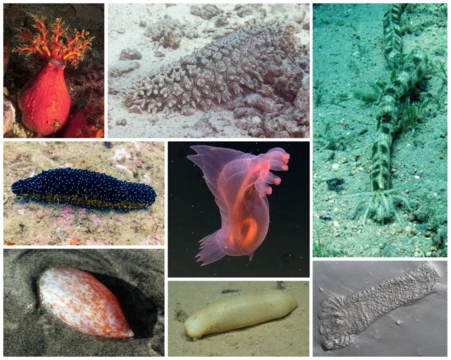
Holothuria stellati
A brown sea cucumber with debated subspecies and small ossicles.

Holothuria stellati, commonly called the Brown sea cucumber, belongs to the family Holothuriidae. It was first described by Delle Chiaje in 1824. The species includes two accepted subspecies—Holothuria stellati dakarensis and Holothuria stellati mammata—but whether these should be considered distinct species remains under debate.
This sea cucumber typically reaches up to 12.9 cm in length, rarely growing to 20 cm. Its body is cylindrical, colored light to dark brown with a few darker spots. The exterior is hard due to a calcareous endoskeleton. On the dorsal side, a rounded bivium bears two rows of large, pointed papillae. The ventral side forms a flat trivium with three rows of podia that contain ossicles. These podia are used for both movement and feeding, as the animal pushes sand into its mouth. Compared to other species in its genus, H. stellati has smaller ossicles: tables range from 31 to 52 μm in diameter, spires from 21 to 42 μm tall, and buttons from 31 to 42 μm long. The mouth and anus are at opposite ends of the body.
H. stellati inhabits both soft and rocky sandy substrates in tropical climates. It lives exclusively in the neritic zones of the benthos in the Mediterranean Sea and Adriatic Sea, near Western Italy, Monaco, Tunisia, Turkey, and Algeria. Unconfirmed reports also place it in the Canary Islands and Croatia.
The species has separate male and female sexes. Females release eggs into the water, where fertilization occurs externally. The larvae pass through two stages: first, a planktonic auricularia stage, then a barrel-shaped doliolaria stage before maturing into adults. Although some sea cucumbers can reproduce asexually by fission, no documented research indicates that H. stellati does so.
Little is known about its exact diet. It is an omnivore, feeding on plankton, algae, and floating detritus. Like other sea cucumbers, it engages in both suspension feeding and deposit feeding, sifting through large amounts of sediment or water and expelling waste through its anus.
H. stellati serves as host and prey to several copepod parasites, including Alantogynous dellamarei, Calpysina changeuxi, and Tisbe holothuriae.
The species is not well studied, and information on its population and distribution is limited. However, it is increasingly targeted by fisheries, especially in Algeria and Turkey.
Quick Facts
- Genus
- Holothuria
- Species
- stellati
Facts from the source article.
Lore & Background
Holothuria stellati grows up to 12.9 cm, rarely reaching 20 cm. Its body is light to dark brown with a few darker spots, cylindrical in shape, and hard on the outside due to a calcareous endoskeleton. The dorsal side forms a round bivium with two rows of large, pointed papillae, while the ventral side forms a flat trivium with three rows of podia containing ossicles. These podia are used for locomotion and feeding, pushing sand into the mouth. The mouth and anus are on opposite terminal ends of the body. H. stellati has smaller ossicles than other species in its genus, with tables 31–52 μm in diameter, spires 21–42 μm tall, and buttons 31–42 μm long.
H. stellati lives on both soft and rocky sandy substrates in tropical climates, exclusively in the neritic zones of the benthos of the Mediterranean Sea and Adriatic Sea, near Western Italy, Monaco, Tunisia, Turkey, and Algeria. Reports of its appearance in the Canary Islands and Croatia remain unconfirmed. The species is separated into male and female sexes, with external fertilization. It goes through two larval stages: auricularia (planktonic) and doliolaria (barrel-shaped). No documented research shows H. stellati can reproduce asexually by fissure.
H. stellati is an omnivore, feeding on plankton, algae, and floating detritus, performing both suspension and deposit feeding. It is host to copepod parasites including Alantogynous dellamarei, Calpysina changeuxi, and Tisbe holothuriae.
Reader's Guide
Holothuria stellati is a poorly studied species with limited information on its population and distribution, yet it faces increasing pressure from fisheries, particularly in Algeria and Turkey. A 2009 study by Graham and Thompson found that sea cucumbers selectively ingest plastic fragments from sediment, posing a potential danger to these benthic organisms. These issues underscore the importance of conservation efforts and further studies, as overfishing and habitat harm may threaten the species. The ongoing debate over its subspecies highlights taxonomic uncertainty that complicates conservation planning. Despite its limited research profile, H. stellati serves as an example of how benthic marine life can be impacted by both direct exploitation and environmental pollution, making it a species of concern in the Mediterranean and Adriatic regions where it resides.
Frequently Asked Questions
What is Holothuria stellati and who first described it?
Holothuria stellati, widely known as the Brown sea cucumber, is a member of the family Holothuriidae. The species was originally described by the Italian naturalist Delle Chiaje back in 1824, making it one of the better-documented holothurians in the Atlantic.
What does Holothuria stellati look like and how big does it get?
It has a cylindrical body ranging from light to dark brown with scattered darker spots, and its surface feels notably hard because of a calcareous endoskeleton. Most individuals top out around 12.9 cm, though exceptionally large specimens can reach 20 cm. The dorsal side features a rounded bivium that carries two rows of tube feet.
Are the two subspecies of Holothuria stellati really separate species?
Taxonomists currently recognize Holothuria stellati dakarensis and Holothuria stellati mammata as subspecies, but the question of whether they warrant full species status is still unresolved. Ongoing morphological and genetic comparisons keep the debate open in the holothurian literature.
What do the microscopic ossicles of Holothuria stellati look like?
The species bears small table-shaped ossicles with a plate diameter falling between 31 and 52 micrometers. The central spire on each table rises roughly 21 to 42 micrometers above the plate, giving the endoskeleton its characteristic fine, rigid texture.
Why do fans and researchers keep coming back to Holothuria stellati?
Its long taxonomic history, the ongoing subspecies controversy, and its compact yet structurally complex body make it a favorite case study for understanding holothurian diversity. It also serves as a handy reference point when comparing ossicle morphology across the broader Holothuriidae family.
More in Sea Cucumbers and Brittle Stars, Part 3 1-24
Spotted an error? Know more?
Reader corrections go straight into our review queue. Suggest an edit · How this site is sourced