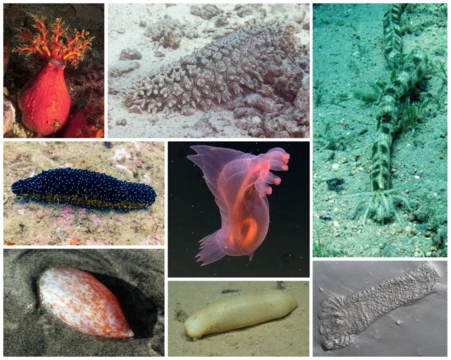
Apostichopus japonicus
A temperate sea cucumber harvested for food across East Asia.

Apostichopus japonicus is a species of sea cucumber in the family Stichopodidae, found in shallow temperate waters along the coasts of southeast Asia. It is commonly known as the Japanese spiky sea cucumber or Japanese sea cucumber, and is notable for its use as food, particularly in Japan, where it supports a large fishery.
Quick Facts
- Genus
- Apostichopus
- Species
- japonicus
Facts from the source article.
Lore & Background
The Japanese sea cucumber has a cylindrical leathery body with blunt, thorny protuberances. At the anterior end is a mouth surrounded by a ring of short feeding tentacles, and at the posterior end is the anus. Three different colour morphs exist: red, green, and black. The red morphs are found on gravel beds offshore at depths of 40 metres or deeper, while the other two colours are found intermingled on muddy and sandy bottoms at shallower depths. Although the red morph may breed red offspring due to reproductive isolation in a different microhabitat, DNA studies show limited genetic difference between it and the other morphs, with no significant difference between the black and green forms. In lagoons in southern Sakhalin, Russia, they are found on solid substrates among growth of the red alga Ahnfeltia tobuchiensis and in oyster beds (Crassostrea gigas).
The Japanese sea cucumber sifts through sediment with its tentacles, feeding on detritus and organic matter including plant and animal remains, bacteria, protozoa, diatoms, and faeces. The sexes are separate; males and females release gametes into the sea for fertilization. In the laboratory, spawning can be induced by varying temperature or using the neuropeptide cubifrin. Planktonic larvae develop through several stages before settling on hard surfaces, undergoing metamorphosis, and becoming juveniles. In locations where water heats up excessively in summer, it undergoes aestivation—a state of dormancy where feeding stops, the gut degenerates, metabolism slows, and weight is lost. The threshold temperature is about 25 °C, higher for smaller individuals and those from the southern part of the range. This sea cucumber has been known to continue aestivation in some areas of China for four years.
Reader's Guide
The Japanese sea cucumber is significant as a food species, with the largest fishery in Japan, where between 2000 and 2005 an average of 8,101 tonnes were harvested annually. The red form is known as 'aka namako' and sells at a different price from the green morph ('ao namako') and the black one ('kuro namako'). In Russia and North Korea, overfishing has reduced populations considerably. Fishing methods include diving and hand collection at depths up to 20 metres, and trawls at greater depths. In the 1920s, a 'sea cucumber fork' was developed in China, operated from several small vessels, allowing harvest from depths up to 60 metres. The species is also cultivated commercially in shallow ponds and by sea ranching in northern China, where production reached 5,865 tonnes in 2002. Rocks and tiles are placed on the bottom to provide settlement for larvae and protection from predators. Breeding programs are under way to improve growth rates and disease resistance, and the genome is being sequenced. Hatchery techniques are being developed in Japan and China, along with preparation of suitable culture feeds and investigation of best ranching methods. Albino forms and a thermally resistant strain less prone to aestivate are being developed in China.
Did You Know?
- The Japanese sea cucumber has three colour morphs: red, green, and black.
- It undergoes aestivation at temperatures above about 25 °C, and has been known to aestivate for four years in some areas of China.
- In the 1920s, a 'sea cucumber fork' was developed in China for harvesting at depths up to 60 metres.
- The red morph is found on gravel beds at depths of 40 metres or deeper, while green and black morphs occur on muddy and sandy bottoms at shallower depths.
Frequently Asked Questions
What is Apostichopus japonicus?
Apostichopus japonicus is a sea cucumber species in the family Stichopodidae, most commonly called the Japanese spiky sea cucumber. It lives in shallow temperate coastal waters of southeast Asia and appears in red, green, or black color morphs.
What role does Apostichopus japonicus play in East Asian fisheries?
It is the backbone of a major food fishery in Japan, where it is harvested as a prized delicacy. Between 2000 and 2005, the country pulled an average of roughly 8,101 tonnes of this animal from the sea each year.
Where does Apostichopus japonicus live, and how deep can it be found?
This species occupies shallow temperate seabeds along southeast Asian coasts. Commercial divers and trawlers collect individuals from depths reaching up to about 60 metres (200 feet).
What happens to Apostichopus japonicus when the water gets too warm?
Once surrounding temperatures climb to around 25 °C (77 °F), the animal enters aestivation, a dormant state in which its metabolism essentially pauses until conditions cool. This thermal limit is a key consideration for seasonal harvest management.
Why is Apostichopus japonicus considered important?
Ecologically it functions as a detritivore in shallow coastal habitats, while economically it anchors a large-scale food industry across East Asia, especially in Japan. Its high market value as a culinary ingredient makes sustainable harvesting a persistent concern for managers and fans alike.
More in Sea Cucumbers and Brittle Stars, Part 3 1-24
Spotted an error? Know more?
Reader corrections go straight into our review queue. Suggest an edit · How this site is sourced