Astichopus
A monotypic genus of fast-moving Caribbean sea cucumbers.

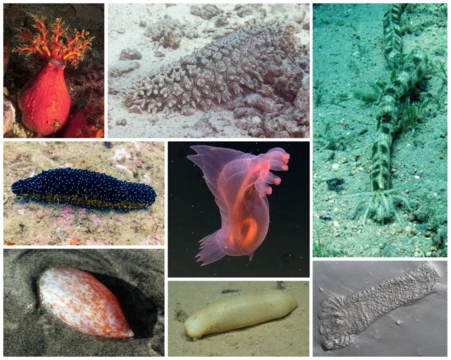
Astichopus is a monotypic genus of sea cucumber, with just one species: Astichopus multifidus. This animal, known as the furry or fissured sea cucumber, lives in the Caribbean Sea. It has a soft, sturdy body that can reach 40 cm long and 10 cm wide. Its entire surface—both top and bottom—is covered in hundreds of tube feet. On the upper side, these feet extend into fleshy, cone-shaped papillae about 1 cm long, each tipped with a tube foot. The color is chocolate brown or dark grey, sometimes with lighter patches or many small white spots.
This sea cucumber is found across the Caribbean, from the West Indies and southern Florida to the Dry Tortugas, the Campeche Bank, and south to Colombia and Venezuela. It lives on sandy seafloors near reefs, and occasionally in seagrass meadows, at depths of 10 to 30 meters. During the day, it buries itself in the sand and comes out at night to feed. It is a scavenger and detritivore, swallowing large amounts of sediment and extracting organic matter as it passes through its gut. Unlike most sea cucumbers, it moves quickly—covering nearly 2 meters in a minute—by crawling, rolling, or even bounding.
The IUCN lists Astichopus multifidus as Least Concern. While other Caribbean sea cucumbers have been more heavily harvested, this species may face increasing pressure as those stocks decline. Its population trend is unknown, but its range includes some protected areas, and sea cucumber collection is illegal in Panama, Costa Rica, and Venezuela.
Quick Facts
- Genus
- Astichopus
- Species
- multifidus
Facts from the source article.
Lore & Background
Astichopus multifidus is a robust, soft-bodied sea cucumber growing to a maximum length of 40 cm and width of 10 cm. Both its dorsal and ventral surfaces are uniformly covered with hundreds of tube feet; those on the dorsal surface are extended into papillae, fleshy conical projections about 1 cm long with tube feet at their tips. It is chocolate brown or dark grey, sometimes mottled with paler patches or speckled with many small white spots.
This species is native to the Caribbean region, including the West Indies, the southern tip of Florida, the Dry Tortugas, the Campeche Bank, and southwards to Colombia and Venezuela. It inhabits sandy seabeds near reefs and occasionally seagrass meadows, at depths between 10 and 30 m.
Astichopus multifidus spends the day buried in the sand, emerging at night to feed. It is a scavenger and detritivore, ingesting large quantities of sediment from which organic matter is extracted. It can move much more rapidly than most sea cucumbers, covering almost 2 m in a minute, using crawling, rolling, or bounding locomotion.
Reader's Guide
Astichopus multifidus is significant as the sole species in its genus, distinguished by its rapid movement and unique morphology. The IUCN has rated it as Least Concern, but notes that as other Caribbean sea cucumber stocks become depleted, this species may be increasingly targeted. Its population trend is unknown, though its range includes some protected areas. Gathering of sea cucumbers is illegal in Panama, Costa Rica, and Venezuela, which may offer some protection. The species' ability to move quickly—covering nearly 2 meters per minute—sets it apart from most sea cucumbers, and its nocturnal, burrowing lifestyle helps it avoid daytime predators. Its common names, furry sea cucumber and fissured sea cucumber, reflect its papillae-covered dorsal surface and possibly its appearance. The species plays a role in sediment processing as a detritivore, contributing to nutrient cycling in its sandy seabed and seagrass habitats.
Did You Know?
- Astichopus multifidus can move almost 2 meters in a minute, much faster than most sea cucumbers.
- It spends the day buried in sand and emerges at night to feed.
- Its dorsal tube feet are extended into fleshy papillae about 1 cm long.
Frequently Asked Questions
Who is Astichopus?
Astichopus is a monotypic genus of sea cucumber that contains only one species, Astichopus multifidus, commonly called the furry or fissured sea cucumber. It is a soft-bodied echinoderm found in Caribbean waters.
What does Astichopus look like?
The animal has a chocolate-brown or dark-grey body, sometimes marked with lighter patches or numerous tiny white spots. Its most distinctive feature is the dense covering of tube feet across the entire surface, with the upper side bearing cone-shaped fleshy papillae roughly 1 cm long, each tipped by a tube foot.
Where does Astichopus live and how big does it get?
This sea cucumber is found throughout the Caribbean Sea, typically at depths of 10 to 30 metres (about 33 to 98 feet). It can grow to roughly 40 cm in length and 10 cm in width, making it a notably large holothurian for its region.
How fast can Astichopus move?
Despite its soft, unassuming body, Astichopus multifidus covers nearly 2 metres (about 10 feet) in a single minute, which is remarkably quick for a sea cucumber. This speed is one of the traits that sets the genus apart from many of its slower-moving relatives.
What is Astichopus's conservation status?
The IUCN currently classifies Astichopus multifidus as Least Concern, meaning its Caribbean populations are not considered significantly threatened at present. Because the genus is monotypic, any future decline in this single species would effectively mean the loss of the entire genus.
More in Sea Cucumbers and Brittle Stars, Part 3 1-24
Spotted an error? Know more?
Reader corrections go straight into our review queue. Suggest an edit · How this site is sourced