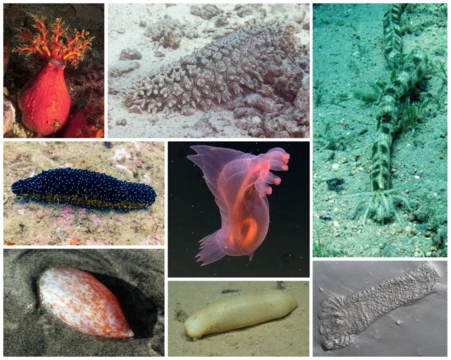
Noble sea cucumber
A warty, burrowing sea cucumber of the western Atlantic.

Holothuria princeps, called the noble sea cucumber, is an echinoderm from the family Holothuriidae. Like most of the roughly 1,100 sea cucumber species, it lacks obvious feet, eyes, mouth, anus, sexual organs, or appendages. Its body is cucumber-shaped, reaching about 30 cm long, and is covered in leathery, densely warty skin—the warts are mostly papillae. The coloration is brown, varying in shade, intensity, and pattern.
Distinguishing features include a thick, rigid body wall due to numerous grain-like calcareous ossicles. On the upper side, papillae of different sizes mix with tube feet that look similar and are used for movement and gripping the substrate. The lower surface has tube feet arranged in about three series of six rows, more numerous in the middle. The mouth is a small, simple hole on the lower side near the front, ringed by 20 short, white, flat-topped tentacles only slightly larger than nearby papillae. Many sea cucumbers defend themselves by ejecting Cuvierian tubules from the anus, but this has not been observed in *H. princeps*.
The species ranges from the U.S. coast of North Carolina and the Bahamas, south through the Caribbean (including Mexico, Colombia, and Venezuela), and along the Brazilian Atlantic coast. It burrows into sandy mud and shell substrates, and occurs in seagrass at depths down to about 73 m. In Brazil, it has also been reported from coral reefs.
Like other holothurians, *H. princeps* is a large-scale detritus feeder, playing a key ecological role by moving and recycling up to 90% of the biomass in the ocean’s benthic zone. Its larvae develop in seawater, then metamorphose and settle on the seafloor to grow into adults.
Sea cucumbers can regenerate damaged or lost parts. In one species (*Leptosynapta*), a small disk of tissue containing the mouth, a calcareous ring, and a nerve ring can regrow the entire animal. Another holothurian, after evisceration, has been observed to fully regenerate its digestive tube, hemal system, and respiratory trees (water lungs that pump water in and out through the anus for gas exchange).
Emil Selenka first formally described *Holothuria princeps* in 1867, based on a collection from Florida, USA. The name sometimes appears as a synonym for the same species published in the same year—likely because Selenka also used it in his 1867 dissertation at the University of Göttingen.
Quick Facts
- Genus
- Holothuria
- Species
- princeps
Facts from the source article.
Lore & Background
Holothuria princeps was first formally described in 1867 by Emil Selenka, based on a collection from Florida. Sometimes the name appears as a synonym for the same species published in the same year, because Selenka also published it in his dissertation at the University of Göttingen. Occasionally the taxon is presented as Holothuria (Theelothuria) princeps, following Elisabeth Deichmann's 1958 erection of the subgenus Theelothuria.
The species displays no conspicuous features promptly identifiable as feet, eyes, mouth, anus, sexual organs or appendages. Its body is the shape and size of a cucumber, covered with leathery, densely warty skin, the warty projections mostly being papillae. The body wall is relatively thick and rigid due to embedded calcareous ossicles. The mouth is a small, simple hole on the lower side near the front end, surrounded by 20 short, white, flat-topped tentacles. The lower surface has tube feet arranged in about three series of six rows, more numerous in the middle part. Often sea cucumbers discharge Cuvierian tubules through the anus as defense, but this has not been observed in Holothuria princeps.
The genus name Holothuria is a New Latin construct based on the Greek word holothoruion, meaning 'water polyp.' The species name princeps is Latin for 'first person, ruler, sovereign,' giving the common name Noble Sea Cucumber.
Reader's Guide
Holothuria princeps occurs on the US coast of North Carolina and the Bahamas southward through the Caribbean, including the coasts of Mexico, Colombia and Venezuela, and along the Brazilian Atlantic coast. It burrows into sandy mud and shell substrates, and occurs in seagrass in waters down to 73 m in depth. In Brazil it has been reported from a coral reef.
As a sea cucumber, it plays an important ecological role as a large-scale detritus feeder. Holothurians are known to move and recycle up to 90% of the biomass of the ocean's benthic zone. The larvae of all sea cucumbers develop in sea water; after metamorphosing, young sea cucumbers settle onto the water body's floor and grow into adults.
Sea cucumbers are capable of regenerating certain damaged or removed parts. In a Leptosynapta sea cucumber, a small disk of tissue containing the mouth, a calcareous ring, and a nerve ring has regenerated the whole rest of the animal. Another holothurian has been observed after evisceration to completely regenerate its entire digestive tube, hemal system, and respiratory trees. These regenerative abilities underscore the resilience of the group, though specific regeneration in Holothuria princeps is not described in the article.
Did You Know?
- Holothuria princeps reaches up to about 30 cm in length.
- It has 20 short, white, flat-topped tentacles surrounding its mouth.
- Discharge of Cuvierian tubules through the anus has not been observed in this species.
Frequently Asked Questions
Who is Noble sea cucumber?
Noble sea cucumber is the common name for Holothuria princeps, a burrowing echinoderm in the family Holothuriidae native to the western Atlantic. Emil Selenka provided its first formal scientific description in 1867, using Florida, USA as the type locality.
What does Noble sea cucumber look like?
It has a cucumber-shaped body reaching roughly 30 cm in length, wrapped in leathery skin densely studded with warty papillae. The overall coloration is brown, though shade, intensity, and patterning shift from individual to individual. Its dorsal surface shows papillae of mixed sizes intermingled with tube feet, and it bears 20 short, white, flat-topped tentacles.
Where can you find Noble sea cucumber in the wild?
This species is a sediment-burrowing benthic animal of the western Atlantic, recorded at depths of up to about 73 metres (roughly 240 feet). It moves through substrate rather than swimming, a lifestyle supported by its notably thick and rigid body wall.
What sets Noble sea cucumber apart from other sea cucumbers?
Its body wall is unusually thick and rigid because of a dense population of grain-like calcareous ossicles embedded throughout the tissue. Together with its 20 short, flat-topped white tentacles and the distinctive multi-sized papillae on the dorsal surface, these traits help separate it visually from close relatives in Holothuriidae.
Why is Noble sea cucumber significant to sea-cucumber enthusiasts?
As one of roughly 1,100 recognized sea-cucumber species, it exemplifies the warty, burrowing lifestyle typical of western Atlantic holothurians. Selenka's 1867 description also makes it a historical anchor point for the regional taxonomy of the family Holothuriidae.
More in Sea Cucumbers and Brittle Stars, Part 3 1-24
Spotted an error? Know more?
Reader corrections go straight into our review queue. Suggest an edit · How this site is sourced