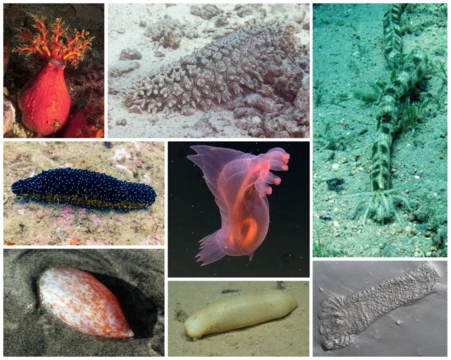
Holothuria spinifera
A tropical sea cucumber fished for beche-de-mer and studied for aquaculture.

Holothuria spinifera, also called the brown sandfish, is a sea cucumber belonging to the family Holothuriidae. Its full scientific name is Holothuria (Theelothuria) spinifera, placing it in the subgenus Theelothuria. In India, it is known locally as cheena attai or raja attai. This species inhabits tropical waters of the western Indo-Pacific Ocean, at depths between 32 and 60 metres. It is harvested commercially for processing into beche-de-mer.
The body of Holothuria spinifera is cylindrical, dark brown on top and pale brown underneath. Its skin is thickly covered with sharp, cone-shaped bumps. It can reach a length of 30 centimetres.
A scavenger, the brown sandfish uses its tentacles to sift through sediment on the seafloor. It typically stays buried during the day and emerges at night. Research on its reproduction and life cycle has been carried out to explore commercial breeding for aquaculture or sea ranching. In one Indian study, adults were collected by hand and placed in a tank, where spawning occurred spontaneously. A male released sperm in a white strand, and a female responded by releasing a spurt of eggs, which were fertilized in the water column. The resulting larvae were pelagic and developed quickly, feeding on microalgae for the first ten days. Over the next four days, they entered a non-feeding, barrel-shaped doliolaria stage, moving around the tank. They then settled on the bottom and transformed into pentactula larvae, with five short tentacles at the front and two tube feet at the rear. By day twenty, the tentacles and feet were more distinct, and the first thorny bumps appeared on the body. Larval mortality in the study was about 95%, partly due to predation by copepods that could not be removed from the tank. Other studies have looked at how to best trigger spawning and the ideal temperature, pH, and salinity for rearing larvae, as well as the best diet and methods to encourage settlement.
In Vietnam, a small bivalve called *Entovalva nhatrangensis* lives as an endosymbiont inside the oesophagus of Holothuria spinifera. This mollusc is a filter feeder, getting nourishment from sediment the sea cucumber has swallowed.
In India, both Holothuria spinifera and the sandfish (*Holothuria scabra*) are collected for food. The best method is to gather them by skin diving and handle them gently.
Quick Facts
- Taxon
- Holothuria spinifera
Facts from the source article.
Lore & Background
Holothuria spinifera has a cylindrical body, dark brown above and pale brown beneath, with skin densely covered in sharp conical protuberances. It can grow to 30 centimetres in length. It lives in tropical regions of the west Indo-Pacific Ocean at depths of 32 to 60 metres. It is a scavenger, sifting through sediment with its tentacles, typically buried during the day and emerging at night. In Vietnam, the small bivalve Entovalva nhatrangensis lives as an endosymbiont inside its oesophagus, extracting nourishment from sediment the sea cucumber has swallowed.
Reader's Guide
Holothuria spinifera is harvested for human consumption in India, alongside the sandfish Holothuria scabra. It is best gathered by skin diving and handled gently, as rough handling can cause it to eviscerate, voiding its viscera and respiratory tree. Most is caught by trawling, but the resulting quality is lower than when brought up by divers. Some are dried and exported as beche-de-mer, particularly to China. It used to be an important article of trade, but export volumes have diminished due to overexploitation, as the sea cucumbers are easy to gather, slow to mature, and need to congregate for successful reproduction. Research has been undertaken into hatchery technology for successful rearing, with the hope of using juveniles to seed suitable areas of the seabed to increase populations. Studies have investigated spawning stimulation, optimal temperature, pH, and salinity for rearing larvae, best diet, and methods to stimulate settlement. In one study, spawning occurred spontaneously in a tank, with larvae developing through pelagic, doliolaria, and pentactula stages, though mortality was about 95%, partly due to copepod predation.
Did You Know?
- Holothuria spinifera is also known as cheena attai or raja attai in India.
- Its skin is densely covered with sharp conical protuberances.
Frequently Asked Questions
Who is Holothuria spinifera?
Holothuria spinifera, commonly called the brown sandfish, is a tropical sea cucumber in the family Holothuriidae. Its full taxonomic placement is Holothuria (Theelothuria) spinifera, nesting it within the subgenus Theelothuria. In Indian coastal communities it goes by the local names cheena attai or raja attai.
What does Holothuria spinifera look like?
It has a cylindrical body that is dark brown on the upper surface and pale brown on the underside, reaching up to about 30 centimetres in length. Its thick skin is densely studded with sharp, cone-shaped bumps that give it a distinctly spiky texture.
Where does Holothuria spinifera live?
This species inhabits the tropical waters of the western Indo-Pacific Ocean, typically at depths between 32 and 60 metres (roughly 105 to 197 feet). It is a mid-depth creature rather than a shallow-water species.
Why is Holothuria spinifera important?
It is commercially harvested to produce beche-de-mer, the dried sea cucumber prized in Asian cuisines. It also features in aquaculture research, as scientists explore ways to farm it sustainably and reduce wild-catch pressure.
What challenges does Holothuria spinifera face?
Studies of its larval stage reveal a mortality rate of roughly 95 %, meaning the vast majority of young do not survive to adulthood. Combined with ongoing commercial fishing for beche-de-mer, this makes population recovery a significant ecological concern.
More in Sea Cucumbers and Brittle Stars, Part 3 1-24
Spotted an error? Know more?
Reader corrections go straight into our review queue. Suggest an edit · How this site is sourced