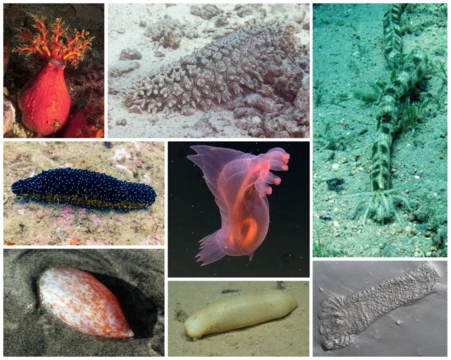
Holothuria poli
A Mediterranean sea cucumber with white-tipped tubercles and anti-Lessepsian migration.

The white spot cucumber, *Holothuria (Roweothuria) poli*, belongs to the family Holothuridae and the subgenus Roweothuria. Italian doctor and naturalist Stefano delle Chiaje first described this sea cucumber in 1824. Its known range covers the Mediterranean Sea, the Red Sea, and the Bay of Biscay. The species likely reached the Red Sea through anti-Lessepsian migration, with its larvae passing via the Suez Canal.
This sea cucumber has a cylindrical body, reaching about 25 cm (10 in) in length and 5 cm (2 in) in width. A crown of retractable tentacles surrounds the mouth at the front end, while the cloacal opening sits at the rear. Its thick, leathery skin contains embedded calcareous sclerites and displays blackish spots on a mottled brown and grey background. The underside is somewhat paler than the upper side, which bears numerous low tubercles tipped with white. Longitudinal rows of tube feet secrete mucus that attracts sand and detritus, often hiding the animal’s appearance. This species is frequently mistaken for *Holothuria tubulosa*, which shares a similar distribution.
*Holothuria poli* inhabits the East Atlantic Ocean between the Canary Islands and the Bay of Biscay, as well as the Mediterranean and Red Seas. It lives on the seabed, usually at depths down to about 20 m (70 ft), though off the coast of Tunisia it has been observed on muddy substrates at much greater depths, from 80 to 250 m (260 to 820 ft). It occurs on sand or rock and favors seagrass meadows and areas with green seaweed like *Caulerpa*.
As a limnivore, this sea cucumber uses its oral tentacles to gather sediment and shovel detritus into its mouth. The gut sorts the material: organic particles are digested, while sand and other indigestible matter mix with mucus and form into balls, which are expelled through the anus in a string. Calculations show that sea cucumbers in a square meter of sand can process nearly 20 kg (44 lb) of sediment per year. The worm-like sea snail *Entoconcha mirabilis* sometimes parasitizes this species. Few predators threaten it, thanks to its thick leathery skin and the bony sclerites in its integument.
The sexes are separate, and reproduction occurs between November and January. Individuals rear up into L-shaped postures to release clouds of gametes into the water, with some synchronization mechanism apparently timing this release.
Quick Facts
- Genus
- Holothuria
- Species
- poli
Facts from the source article.
Lore & Background
Holothuria poli is cylindrical, growing to about 25 cm in length and 5 cm in width. At the anterior end is a crown of retractable tentacles surrounding the mouth; at the posterior end is the cloacal opening. The thick leathery skin contains embedded calcareous sclerites and has blackish spots on a mottled background of brown and grey. The ventral surface is paler than the dorsal surface, which has numerous low tubercles tipped with white. Longitudinal rows of tube feet exude mucus to which sand and detritus adhere, often concealing the animal's appearance. This species is often confused with Holothuria tubulosa, which has a similar distribution.
It inhabits the seabed, usually at depths down to about 20 m, but has been observed on a muddy substrate off the coast of Tunisia at much greater depths (80 to 250 m). It is found on sand or rock, and favours seagrass meadows and areas with green seaweed such as Caulerpa. The species is a limnivore, using tentacles to gather sediment and shovel detritus into its mouth. Organic particles are digested, while sand and indigestible material are mixed with mucus and voided as balls. It has been calculated that the sea cucumbers in a square metre of sand can process nearly 20 kg of sediment in a year. This sea cucumber is sometimes parasitised by the worm-like sea snail Entoconcha mirabilis. It has few predators because of its thick leathery skin and bony sclerites. The sexes are separate, and reproduction takes place between November and January, with animals rearing up in L-shaped postures to release gametes; there seems to be some synchronisation mechanism. Larvae are planktonic before settling and metamorphosing into juveniles.
Reader's Guide
Holothuria poli is notable as a species of sea cucumber first described in 1824 by Stefano delle Chiaje, an Italian doctor and naturalist. Its distribution across the Mediterranean Sea, Red Sea, and Bay of Biscay highlights its adaptability, with its occurrence in the Red Sea attributed to anti-Lessepsian migration of larvae through the Suez Canal. The species plays a significant ecological role as a limnivore, processing nearly 20 kg of sediment per square metre per year, thereby contributing to nutrient cycling and sediment turnover in its habitats, which include seagrass meadows and areas with green seaweed such as Caulerpa. Its thick leathery skin and calcareous sclerites provide defense against predators, and it is occasionally parasitised by the sea snail Entoconcha mirabilis. The species is often confused with Holothuria tubulosa, indicating taxonomic challenges. Its reproductive strategy involves synchronized spawning between November and January, with planktonic larvae that disperse before settlement. The species' ability to inhabit depths from shallow waters down to 250 m off Tunisia demonstrates its ecological flexibility. Overall, H. poli is a key component of benthic communities in its range, with its sediment-processing activities and migratory history contributing to its scientific interest.
Did You Know?
- Holothuria poli was first described in 1824 by Italian doctor and naturalist Stefano delle Chiaje.
- Its presence in the Red Sea is likely due to anti-Lessepsian migration of larvae through the Suez Canal.
Frequently Asked Questions
What is Holothuria poli?
Holothuria poli, commonly called the white spot cucumber, is a Mediterranean sea cucumber in the family Holothuridae that was first formally described by Italian naturalist Stefano delle Chiaje in 1824. It is classified within the subgenus Roweothuria.
What does Holothuria poli look like?
It has a cylindrical body that can grow to roughly 25 cm in length and 5 cm in width, covered in distinctive white-tipped tubercles. A ring of retractable tentacles surrounds its mouth at the front end.
Where can you find Holothuria poli?
Its known range spans the Mediterranean Sea, the Bay of Biscay, and the Red Sea. The Red Sea population is believed to have arrived through anti-Lessepsian migration, with larvae drifting in via the Suez Canal.
How deep does Holothuria poli typically live?
Under normal conditions it is usually encountered at depths down to about 20 metres. However, observations off Tunisia have recorded individuals at considerably greater depths, between 80 and 250 metres.
Why is Holothuria poli notable among sea cucumbers?
Its anti-Lessepsian migration into the Red Sea makes it a well-known example of species movement through the Suez Canal. Combined with its striking white-tipped tubercles and its 1824 description by delle Chiaje, it remains one of the more recognisable Mediterranean holothurians.
More in Sea Cucumbers and Brittle Stars, Part 3 1-24
Spotted an error? Know more?
Reader corrections go straight into our review queue. Suggest an edit · How this site is sourced