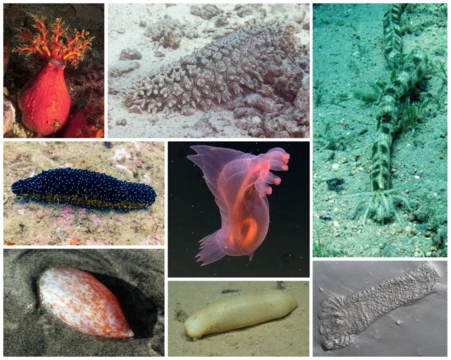
Stichopus naso
A tropical sea cucumber with erect tubercles and dual activity patterns.

Stichopus naso is a species of sea cucumber from the family Stichopodidae. It is notable for being both diurnal and nocturnal, unlike most of its sibling species, and for its distinctive large, erect tubercle-like excrescences on the dorsum.
Quick Facts
- Taxon
- Stichopus naso
Facts from the source article.
Lore & Background
Stichopus naso was first discovered in 1867 in the Philippines. The most recent discovery of this species was in 2011 off the coast of Kagoshima, Kyushu, Japan. Its range extends from the Andaman Sea to New Caledonia and southern Japan, including the Philippines and Indonesia.
It is a classical Stichopus, stout and trapezoidal to rectangular in cross-section, with three rows of podia on the ventral face. Its color is uniform or mottled, ranging from sandy to dark brown, with black lines and dots. The dorsum bears large, erect (though retractile) tubercle-like excrescences.
This species is both diurnal and nocturnal, an unusual trait among its sibling species. It lives in tropical waters between 1 and 20 meters depth, often in seagrass beds.
Reader's Guide
Stichopus naso is a species of sea cucumber from the family Stichopodidae, first documented in 1867 in the Philippines. Its most recent recorded discovery occurred in 2011 near Kagoshima, Kyushu, Japan. The species is distributed from the Andaman Sea to New Caledonia and southern Japan, including the Philippines and Indonesia. It inhabits tropical waters at depths of 1 to 20 meters, frequently in seagrass beds. Morphologically, it is a typical Stichopus: stout, trapezoidal to rectangular in cross-section, with three rows of podia on the ventral face. Its coloration is uniform or mottled, from sandy to dark brown, with black lines and dots. A distinctive feature is the presence of large, erect (though retractile) tubercle-like excrescences on the dorsum. Ecologically, it is notable for being both diurnal and nocturnal, unlike most of its sibling species. The species is referenced in the FAO Species Catalogue for Fishery Purposes, indicating its commercial importance among sea cucumbers.
More in Sea Cucumbers and Brittle Stars, Part 3 1-24
Spotted an error? Know more?
Reader corrections go straight into our review queue. Suggest an edit · How this site is sourced