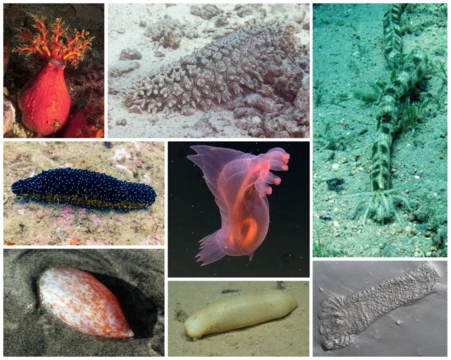
Holothuria pervicax
A sea cucumber known for its inability to survive in captivity.

**Holothuria pervicax**, known as the stubborn sea cucumber, belongs to the genus *Holothuria*. It gets its common name from the fact that it cannot survive in captivity. In the wild, it typically hides under rocks on warm-water reefs.
**Description** This sea cucumber is gray or brown, with red-brown papillae and white tube feet used for movement. Its body is elongated, with an oral-aboral orientation, and can reach up to 30 centimeters in length. The skin is soft and somewhat bumpy. Around the mouth are thin, branched tentacles, and poorly formed spicules are scattered across the body. Telling it apart from its close relative *Holothuria fusconierea* is difficult; the main differences are spicule size and slight color variations. Aquariums have never successfully kept this species alive, leading to the belief that it is highly sensitive and requires very specific conditions.
**Distribution** *Holothuria pervicax* is found in the Maldives, Australia, Cebu (Philippines), Cook Islands, Comoros, French Polynesia, Guam, Hawaii, the Indo-Pacific region, Indonesia, Johnston Atoll, Kenya, Marshall Islands, New Caledonia, Papua New Guinea, Réunion, Somalia, the Sulu Sea, Tanzania, the Cocos Islands, the Seychelles, the Western Indian Ocean, and the Western Pacific Ocean. It prefers habitats under rocks on reefs in warm waters, with temperatures between 24°C and 28.7°C.
**Reproduction** Individuals have separate sexes, each with one gonad. Fertilization and spawning occur externally. The planktonic larvae (auricularia) transform over time into barrel-shaped larvae, which then become juvenile sea cucumbers.
**Diet** These sea cucumbers are suspension and deposit feeders, usually active at night. They use a conveyor-belt feeding method, ingesting the surface of the substrate and defecating on it.
**Ecology** *Holothuria pervicax* has several defenses against predators. It can expel its guts and large amounts of Cuvierian tubules when disturbed. It also releases a toxin called holothurian, which can kill fish, small worms, and mollusks. The toxin may be expelled through the anus or the front of the body, causing rupture of the tentacles, pharynx, and part of the intestine—all of which can regenerate over time. Expulsion through the anus entangles prey, but the tubule is destroyed and takes weeks to regrow.
Quick Facts
- Genus
- Holothuria
- Species
- pervicax
Facts from the source article.
Lore & Background
Holothuria pervicax is described as having an elongated body with an oral-aboral orientation, a soft epidermis, and a somewhat bumpy body. Its mouth is surrounded by thin branched tentacles with poorly formed spicules found around the body. Distinctions between H. pervicax and its sister species fusconierea are hard to find, but the main differences are spicule size and slight coloration differences. Aquariums have had a very hard time keeping these animals alive and have yet to successfully keep one in captivity, earning this species the name 'stubborn sea cucumber'. This has led to the belief that this animal is highly sensitive and requires a very specific lifestyle in order to survive. Sexes are separate in these cucumbers, with individuals having one gonad. Fertilization and spawning happen externally. Their planktonic larvae (auricularia) morph with age into barrel-shaped larvae and then finally into juvenile sea cucumbers. Sea cucumbers are effective suspension and deposit feeders, typically becoming active feeding at night. They have conveyor belt feeding methods where they ingest the substrate's surface and defecate on it.
Reader's Guide
Holothuria pervicax has many defense mechanisms to fight against being preyed upon. It is able to expel its guts as well as large amounts of Cuvierian tubules when disturbed. These cucumbers can release a toxin called holothurian that has the ability to kill fish, small worms, and mollusks. It can be released through the anus or the front of the body, causing rupture of the tentacles, pharynx, and part of the intestine that can be regenerated over time. Expulsion through the anus is used to entangle prey, but the tubule is destroyed in the process and takes weeks to regenerate. The toxin may be expelled after the cucumber dies, if it gets damaged, or if an animal is picking at it. Change in temperature or salinity will cause release of the toxin, and it only takes about 5 minutes to kill a fish, which explains why this species is so hard to keep in captivity. Research has found that this cucumber secretes a biologically active glycosphingolipid HPG-7 that is a major component of cell membranes. Glycosphingolipids function as antigens, mediators of cell adhesion, and aid signal transduction. Sea cucumbers have high commercial value due to their production of nutrients such as vitamins A, B1, B2, and B3, and minerals such as calcium, magnesium, iron and zinc. Many of these nutrients can be used in pharmaceutical medicines such as anti-angiogenic, anticancer, anticoagulant, anti-hypertension, anti-inflammatory, antimicrobial, antioxidant, antithrombotic, antitumor and wound healing.
Did You Know?
- Holothuria pervicax is commonly called the stubborn sea cucumber because it cannot be kept alive in captivity.
- It can release a toxin called holothurian that kills fish in about 5 minutes.
- Its planktonic larvae (auricularia) morph into barrel-shaped larvae and then into juvenile sea cucumbers.
- The species secretes a biologically active glycosphingolipid HPG-7, a major component of cell membranes.
Frequently Asked Questions
What is Holothuria pervicax?
Holothuria pervicax is a species of sea cucumber in the genus Holothuria, commonly nicknamed the stubborn sea cucumber. It is an elongated, soft-bodied echinoderm that can grow to roughly 30 centimeters in length.
Why is Holothuria pervicax called the stubborn sea cucumber?
The common name reflects the fact that this species simply cannot be kept alive in captivity. No matter what aquarium conditions are set up, the animal refuses to survive outside its natural reef habitat.
What does Holothuria pervicax look like?
Its body is gray or brown, covered with red-brown papillae and white tube feet, and has a soft, slightly bumpy texture. Thin, branched tentacles surround the mouth, and poorly formed spicules are scattered across the surface.
Where can you find Holothuria pervicax in the wild?
It shelters beneath rocks on warm-water reefs, thriving at temperatures between 24 °C and 28.7 °C. Its range spans the Indo-Pacific, appearing in locations from the Maldives and Australia to Hawaii, the Philippines, and numerous Pacific and Indian Ocean island groups.
How big does Holothuria pervicax get?
This sea cucumber reaches a maximum length of 30 centimeters. Its body is distinctly elongated along the oral-aboral axis, giving it a long, cylindrical silhouette.
More in Sea Cucumbers and Brittle Stars, Part 3 1-24
Spotted an error? Know more?
Reader corrections go straight into our review queue. Suggest an edit · How this site is sourced