Holothuria thomasi
Largest western Atlantic sea cucumber, camouflaged until 1980.

Holothuria thomasi, called the tiger's tail, is a sea cucumber belonging to the family Holothuriidae. It holds the record as the largest sea cucumber in the western Atlantic, but its excellent camouflage meant scientists did not formally describe it until 1980. Its full scientific name is Holothuria (Thymiosycia) thomasi, placing it in the subgenus Thymiosycia.
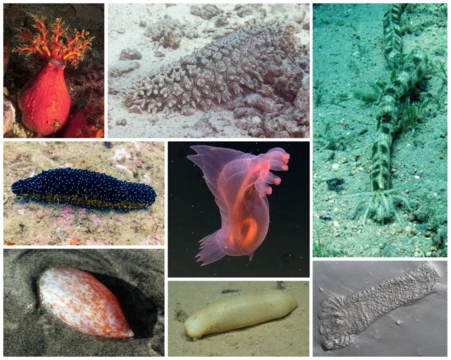
This species gets its common name from its tiger-like appearance. Its body is a long, rounded cylinder with blunt ends, reaching up to 2 meters in length. The skin is mottled with dark brown, golden brown, and white patches and streaks, sometimes forming irregular rings. The upper side bears dark brown, thorn-like projections called papillae, each tipped with white. The underside is lighter in color and has several lengthwise rows of tube feet. The animal lacks eyes; its mouth sits at the front end, ringed by about twenty shield-shaped tentacles. When feeding, this front end expands. Small individuals move around freely, but larger ones hide in crevices or under overhangs and are rarely seen.
The tiger's tail lives in the Caribbean Sea, the Gulf of Mexico, and nearby waters. It inhabits coral reefs, concealed among the bases of corals at depths between 3 and 30 meters. Its preferred spot is the outer reef's escarpments, between the outer ridge and the steep reef slopes.
As a scavenger, it anchors its rear end firmly in a crack or under a rock. It then sweeps the front third of its body over the surrounding sand and algae-covered rocks. Its tentacles grab detritus, sand, gravel, and algae, pushing them into its mouth. The material passes through its gut, and the animal expels the indigestible fragments through its anus.
Quick Facts
- Taxon
- Holothuria thomasi
Facts from the source article.
Lore & Background
Holothuria thomasi receives its vernacular name from its resemblance to a tiger's tail. It takes the form of an elongated cylinder with rounded ends and can reach 2 metres long. It is mottled with patches and streaks of dark brown, golden brown and white, sometimes with irregular rings of colour. On the upper side there are papillae, thornlike projections, which are dark brown tipped with white. The underside is paler and has several longitudinal rows of tube feet. The animal has no eyes and the mouth is at the anterior end surrounded by a fringe of about 20 shield-shaped tentacles. When it is feeding, this end is enlarged. When small, individuals move about freely, but larger ones conceal themselves in crevices or under projections and are seldom seen.
Holothuria thomasi is found in the Caribbean Sea, the Gulf of Mexico and surrounding areas. It lives on coral reefs, hidden among the bases of corals at depths of 3 metres to 30 metres. Its favoured habitat is the escarpments of the outer reef, between the outer ridge and the steep reef slopes.
Holothuria thomasi is a scavenger. Keeping its posterior end firmly anchored in a crack or underneath a rock, it sweeps the surrounding sand and algae-covered rocks with the front third of its body. The tentacles grab the detritus, sand, gravel and algae that it encounters and pushes them into its mouth. It then processes this material in its gut and expels the inedible fragments through its anus.
Reader's Guide
Holothuria thomasi holds significance as the largest sea cucumber known in the western Atlantic Ocean, yet its remarkable camouflage delayed its scientific description until 1980. Its tiger-like coloration and thornlike papillae contribute to its cryptic appearance, allowing it to remain hidden among coral reef escarpments. The species is a scavenger, using a unique feeding method where it anchors its posterior end and sweeps the surrounding substrate with its tentacles. Its habitat is restricted to coral reefs in the Caribbean Sea and Gulf of Mexico, at depths between 3 and 30 metres. The fact that such a large animal evaded discovery for so long underscores the effectiveness of its camouflage and the challenges of studying reef ecosystems. Its placement in the subgenus Thymiosycia further situates it within the broader taxonomy of Holothuriidae. The species' behavior—small individuals moving freely while larger ones remain concealed—adds to its ecological interest.
Did You Know?
- It was first described in 1980 due to its effective camouflage.
- Its vernacular name comes from its resemblance to a tiger's tail.
- It has no eyes and uses about 20 shield-shaped tentacles to feed.
Frequently Asked Questions
What is Holothuria thomasi?
Holothuria thomasi is a sea cucumber in the family Holothuriidae, placed in the subgenus Thymiosycia under the full name Holothuria (Thymiosycia) thomasi. It holds the title of the largest sea cucumber found in the western Atlantic.
Why is it called the "tiger's tail"?
The common name comes from its mottled skin of dark brown, golden brown, and white patches and streaks that evoke a tiger's coat. Its long, rounded cylindrical body with blunt ends reinforces the tiger-tail resemblance.
How big does Holothuria thomasi get?
This species can grow to a maximum length of roughly two meters, or about 6 feet 7 inches. That size makes it the biggest sea cucumber recorded in the western Atlantic.
When was Holothuria thomasi first formally described?
Its effective camouflage kept it overlooked by scientists for a long time, and it was not formally described until 1980. That delay is notable given that it is the largest sea cucumber in its region.
At what depths does Holothuria thomasi live?
This sea cucumber is found at depths ranging from about 3 meters (roughly 10 feet) down to 30 meters (about 98 feet) in the western Atlantic.
More in Sea Cucumbers and Brittle Stars, Part 3 1-24
Spotted an error? Know more?
Reader corrections go straight into our review queue. Suggest an edit · How this site is sourced