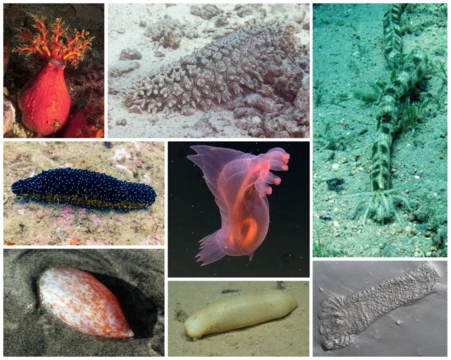
Holothuria whitmaei
Black teatfish, a high-value sea cucumber in Pacific beche-de-mer trade.

Holothuria (Microthele) whitmaei, called the black teatfish, belongs to the sea cucumber family Holothuriidae. This species lives in the western Indian and Pacific Oceans, with recorded locations off Tanzania, New Caledonia, and the Philippines. Groups typically contain between five and twenty-five individuals.
H. whitmaei is now recognized as a distinct species, separate from H. nobilis, which once included it. Studies of two populations—one on the Great Barrier Reef and another on Ningaloo Reef—tracked seasonal patterns. The gonad index peaked from April to June. Microscopic and tissue analysis showed that large germinal tubules at the center of the gonad base move through four maturity stages: growing (II), mature (III), partly spawned (IV), and spent (V). In a 2003 study, researchers could not explain why up to 23% of H. whitmaei specimens stayed hidden from sometime during the night until midday. However, another ecological study found that marked specimens became significantly more active in the first hours after marking, suggesting the marking process itself may skew results. A daytime study of thirty black teatfish on Ningaloo Reef revealed that the proportion of animals sheltered—and thus hidden when viewed from directly above—was much higher in the morning than in the afternoon. A separate study, using both marked and unmarked individuals, recorded peak activity between 2:30 and 5:30 PM.
Many sea cucumbers are boiled, dried, and processed into beche-de-mer, a valuable trade product in Pacific countries and communities, especially Papua New Guinea, the Solomon Islands, Australia, and Fiji. H. whitmaei ranks among the highest-value species; well-dried, A-grade product can sell for US$70–190 per kilogram, depending on size and quality. Since 2009, a moratorium due to overproduction has halted supply from Papua New Guinea. Fiji, by contrast, exports 243 tons of sea cucumber food annually.
Quick Facts
- Genus
- Holothuria
- Species
- whitmaei
Facts from the source article.
Lore & Background
Holothuria whitmaei is now classified as a separate species from H. nobilis, having previously been included in that species. Seasonal trends from two populations, between the Great Barrier Reef and Ningaloo Reef, showed that the gonad index peaks between April and June. Macroscopic and histological analysis revealed that large germinal tubules, positioned centrally on the gonad basis, progress through four maturity stages: growing (II), mature (III), partly spawned (IV), and spent (V).
Diurnal studies of 30 black teatfish on the Ningaloo Reef found that the proportion of animals sheltered (hidden when viewed from directly above) was significantly greater in the morning relative to the afternoon. A different study found that marked and unmarked specimens were most active between 2:30 and 5:30 pm. In one study in 2003, researchers were unsure why up to 23% of H. whitmaei specimens were hidden from some time during the night until midday. Another study noted that rates of activity in marked specimens increased significantly in the initial hours after marking, suggesting that marking likely compromises the research.
Reader's Guide
Holothuria whitmaei holds significance as a high-value species in the beche-de-mer trade, a processed and dried sea cucumber commodity. The article notes that well-dried A grade product may command a price of $US 70–190 per kg depending on size and quality. This trade is very important and profitable in many Pacific countries and communities, particularly Papua New Guinea, the Solomon Islands, Australia, and the Fiji Islands. However, a moratorium due to overproduction has prevented supply from Papua New Guinea since 2009. Fiji, in contrast, exports 243 tons of sea cucumber food per year. The species' ecological behavior, including diurnal sheltering patterns and activity peaks in the late afternoon, has been studied, though researchers noted that marking specimens may compromise the accuracy of activity data. The species' classification as distinct from H. nobilis and its reproductive seasonality (gonad index peaking April–June) contribute to its biological and commercial profile.
Did You Know?
- The gonad index of H. whitmaei peaks between April and June.
- Well-dried A grade H. whitmaei may command a price of $US 70–190 per kg.
Frequently Asked Questions
What is Holothuria whitmaei?
Holothuria whitmaei, commonly called the black teatfish, is a sea cucumber species in the family Holothuriidae. It is now recognized as its own distinct species rather than being subsumed under H. nobilis, as earlier classifications did.
Where does Holothuria whitmaei live in the wild?
The black teatfish ranges across the western Indian and Pacific Oceans, with documented records off Tanzania, New Caledonia, and the Philippines. Australian reef sites such as the Great Barrier Reef and Ningaloo Reef also host populations.
How do Holothuria whitmaei individuals live socially?
Rather than roaming alone, black teatfish typically form modest aggregations of about five to twenty-five individuals. These small group sizes have been noted consistently across the species' range.
When does Holothuria whitmaei breed?
Seasonal monitoring on the Great Barrier Reef and Ningaloo Reef shows the gonad index reaching its peak from April through June. Researchers distinguish five maturity stages, progressing from growing (stage II) through mature, partly spawned, and fully spent (stage V).
What is Holothuria whitmaei worth in the beche-de-mer trade?
As a high-value species in the Pacific beche-de-mer market, well-dried A-grade product commands roughly US $70 to $190 per kilogram. Fiji's annual export of about 243 tons of sea cucumber product highlights the species' significant economic role.
More in Sea Cucumbers and Brittle Stars, Part 3 1-24
Spotted an error? Know more?
Reader corrections go straight into our review queue. Suggest an edit · How this site is sourced