Synthetic element
Last updated
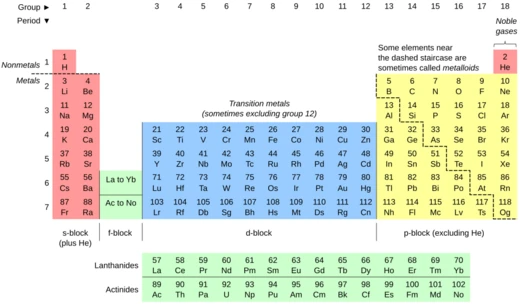
A synthetic element is a chemical element that does not occur naturally on Earth and is created by human manipulation of fundamental particles.[1] These elements are unstable and radioactive, decaying into other elements.[2] Twenty-four elements with atomic numbers ranging from 95 to 118, first produced between 1944 and 2010, are classified as synthetic.[1]
Quick Facts
- Number of synthetic elements
- 24
- Atomic number range
- 95–118
- First synthetic element created
- Curium (1944)
- Shortest half-life listed
- Bohrium-270 (approximately 61 seconds)
Facts from the source article.
Key facts and history
The first element to be synthesized, rather than discovered in nature, was technetium in 1937.[3] All elements with atomic number greater than 94 decay quickly enough that any atoms from Earth's formation have long since decayed.[4] Curium, created in 1944 through the bombardment of plutonium with alpha particles, was the first element made entirely by artificial means.[5] In 1952, einsteinium and fermium were identified within the radioactive fallout from the first hydrogen bomb explosion.[6]
Plutonium has the highest atomic number of any element found in nature, but its natural abundance is so low that artificial production is much more practical.[7] The primary applications of plutonium are in nuclear weapons and nuclear reactors.[7]
What the research sources say
Kulkarni's account states that synthetic elements are produced by the process of nuclear fusion, using nuclear reactors or particle accelerators.[2] In particle accelerators, nuclei of two elements collide at high speed and merge to form a larger element.[2] The Infoplease entry notes that elements 101 through 106 were first produced by fusing nuclei of slightly lighter elements with those of light elements like carbon.[8] Transfermium elements are produced in very small quantities, often one atom at a time.[8]
Bradford also states that plutonium, along with all other transuranium elements, is a radiological hazard requiring specialized handling.[9] Kulkarni's list includes technetium, promethium, astatine, francium, and all transuranium elements as synthetic.[2]
References
- Wikipedia, "Synthetic element" (CC BY-SA 4.0), which cites: Kulkarni, "A Complete List of Man-made Synthetic Elements", ScienceStuck, 15 June 2009 (we also read that source) en.wikipedia.org
- Kulkarni, "A Complete List of Man-made Synthetic Elements", ScienceStuck, 15 June 2009. facts only, no text reused. sciencestruck.com
- Wikipedia, "Synthetic element" (CC BY-SA 4.0), which cites: Helmenstine, "Technetium or Masurium Facts", ThoughtCo; "Technetium decay and its cardiac application", Khan Academy; Stewart, "Technetium Element Facts", Chemicool; Bentor, "Periodic Table: Technetium", Chemical Elements; Hammond, "Handbook of Chemistry and Physics", CRC press, 2004; Moore, "Technetium in the Sun", Science, 1951, p. 59–61; Dixon, "Analysis of Naturally Produced Technetium and Plutonium in Geologic Materials", Analytical Chemistry, 1997, p. 1692–9; Curtis, "Nature's uncommon elements: plutonium and technetium", Geochi en.wikipedia.org
- Wikipedia, "Synthetic element" (CC BY-SA 4.0), which cites: Redd, "How Was Earth Formed?", Space.com, November 2016; "Synthetic elements", Infoplease; Kulkarni, "A Complete List of Man-made Synthetic Elements", ScienceStuck, 15 June 2009 (we also read that source) en.wikipedia.org
- Wikipedia, "Synthetic element" (CC BY-SA 4.0), which cites: Krebs, Robert E. The history and use of our earth's chemical elements: a reference guide, Greenwood Publishing Group, 2006, p. 322; Hall, "The New Chemistry: A Showcase for Modern Chemistry and Its Applications", Cambridge University Press, 2000, p. 8–9 (original not read by us) en.wikipedia.org
- Wikipedia, "Synthetic element" (CC BY-SA 4.0), which cites: Ghiorso, "Einsteinium and Fermium", Chemical & Engineering News Archive, 2003, p. 174–175 (original not read by us) en.wikipedia.org
- Wikipedia, "Synthetic element" (CC BY-SA 4.0), which cites: Bradford, "Facts About Plutonium", LiveScience, 8 December 2016 (we also read that source) en.wikipedia.org
- "Synthetic elements", Infoplease. facts only, no text reused. infoplease.com
- Bradford, "Facts About Plutonium", LiveScience, 8 December 2016. facts only, no text reused. livescience.com
Each numbered sentence above was checked against the source it cites before publication. Sentences citing Wikipedia adapt text from the English Wikipedia article Synthetic element (contributors), used under CC BY-SA 4.0; this entry is available under the same licence. Other sources were used for facts only; no text or images are copied from them.
More in Periodic Table & Elements
Sources
Compiled from Wikipedia and the sources listed below. Text from Wikipedia is available under CC BY-SA 4.0; this entry is adapted from it.
- Wikipedia: Synthetic element (CC BY-SA 4.0).
- Word definitions: the Codexery glossary, each quoted from its Wikipedia article.
Spotted an error? Know more?
Reader corrections go straight into our review queue. Suggest an edit · How this site is sourced