Genetic drift
Random change in allele frequencies across generations.

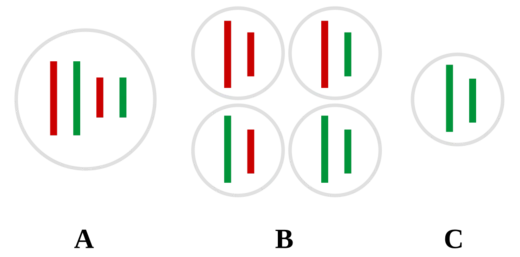
Genetic drift is the change in the frequency of an existing allele in a population due to chance. It may cause alleles to disappear completely, reducing genetic variation, or cause initially rare alleles to become much more frequent, possibly leading to fixation. The process is illustrated by analogy with marbles in a jar, where random sampling from one generation to the next produces fluctuations in allele frequencies.
- field
- Population genetics
- key_concept
- Change in allele frequency due to chance
- associated_figures
- Ronald Fisher, Motoo Kimura
- models
- Wright–Fisher model, branching processes, diffusion equation
- neutral_theory
- Motoo Kimura's neutral theory of molecular evolution (1968)
Lore & Background
In the middle of the 20th century, vigorous debates occurred over the relative importance of natural selection versus neutral processes, including genetic drift. Ronald Fisher, who explained natural selection using Mendelian genetics, held the view that genetic drift plays at most a minor role in evolution, and this remained the dominant view for several decades. In 1968, population geneticist Motoo Kimura rekindled the debate with his neutral theory of molecular evolution, which claims that most instances where a genetic change spreads across a population (although not necessarily changes in phenotypes) are caused by genetic drift acting on neutral mutations.
Reader's Guide
Genetic drift is a fundamental mechanism of evolution distinct from natural selection. Its significance lies in demonstrating that random sampling can alter allele frequencies, especially in small populations, leading to loss of genetic variation or fixation of alleles. The Wright–Fisher model provides a mathematical framework for understanding these changes, assuming non-overlapping generations and random independent draws of gene copies. The debate between Fisher and Kimura highlighted the tension between selectionist and neutralist views, with Kimura's neutral theory arguing that most molecular evolution is driven by drift rather than selection. This shifted the focus of evolutionary biology toward understanding the role of chance in genetic change. The marble-in-a-jar analogy and the bacterial bottleneck example illustrate how drift can occur even in populations starting with equal allele frequencies, often producing unequal outcomes. The concept remains central to population genetics, conservation biology, and the study of molecular evolution.
Did You Know?
- Genetic drift can cause alleles to disappear completely, reducing genetic variation.
- In the Wright–Fisher model, generations do not overlap and each gene copy in the new generation is drawn independently at random from the old generation.
- The probability of obtaining k copies of an allele with frequency p in the last generation is given by (2N)!/(k!(2N−k)!) p^k q^(2N−k).
- In a bacterial bottleneck example with four survivors, the probability of unequal numbers of A and B alleles is 10/16, while equal numbers have probability 6/16.
More in Genetics 1-24
Spotted an error? Know more?
This is a living reference — every entry is fact-audited, and reader corrections feed straight into our audit queue. Suggest an edit · See this site's audit record