Complementary DNA
DNA reverse transcribed from RNA for research and viral replication.

explorebiology · CC BY 4.0
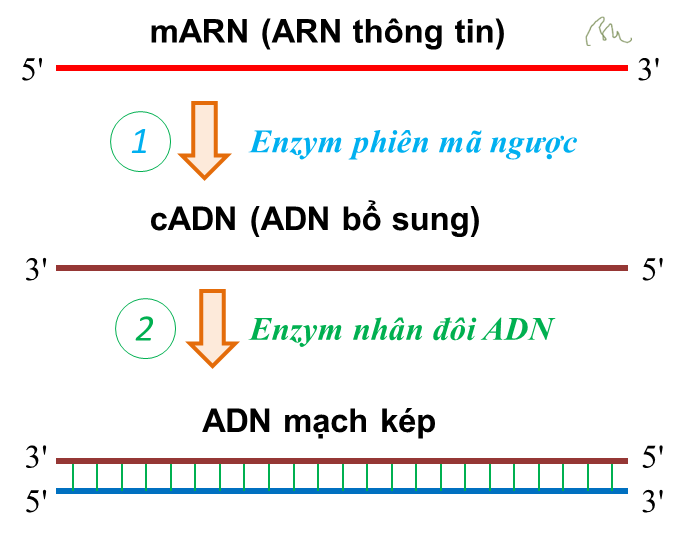
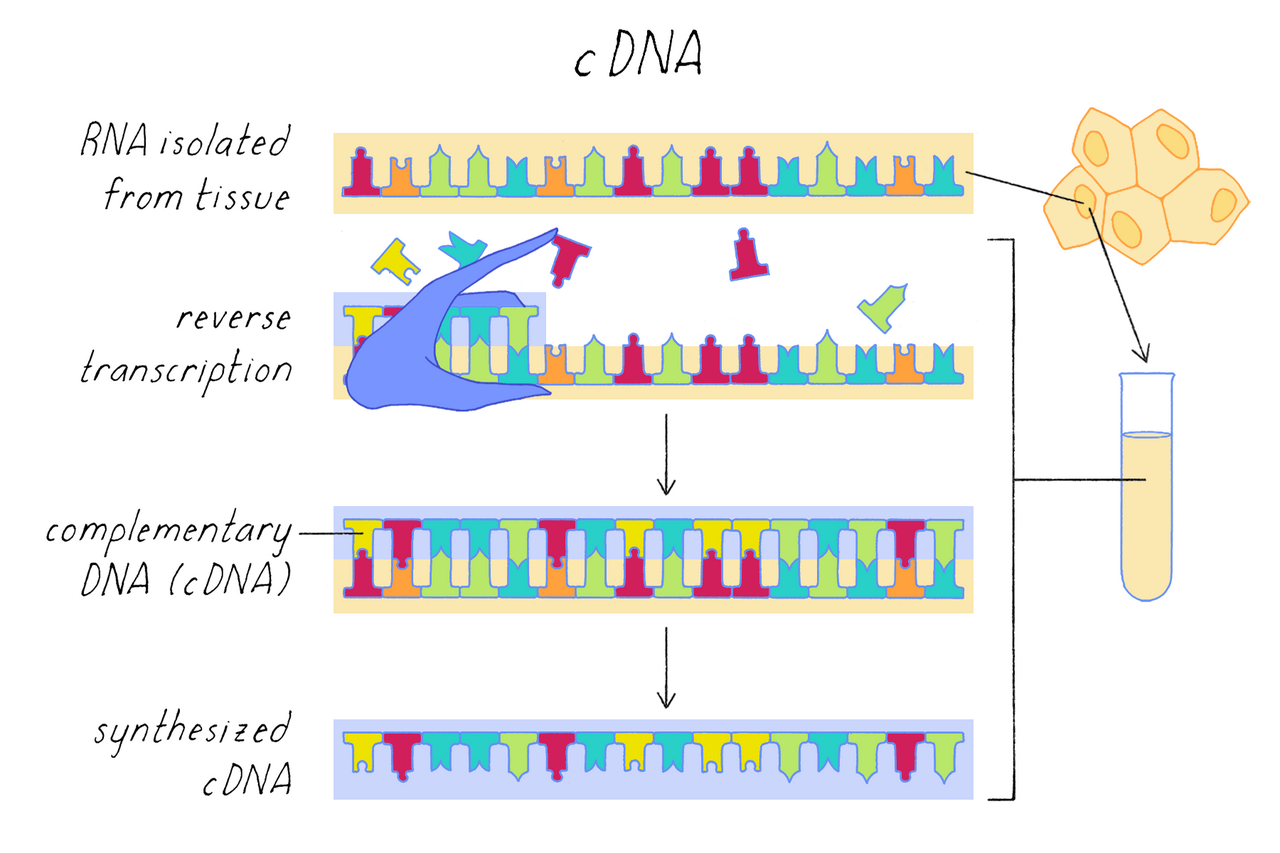
Complementary DNA (cDNA) is DNA that is reverse transcribed from RNA via the enzyme reverse transcriptase. It exists in both single-stranded and double-stranded forms and can be either natural or engineered. In molecular biology, engineered cDNA is widely used to express specific proteins in cells that do not normally produce them, to sequence or quantify mRNA, and to analyze transcriptomic profiles. Natural cDNA is produced by retroviruses and retrotransposons for integration into host genomes.
- field
- Genetics, Molecular Biology
- known_for
- Reverse transcription of RNA into DNA for gene expression analysis, cloning, and viral replication
- patent_status
- Exons-only cDNA ruled patent-eligible by US Supreme Court in 2013 (Association for Molecular Pathology v. Myriad Genetics, Inc.)
- synthesis_enzymes
- M-MLV reverse transcriptase (Moloney murine leukemia virus) and AMV reverse transcriptase (avian myeloblastosis virus)
- applications
- Heterologous expression, qPCR, RNA-seq, microarrays, cDNA library creation
Lore & Background
cDNA is synthesized from RNA templates using reverse transcriptase enzymes. In molecular biology, RNA is first purified from source material by lysing cells and using methods such as phenol-chloroform extraction, silica columns, or bead-based techniques. Chaotropic agents like guanidinium isothiocyanate or SDS are used to inactivate RNases and maintain RNA integrity. First-strand cDNA synthesis uses reverse transcriptase and primers such as oligo-dT (which binds to the poly-A tail of mRNA) or random hexamers. Second-strand synthesis can be performed via the Gubler and Hoffman procedure using E. coli RNase H, DNA Polymerase I, and DNA Ligase, or through optimized methods that reduce sequence loss at the 5' end.
Reader's Guide
Complementary DNA is a foundational tool in molecular biology, enabling the study of gene expression and protein production without the complications of introns. By reverse transcribing mRNA into cDNA, researchers can clone genes, create cDNA libraries, and quantify transcripts using methods like RT-qPCR and RNA-seq. The US Supreme Court's 2013 decision in Association for Molecular Pathology v. Myriad Genetics, Inc. established that exons-only cDNA is patent-eligible, distinguishing it from naturally occurring genomic DNA. In nature, retroviruses such as HIV use cDNA to integrate their RNA genomes into host DNA, forming proviruses. Retrotransposons also generate cDNA to move within eukaryotic genomes. The ability to produce cDNA from specific RNA templates has revolutionized genetic engineering, allowing heterologous expression of proteins in bacterial or yeast systems and enabling detailed transcriptomic analysis at the bulk tissue, single-cell, or single-nucleus level.
Did You Know?
- cDNA is produced by retroviruses such as HIV-1, HIV-2, and simian immunodeficiency virus, and is integrated into the host genome as a provirus.
- The US Supreme Court ruled in 2013 that exons-only cDNA is patent-eligible, while isolated naturally occurring DNA with introns is not.
- M-MLV reverse transcriptase from Moloney murine leukemia virus is commonly used for first-strand cDNA synthesis due to its reduced RNase H activity.
- cDNA can be generated from mRNA using oligo-dT primers that anneal to the poly-adenylated tail.
What cDNA Is and Where It Appears in Nature
Complementary DNA, commonly abbreviated cDNA, is a strand of DNA generated when an RNA molecule—such as messenger RNA or microRNA—is reverse transcribed by the enzyme reverse transcriptase. Unlike genomic DNA, cDNA can exist as either a single strand or a double strand, and it appears in both naturally occurring and laboratory-engineered contexts. In engineered settings, cDNA essentially mirrors the coding portions of an organism's original genome: because the cell's mRNA was itself transcribed from that genome, running the mRNA back through reverse transcriptase yields a faithful duplicate of the source DNA sequence. In the natural world, cDNA is produced by retroviruses including HIV-1, HIV-2, and simian immunodeficiency virus, which then splice their newly made cDNA into the host cell's genome, establishing what is called a provirus. The abbreviation also carries a lighter, bioinformatics-specific meaning, where it simply denotes an mRNA sequence rewritten using the four DNA bases rather than the RNA alphabet.
From Cell Lysis to Double-Stranded Product
Building cDNA in the laboratory is a multi-step pipeline. The first phase is RNA purification: cells are lysed, and the RNA is separated from genomic DNA, proteins, and other debris using techniques such as phenol-chloroform extraction, silica-column binding, or magnetic bead capture. Plant samples demand extra care; reagents like polyvinylpyrrolidone are added to strip away phenolic compounds and carbohydrates that would otherwise ruin the RNA. Enzymes DNase and Proteinase K degrade contaminating DNA and protein, while chaotropic agents—guanidinium isothiocyanate, sodium dodecyl sulphate, phenol, or chloroform—neutralize RNases to preserve RNA integrity. The purified RNA is then precipitated with alcohol. In the reverse-transcription phase, the M-MLV reverse transcriptase from the Moloney murine leukemia virus is a popular choice for longer templates because of its low RNase H activity, whereas the AMV enzyme from avian myeloblastosis virus handles RNAs with strong secondary structures. Oligo-dT primers bind the poly-adenylated 3' tail of mRNA, and mixing them with random hexamers helps capture full-length transcripts. For second-strand synthesis, the Gubler-Hoffman procedure employs E. coli RNase H to nick the mRNA strand, E. coli DNA Polymerase I to fill in, and DNA Ligase to seal the backbone.
Why Researchers Reach for cDNA Instead of Genomic DNA
One of the most practical reasons cDNA dominates molecular biology is that it strips away the non-coding interruptions—introns—that sit between the protein-coding exons in a full genomic gene. When a scientist wants a recipient cell, perhaps a bacterium or a yeast, to manufacture a protein it would never normally produce (a process called heterologous expression), inserting the cDNA rather than the entire gene avoids those intronic gaps and yields a clean, continuous coding sequence. The same logic applies to gene cloning, the construction of cDNA libraries, and the use of cDNA fragments as gene probes. In modern transcriptomics, cDNA is the essential intermediate for quantifying and sequencing mRNA populations through qPCR, microarrays, and RNA-seq, whether the sample is bulk tissue, individual cells, or isolated nuclei. Partial cDNA reads are catalogued as expressed sequence tags. Once a target region is amplified by PCR with sequence-specific primers, the product can be cleaved at both ends with nucleases and ligated into a small circular expression vector, which then replicates autonomously inside the host and may even integrate into its chromosome.
A Patent Ruling That Drew a Line in the Sand
The legal status of cDNA took a dramatic turn in 2013 when the United States Supreme Court heard Association for Molecular Pathology v. Myriad Genetics, Inc. The central question was whether a synthetic DNA molecule made in a laboratory from a naturally occurring RNA could be treated as a human invention eligible for a patent. The Court's compromise holding drew a clear boundary: cDNA that contains only exons—meaning the introns have been removed during the reverse-transcription process—is patent-eligible, whereas an isolated stretch of naturally occurring genomic DNA that still includes introns is not. The decision effectively recognized that the act of reverse transcription, which requires a human-designed enzyme and a deliberate laboratory procedure, transforms the molecule enough to qualify as a product of human ingenuity, while merely plucking a segment of chromosomal DNA out of a cell does not. This ruling reshaped how biotech companies and academic labs approach the commercialization of gene-based diagnostics and therapeutics, and it remains a touchstone in intellectual-property law for any technology that bridges the gap between a natural biological sequence and a synthetic one.
Gallery
More in Genetics 1-24
Spotted an error? Know more?
This is a living reference — every entry is fact-audited, and reader corrections feed straight into our audit queue. Suggest an edit · See this site's audit record