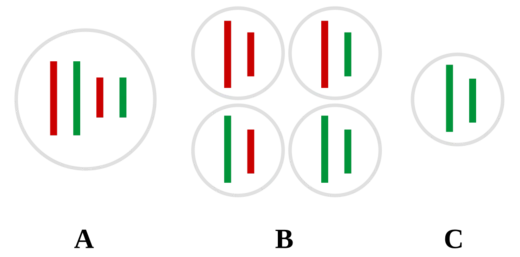
DNA polymerase
Enzymes that synthesize DNA, essential for replication and PCR.

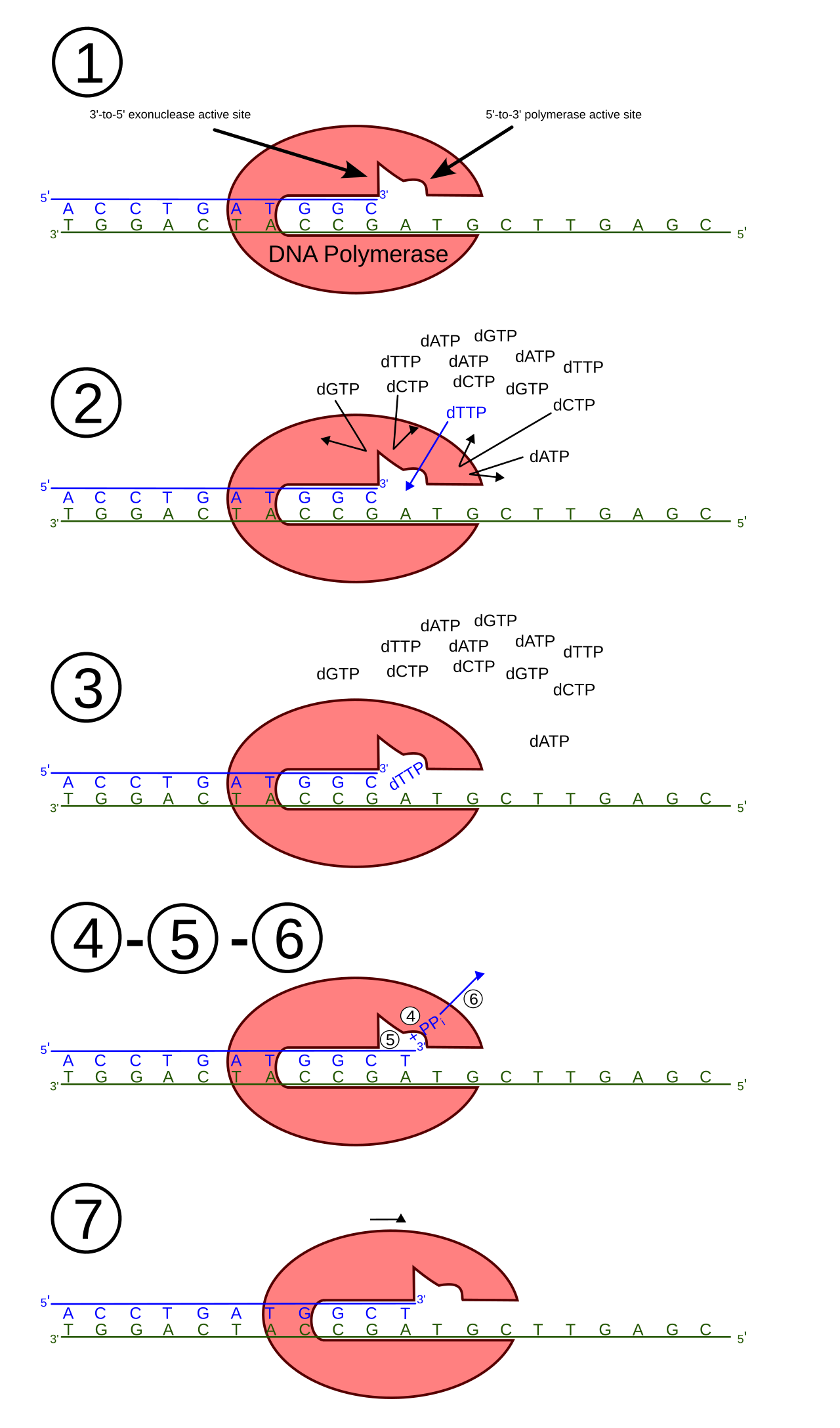
DNA_polymerase.svg : Madprime derivative work: Chandres · CC BY-SA 3.0
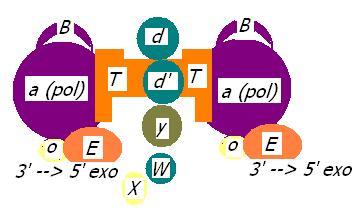
DNA polymerase is an enzyme that builds DNA by linking together nucleoside triphosphates, the raw materials of DNA. It works in teams to copy a single DNA double helix into two identical copies. To do this, it reads the sequence of the original strands and assembles matching new strands. This copying happens every time a cell divides, ensuring each daughter cell gets a complete set of genetic instructions.
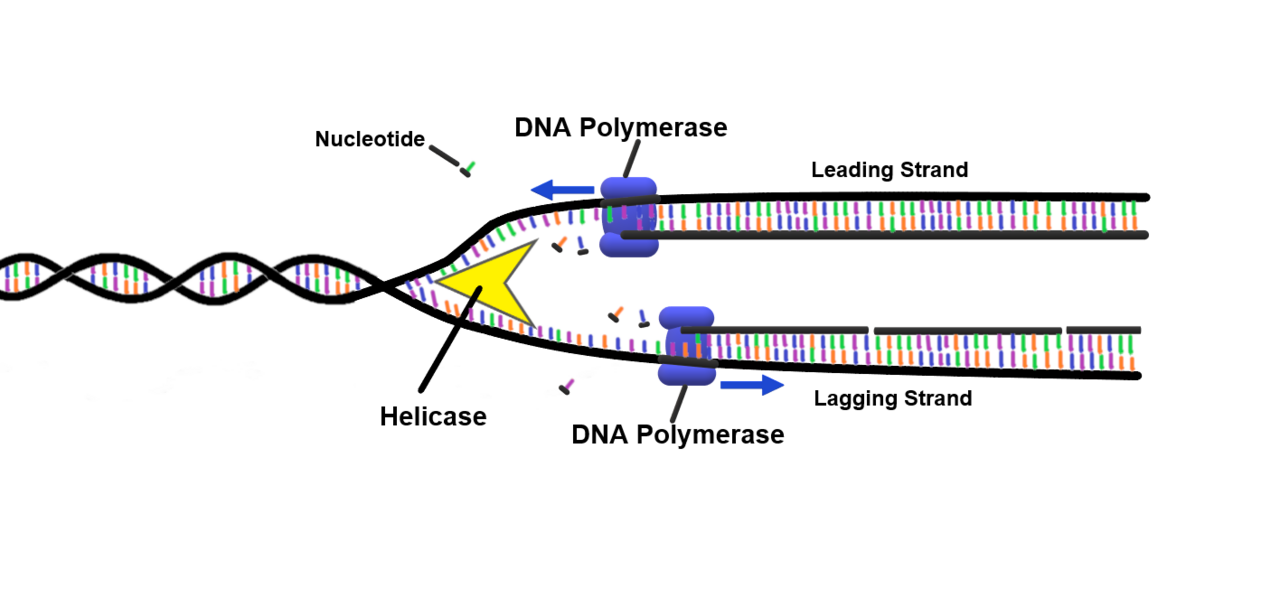
The enzyme adds nucleotides one at a time, always to the 3' end of a growing DNA strand. Before it can start, another enzyme called helicase unwinds the double helix by breaking the hydrogen bonds between bases, unzipping it into two single strands that serve as templates.
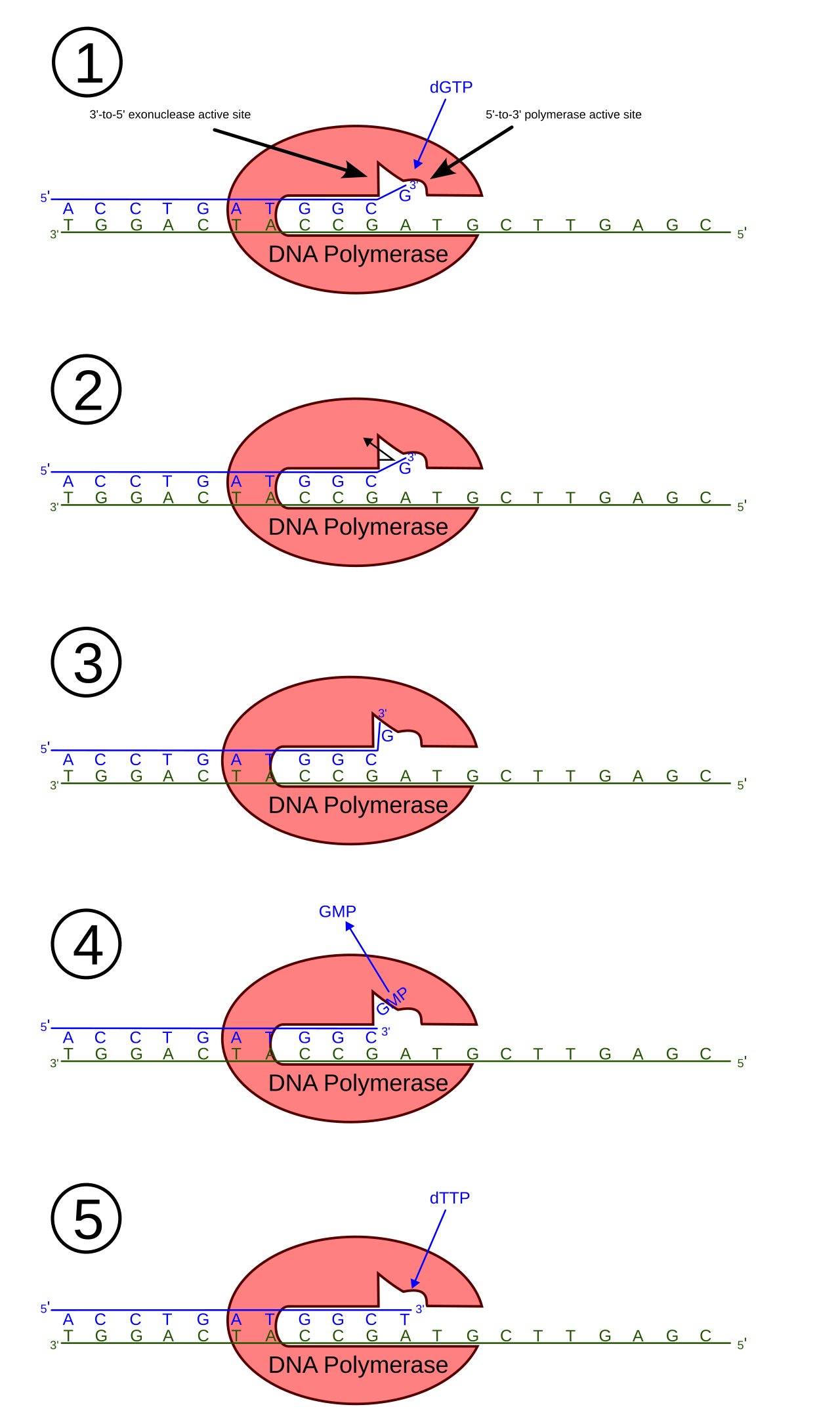
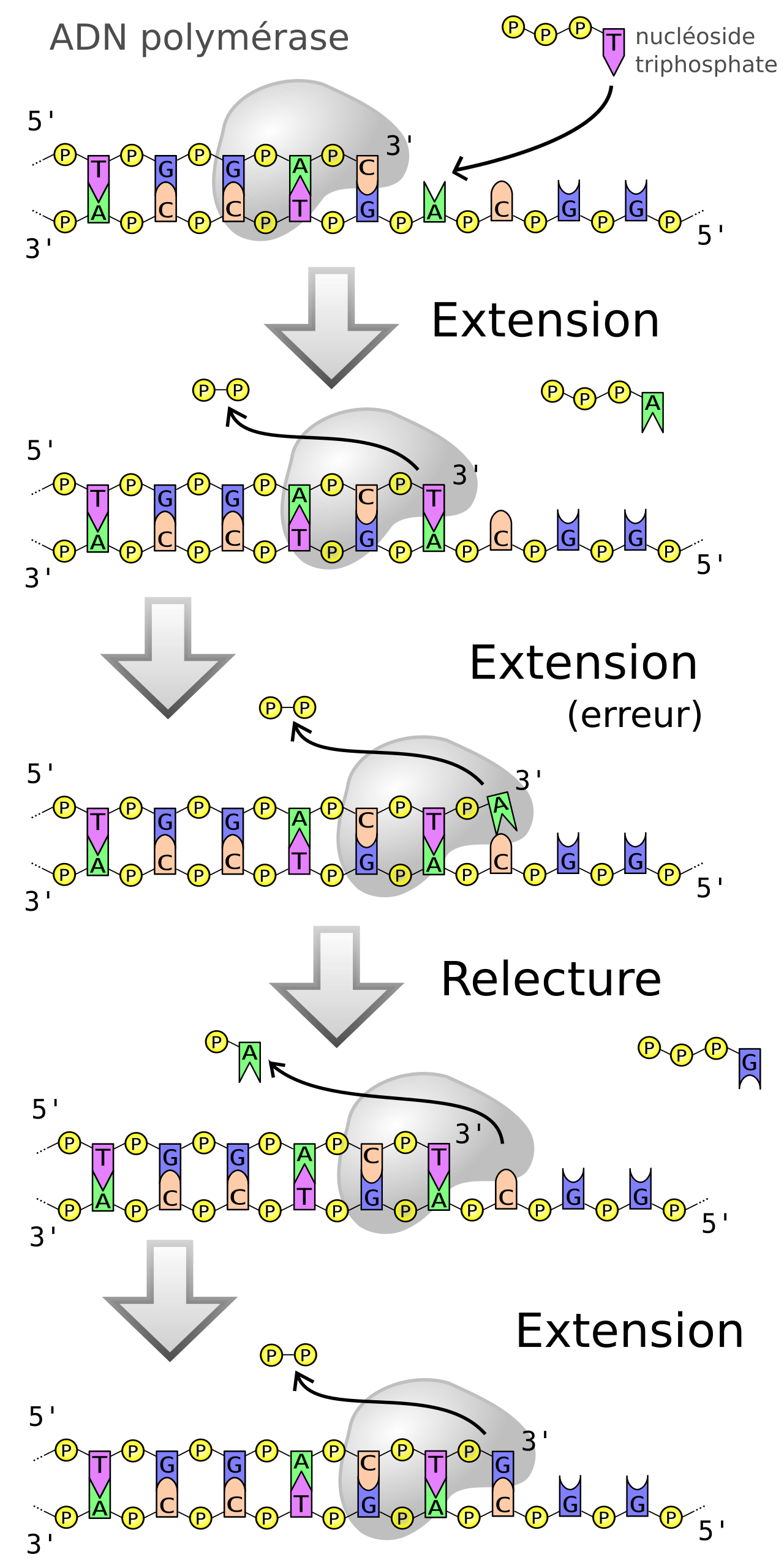
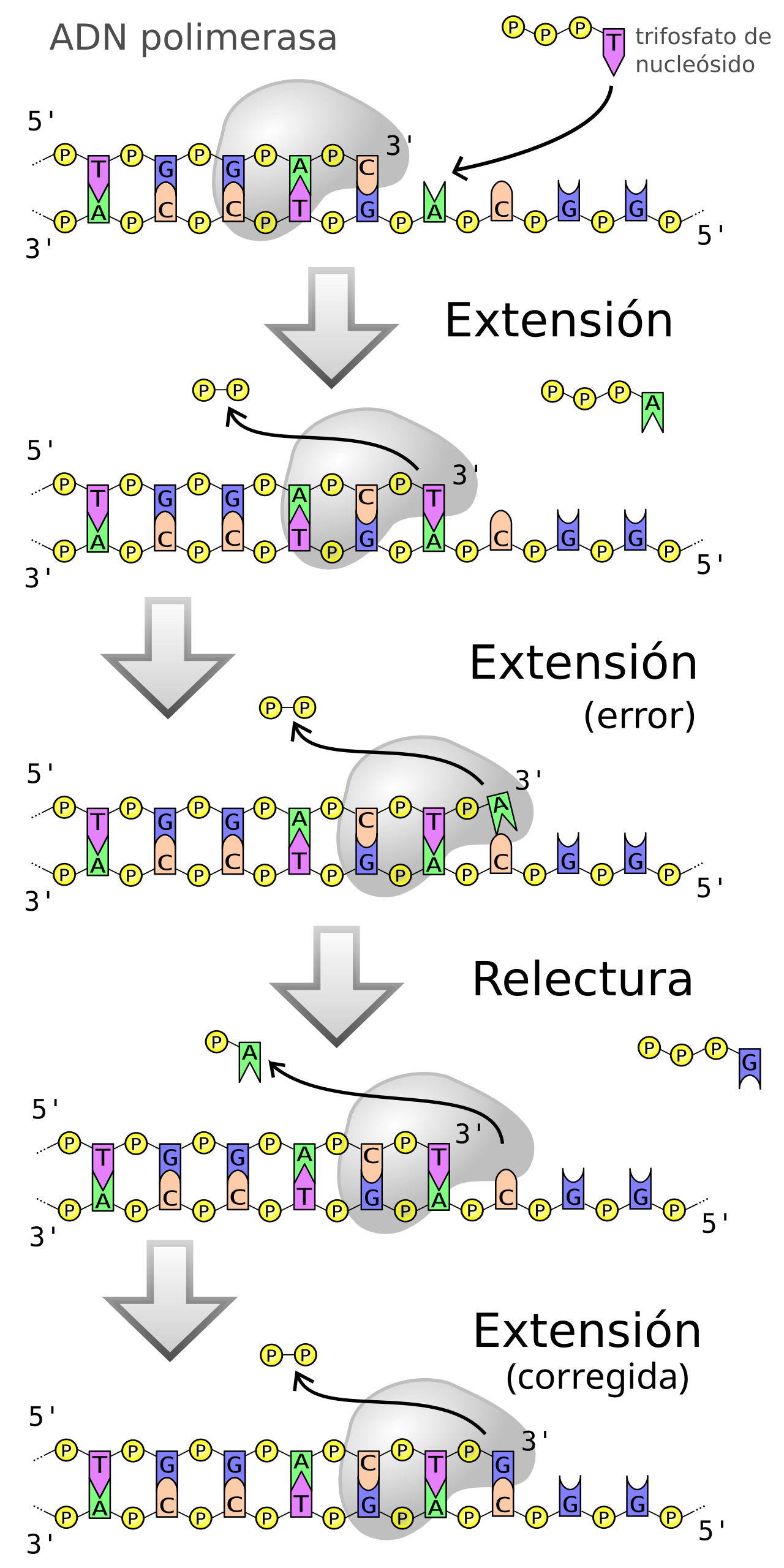
DNA polymerase is not perfect—on its own, it makes about one error per 10^4 to 10^5 base pairs. However, thanks to proofreading and mismatch repair, the final error rate drops to about one error per billion base pairs. Some polymerases can fix these mistakes. When a wrong base is added, the enzyme backs up by one base pair. Its 3'–5' exonuclease activity snips out the incorrect nucleotide, then the polymerase inserts the right one and continues. This proofreading is crucial because mismatches can lead to faulty proteins or cancer. The enzyme detects errors mainly through the shape and interactions of the base pairs; hydrogen bonds are key. A mismatch disrupts these interactions, shifting the template-primer from the polymerase site to the exonuclease site. A wrong nucleotide also slows down polymerization, giving time for this switch. Different mismatches cause different structural changes—for example, a purine:pyrimidine mismatch pushes the pyrimidine into the major groove and the purine into the minor groove, causing steric clashes and lost interactions. Despite these variations, DNA polymerase reliably detects and corrects them.
DNA polymerase is essential for replication and is also widely used in biotechnology, especially in mutagenesis processes.
- field
- Biochemistry, Molecular Biology
- known_for
- Catalyzing DNA synthesis, essential for DNA replication, used in polymerase chain reaction (PCR)
- discovered_by
- Arthur Kornberg and colleagues (DNA polymerase I, 1956); earlier work by Knippers, or by Moses and Richardson in 1969 (DNA polymerase II)
Lore & Background
In 1956, Arthur Kornberg and colleagues discovered DNA polymerase I (Pol I) in Escherichia coli. They described the DNA replication process by which DNA polymerase copies the base sequence of a template DNA strand. Kornberg was later awarded the Nobel Prize in Physiology or Medicine in 1959 for this work. DNA polymerase II was first identified in earlier work, such as by Knippers, or by Moses and Richardson in 1969, though Thomas Kornberg (the son of Arthur Kornberg) and Malcolm E. Gefter also contributed to its characterization in 1970. Three more DNA polymerases have been found in E. coli, including DNA polymerase III (discovered in the 1970s) and DNA polymerases IV and V (discovered in 1999). From 1985 on, DNA polymerases have been used in the polymerase chain reaction (PCR), and from 1988 thermostable DNA polymerases were used instead, as they do not need to be added in every cycle of a PCR.
The main function of DNA polymerase is to synthesize DNA from deoxyribonucleotides. When synthesizing new DNA, DNA polymerase can add free nucleotides only to the 3' end of the newly forming strand, resulting in elongation in a 5'–3' direction. DNA polymerase moves along the template strand in a 3'–5' direction. Error correction is a property of some, but not all DNA polymerases. When an incorrect base pair is recognized, DNA polymerase moves backwards by one base pair of D
Reader's Guide
DNA polymerase is fundamental to molecular biology and genetics. Its discovery by Arthur Kornberg in 1956 provided the first understanding of how DNA is replicated, a process essential for cell division and inheritance. The enzyme's ability to synthesize DNA from deoxyribonucleotides, with high fidelity due to proofreading mechanisms, ensures the accurate transmission of genetic information. The development of thermostable DNA polymerases in 1988 revolutionized biotechnology by enabling the polymerase chain reaction (PCR), a technique that amplifies specific DNA sequences without requiring fresh enzyme addition each cycle. This has had profound applications in medical diagnostics, forensic science, and genetic research. DNA polymerase's processivity, aided by sliding clamps, allows rapid DNA synthesis—up to 749 nucleotides per second in phage-infected E. coli. The conserved structure of DNA polymerases, resembling a right hand with thumb, finger, and palm domains, reflects their critical and irreplaceable cellular function. Their role in mutagenesis and error correction also makes them key to understanding cancer and evolutionary processes.
Did You Know?
- DNA polymerase adds nucleotides only to the 3' end of a DNA strand, one nucleotide at a time.
- The enzyme makes about one mistake for every billion base pairs copied.
- Thermostable DNA polymerases were used in PCR from 1988, eliminating the need to add enzyme in every cycle.
- DNA polymerase's shape is described as resembling a right hand with thumb, finger, and palm domains.
The Engine of Genetic Continuity
DNA polymerase sits at the heart of every cell division, serving as the molecular machine that ensures genetic information survives the passage from one generation to the next. As a member of a large enzyme family, it catalyzes the assembly of new DNA molecules from nucleoside triphosphates, the raw molecular precursors. In practice, these enzymes rarely work alone; they operate in coordinated groups to transform a single original double helix into two identical daughter duplexes. The process begins when helicase unwinds the tightly wound DNA, severing the hydrogen bonds between complementary bases and exposing two single strands as templates. DNA polymerase then reads each template strand and builds a matching partner, adding one nucleotide at a time to the three-prime end. The underlying chemical exchange is elegantly simple: a deoxynucleoside triphosphate joins the growing chain, releasing pyrophosphate in the process. Because this duplication is mandatory before any cell can divide and pass its genome to daughter cells, the enzyme's role is, in the most literal sense, the continuity of life itself.
A Century of Discovery
The story of DNA polymerase begins in 1956, when Arthur Kornberg and his team identified DNA polymerase I in the bacterium Escherichia coli, describing for the first time how the enzyme copies the base sequence of a template strand. That landmark work earned Kornberg the Nobel Prize in Physiology or Medicine just three years later, in 1959. The search for additional polymerases continued across decades: in 1970, Thomas Kornberg—Arthur's son—along with Malcolm E. Gefter, identified DNA polymerase II while probing the broader role of Pol I in E. coli replication. DNA polymerase III followed in the 1970s, and the family was further expanded in 1999 with the discovery of polymerases IV and V. Beyond pure biology, the enzyme found a transformative second life in the laboratory. Starting in 1983, DNA polymerases became the workhorse of the polymerase chain reaction, and by 1988, thermostable variants replaced the original enzymes, eliminating the need to replenish the catalyst after every heating cycle.
The Architecture of Fidelity
Despite handling billions of base pairs across a lifetime of cell divisions, DNA polymerase makes roughly one error per billion nucleotides copied—a remarkably low rate given the stakes. Mismatches in base pairing, if left uncorrected, can produce dysfunctional proteins and even drive the development of cancer. To guard against this, many though not all polymerases carry a built-in proofreading mechanism. When an incorrect base pair is detected, the enzyme reverses direction by a single base pair and uses its 3'-to-5' exonuclease activity to excise the wrong nucleotide, then re-inserts the correct base and resumes forward synthesis. The detection itself hinges on the precise geometry of Watson-Crick base pairs and the hydrogen bonds that stabilize them. A mismatch disrupts these interactions, triggering a conformational shift that hands the DNA from the polymerase site to the exonuclease domain. In purine-pyrimidine mismatches, the pyrimidine is displaced toward the major groove while the purine shifts toward the minor groove, creating steric clashes and losing critical van der Waals and electrostatic contacts. Pyrimidine-pyrimidine and purine-purine mismatches produce subtler geometric changes, yet the enzyme still distinguishes them uniformly, preserving replication fidelity across all mismatch types.
A Right Hand Shaped by Evolution
One of the most striking features of DNA polymerase is its structural conservation. Across the tree of life, the catalytic subunits of known polymerases vary remarkably little from species to species, regardless of differences in their broader domain arrangements. Such deep conservation signals a function so fundamental that evolution has had little room to alter it. The overall shape of the enzyme is often compared to a right hand, with distinct thumb, finger, and palm domains. The palm domain appears to be the catalytic core, responsible for transferring phosphoryl groups during nucleotide addition. This hand-like architecture also underpins the enzyme's strict directionality: it can only add free nucleotides to the three-prime hydroxyl end of a growing strand, meaning synthesis always proceeds in the five-prime-to-three-prime direction. Because the enzyme must read the template in the opposite three-prime-to-five-prime direction, the two strands of the resulting double helix end up antiparallel. The requirement for a free 3' OH group for initiation means the polymerase can extend only a preexisting chain, a constraint that shapes the entire replication machinery.
Gallery
More in Genetics 1-24
Spotted an error? Know more?
This is a living reference — every entry is fact-audited, and reader corrections feed straight into our audit queue. Suggest an edit · See this site's audit record