DNA ligase
Enzyme that joins DNA strands by catalyzing phosphodiester bond formation.

Dcrjsr · CC BY 4.0
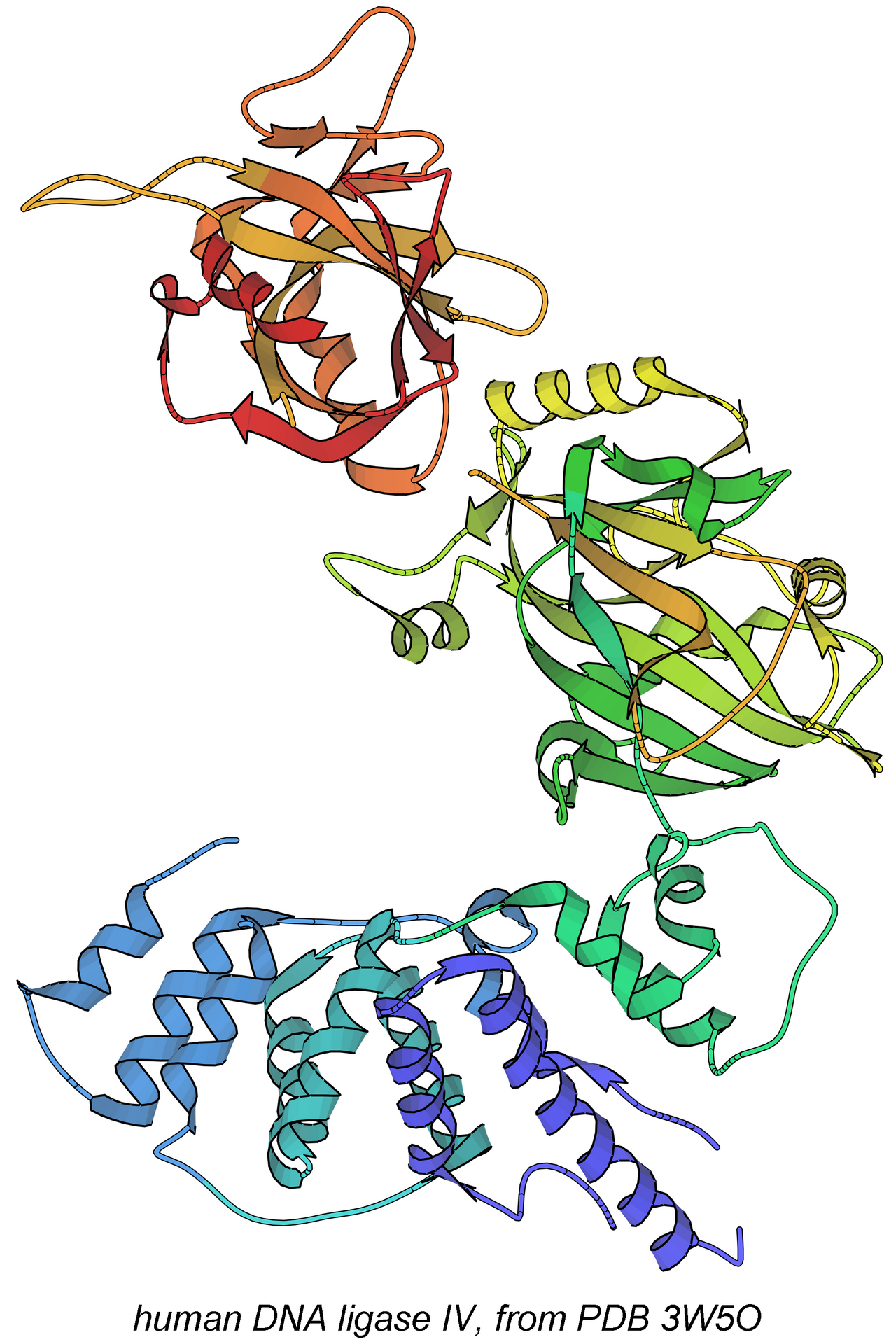
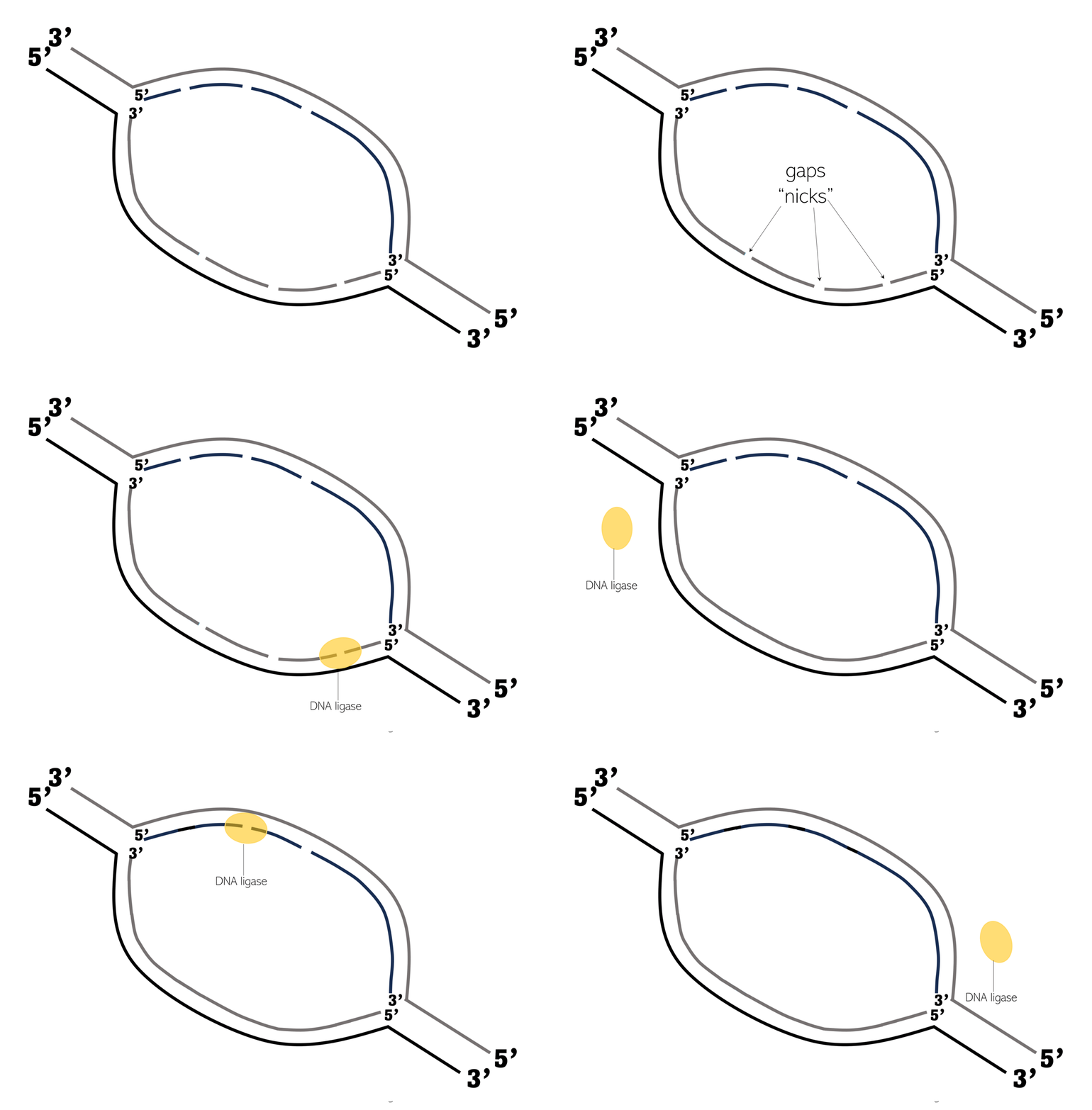
DNA ligase is an enzyme that stitches DNA strands together by creating phosphodiester bonds. In living organisms, it mends single-strand breaks in double-stranded DNA, using the intact complementary strand as a guide to seal the final bond. Some variants, like DNA ligase IV, can also repair double-strand breaks—where both strands are severed. Beyond repair, DNA ligase is essential for DNA replication and is a staple tool in molecular biology labs for making recombinant DNA, such as in gene cloning.
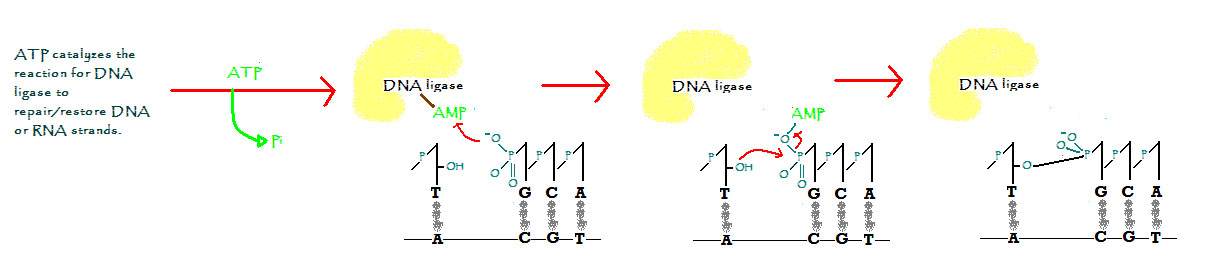
The enzyme works by forming a phosphodiester bond between a 3' hydroxyl end (the acceptor) and a 5' phosphate end (the donor). Each ligation event consumes one ATP (or NAD) molecule, with AMP as a transient intermediate. The reaction unfolds in three steps: first, a lysine residue in the enzyme gets adenylylated (AMP added), releasing pyrophosphate; second, AMP transfers to the donor’s 5' phosphate, creating a pyrophosphate bond; finally, a phosphodiester bond forms between the donor’s 5' phosphate and the acceptor’s 3' hydroxyl, releasing AMP. Blunt ends can also be ligated, but this needs higher enzyme concentrations and different conditions.
Different organisms have distinct DNA ligases. In *E. coli*, the ligase (coded by the *lig* gene) uses energy from cleaving NAD to form bonds. It cannot ligate blunt ends unless polyethylene glycol creates molecular crowding, and it joins RNA to DNA poorly. Its activity can be boosted by low concentrations of DNA polymerase I, but high polymerase levels hinder it.
The T4 bacteriophage ligase is the lab favorite. It works on cohesive or blunt ends, oligonucleotides, RNA, and RNA-DNA hybrids, but not single-stranded nucleic acids. It ligates blunt ends far more efficiently than *E. coli* ligase and requires ATP, not NAD. Engineered versions, like those fused to p50 or NF-κB, show over 160% more blunt-end activity. Typical reactions use 0.01 units (sticky ends) to 1 unit (blunt ends). Optimal temperature is 37 °C, though 16 °C is often used to balance activity with base-pairing. T4 ligase mutants are more sensitive to UV and alkylating agents, confirming its role in DNA repair.
Mammals have four ligase types. DNA ligase 1 seals lagging-strand DNA after RNA primers are removed. DNA ligase 3 works with XRCC1 in nucleotide excision repair and is the only mammalian ligase found in mitochondria. DNA ligase 4 p
- type
- Enzyme
- first_purified
- 1967
- discovered_by
- Gellert, Lehman, Richardson, and Hurwitz laboratories
- common_source
- Bacteriophage T4
- cofactor
- ATP or NAD (depending on type)
- function
- Joins DNA strands by catalyzing phosphodiester bond formation
Lore & Background
The first DNA ligase (from E. coli) was independently discovered and characterized in 1967 by the Gellert, Lehman, Richardson, and Hurwitz laboratories, with Weiss and Richardson (part of the Richardson lab) publishing a specific six-step chromatographic-fractionation purification method. DNA ligase from bacteriophage T4 is the most commonly used in laboratory research; it can ligate cohesive or blunt ends of DNA, oligonucleotides, as well as RNA and RNA-DNA hybrids, but not single-stranded nucleic acids. Unlike E. coli DNA ligase, T4 DNA ligase cannot utilize NAD and has an absolute requirement for ATP as a cofactor.
Reader's Guide
DNA ligase is indispensable in modern molecular biology for generating recombinant DNA sequences. It is used with restriction enzymes to insert DNA fragments into plasmids. The optimal temperature for ligation depends on the type of ends: cohesive-ended fragments require balancing enzyme activity with the melting temperature of the sticky ends, while blunt-ended ligations are most efficient at 14-25 °C overnight. T4 DNA ligase is most active at 37 °C, but ligation reactions are often set at 16 °C to allow stable annealing of sticky ends. Thermostable DNA ligases, derived from thermophilic bacteria, are stable at high temperatures and permit high hybridization stringency. DNA ligase also has novel applications in DNA origami for organizing nanoscale objects.
Did You Know?
- DNA ligase IV specifically repairs double-strand breaks and is required for V(D)J recombination in immune system development.
- T4 DNA ligase can ligate blunt-ended DNA with much greater efficiency than E. coli DNA ligase.
- Some engineered T4 DNA ligase fused to p50 or NF-kB showed over 160% more activity in blunt-end ligations than wild type.
- Thermostable DNA ligase has a half-life of 48 hours at 65 °C and greater than 1 hour at 95 °C.
The Four-Step Catalytic Dance
DNA ligase works through a precise four-step mechanism to seal nicks in DNA. The process begins with the enzyme reorganizing its active site to accommodate the break, whether in a linear segment or an Okazaki fragment. Next, an adenylylation step occurs: AMP is transferred onto a lysine residue in the enzyme's active center, releasing pyrophosphate. In the third step, that AMP group is handed off to the 5' phosphate of the donor nucleotide, forming a pyrophosphate linkage. Finally, the phosphodiester bond is forged between the 5' phosphate of the donor and the 3' hydroxyl of the acceptor nucleotide. Each bond formation consumes two ATP molecules. The enzyme can also join blunt-ended DNA, though this demands higher concentrations and altered reaction conditions compared to cohesive-end ligation. The entire reaction requires AMP as a cofactor, and the energy source varies by organism: prokaryotes like E. coli tap NAD, while eukaryotes and bacteriophage T4 rely on ATP.
Four Mammalian Ligases and One Unusual Nomenclature
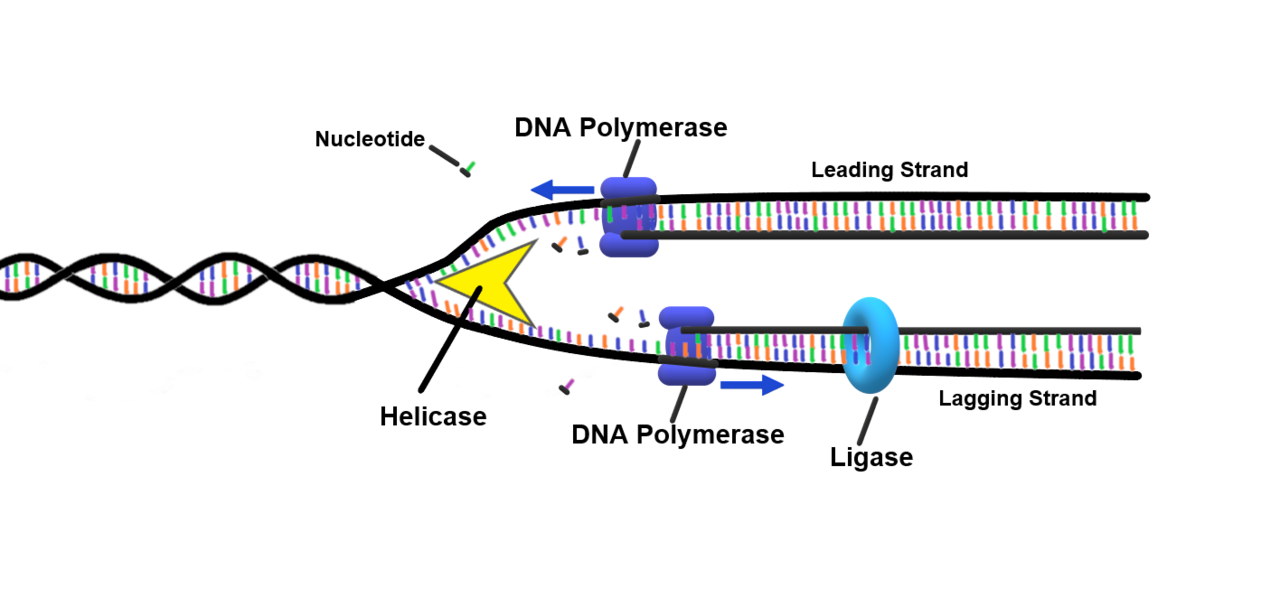
Mammals possess four distinct DNA ligases, each with a specialized role. DNA ligase 1 handles the lagging strand of replication, sealing Okazaki fragments after RNase H strips away RNA primers. DNA ligase 3 partners with the repair protein XRCC1 to seal nicks during nucleotide excision repair and recombinant fragment processing; it is the only mammalian ligase found in mitochondria. DNA ligase 4 teams with XRCC4 to catalyze the final step of non-homologous end joining, the pathway that repairs double-strand breaks, and it is also essential for V(D)J recombination, the process that shuffles immunoglobulin and T-cell receptor gene segments during immune development. The nomenclature carries a historical quirk: DNA ligase 2 was originally identified as a separate enzyme but later revealed to be a proteolytic degradation product of ligase 3, a purification artifact that permanently distorted the numbering scheme for the entire family.
From Bacteriophage to the Bench
Bacteriophage T4 ligase has become the workhorse of molecular biology laboratories. Unlike its E. coli counterpart, T4 ligase absolutely requires ATP rather than NAD as its energy cofactor, and it can ligate cohesive ends, blunt ends, oligonucleotides, RNA, and RNA-DNA hybrids, though it cannot join single-stranded nucleic acids. Its efficiency with blunt ends far exceeds that of E. coli ligase. Typical cloning reactions call for roughly 0.01 units for sticky-end ligations up to 1 unit for blunt-end work, with an optimal incubation temperature of 37 °C, though 16 °C is frequently chosen to balance enzyme activity with stable sticky-end base pairing. Researchers have also engineered fusion proteins pairing T4 ligase with DNA-binding partners such as p50 or NF-kB, boosting blunt-end ligation activity by over 160 percent. Meanwhile, thermostable ligases derived from thermophilic bacteria remain active through 500 thermal cycles at 94 °C and 80 °C, enabling extreme hybridization stringency.
Sealing the Genome's Wounds
Beyond replication, DNA ligase serves as a critical guardian of genomic integrity. In living cells, it repairs single-strand breaks in duplex DNA by using the complementary strand as a template and then forging the final phosphodiester bond to restore the sugar-phosphate backbone. Certain mammalian forms tackle more severe damage: ligase 4, in complex with XRCC4, executes the terminal step of non-homologous end joining to mend double-strand breaks where both complementary strands are severed. Ligase 3, paired with XRCC1, seals nicks generated during nucleotide excision repair. Evidence from bacteriophage T4 mutants shows that ligase is also deployed against damage caused by UV irradiation and the alkylating agent methyl methanesulfonate. In E. coli, the enzyme's activity can be modulated by DNA polymerase I, enhanced at low polymerase concentrations but inhibited when polymerase levels exceed those of the DNA fragments being joined. Together, these repair roles underscore ligase as a versatile sentinel maintaining the continuity of the genetic code.
Gallery


More in Genetics 1-24
Spotted an error? Know more?
This is a living reference — every entry is fact-audited, and reader corrections feed straight into our audit queue. Suggest an edit · See this site's audit record