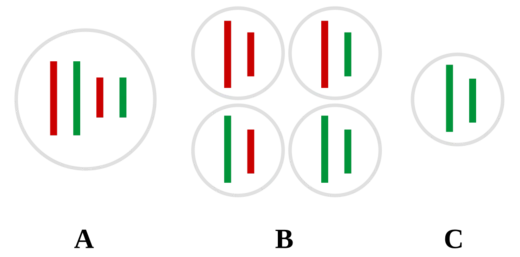
Allele
Variant DNA sequences at a locus shaping inheritance and traits.

user:toony · CC BY-SA 3.0
An allele is a specific version of a DNA sequence found at a particular spot, or locus, on a chromosome. These variants can arise from a single changed nucleotide, known as a single-nucleotide polymorphism, or from insertions or deletions that can stretch for thousands of base pairs. While most alleles cause little to no noticeable effect on an organism, some produce distinct observable traits—like antibiotic resistance in bacteria, developmental changes in fruit flies, or genetic disorders in humans.
Most multicellular organisms are diploid, meaning they carry two sets of chromosomes at some life stage. If both chromosomes at a given locus hold the same allele, the organism is homozygous for that allele; if the alleles differ, it is heterozygous. Gregor Mendel famously demonstrated this with pea plants, where a single gene with two alleles determined flower color (purple or white). His work led to the laws explaining how alleles are inherited.
Common definitions of "allele" often focus on variants within genes. For instance, the ABO blood group is controlled by the ABO gene, which has three main alleles: A, B, and O. In population genetics, nearly every human's ABO blood phenotype comes from a combination of these three alleles.
The word "allele" is a shortened form of "allelomorph," coined by British geneticists William Bateson and Edith Rebecca Saunders in the early 1900s to describe variant forms of a gene that cause different phenotypes. It comes from the Greek prefix *allelo-*, meaning "mutual" or "each other," related to the Greek *allos* ("other").
When two alleles at a locus interact, one may be dominant and the other recessive. The heterozygote then resembles the homozygous dominant phenotype, with the dominant allele masking the recessive one. The recessive phenotype appears only in homozygous recessives. This pattern, first formally described by Mendel, varies across loci, and many traits show co-dominance or polygenic inheritance instead.
The term "wild type" allele once referred to the common, normal phenotype seen in wild populations, such as fruit flies. It was thought to be dominant, while "mutant" alleles were recessive, rare, and often harmful. Most individuals were believed to be homozygous for wild type at most loci, with mutants appearing only in a few affected homozygotes or as carriers. Today, it is clear that most gene loci are
- field
- Genetics
- known_for
- Variant forms of a gene at a given locus; basis of inheritance and phenotypic diversity
- etymology
- Short form of 'allelomorph' coined by William Bateson and Edith Rebecca Saunders in the early 1900s; from Greek ἀλληλο- (allelo-, 'mutual') and ἄλλος (allos, 'other')
Lore & Background
The word 'allele' is a short form of 'allelomorph' ('other form'), a word coined by British geneticists William Bateson and Edith Rebecca Saunders in the early 1900s. It was used in the early days of genetics to describe variant forms of a gene detected in different phenotypes and identified to cause the differences between them. It derives from the Greek prefix ἀλληλο-, allelo-, meaning 'mutual', 'reciprocal', or 'each other', which itself is related to the Greek adjective ἄλλος, allos (cognate with Latin alius), meaning 'other'.
A notable example of alleles is Gregor Mendel's discovery that the white and purple flower colors in pea plants were the result of a single gene with two alleles. Mendel's discovery of what are now known as alleles resulted in three laws that help understand how alleles are passed on to progeny. In many cases, genotypic interactions between the two alleles at a locus can be described as dominant or recessive, according to which of the two homozygous phenotypes the heterozygote most resembles.
Nearly all multicellular organisms have two sets of chromosomes at some point in their biological life cycle; that is, they are diploid. For a given locus, if the two chromosomes contain the same allele, they, and the organism, are homozygous with respect to that allele. If the alleles are different, they, and the organism, are heterozygous with respect to those alleles.
Reader's Guide
Alleles are fundamental to understanding genetic variation and inheritance. They represent the different forms a gene can take at a specific locus on a chromosome, arising from single-nucleotide polymorphisms, insertions, or deletions. The concept, originally termed 'allelomorph' by Bateson and Saunders, was crucial to Gregor Mendel's work on pea plants, where he identified that flower color differences resulted from two alleles of a single gene. This led to the laws of inheritance that describe how alleles are passed to offspring.
Alleles can produce dominant or recessive phenotypes. In a heterozygote, the dominant allele masks the effect of the recessive allele, while recessive phenotypes appear only in homozygous recessive individuals. However, many traits defy simple dominance, showing co-dominance or polygenic inheritance. The ABO blood group system in humans exemplifies multiple alleles, with six common alleles at the ABO gene producing four phenotypes (A, B, AB, O).
In population genetics, allele frequencies can predict genotype frequencies using the Hardy–Weinberg principle. For two alleles, the frequencies p and q (summing to 1) give homozygous frequencies p² and q², and heterozygote frequency 2pq. The number of possible genotypes at a diploid locus with a alleles is a(a+1)/2. Alleles also underlie genetic disorders: recessive disorders like cystic fibrosis require two recessive alleles, while dominant disorders like Huntington's disease require only one dominant allele. The term 'epiallele' distinguishes heritable epigenetic marks from sequence-based alleles.
Did You Know?
- The word 'allele' is a short form of 'allelomorph', coined by British geneticists William Bateson and Edith Rebecca Saunders in the early 1900s.
- Gregor Mendel's discovery of white and purple flower colors in pea plants was the result of a single gene with two alleles.
- The ABO blood grouping is controlled by the ABO gene, which has six common alleles; more than 70 alleles are now known at the ABO locus.
- A null allele is a gene variant that lacks the gene's normal function because it either is not expressed, or the expressed protein is inactive.
The Nature of Alleles and Biological Variation
An allele is a distinct variant of a single gene, representing one specific set of instructions among potentially many. While the fundamental architecture of a gene stays consistent across organisms, the precise ordering of its molecular building blocks can shift from one individual to the next, generating these separate allelic forms. A striking illustration involves hair color: one variant might signal the body to generate large amounts of pigment, resulting in black hair, whereas another variant of the same gene could carry faulty instructions that prevent pigment production entirely, yielding white hair. This capacity for variation is far more than a cosmetic detail. Random mutations—spontaneous alterations in the genetic sequence—can give rise to entirely new alleles, and with them, novel traits. The appearance of such new characteristics through mutation is a cornerstone of evolution, supplying the raw diversity upon which natural selection operates. In essence, alleles mark the points at which genetic diversity enters a population, turning a single shared blueprint into a broad spectrum of living forms.
The Mechanics of Inheritance and Dominance
When two parents produce offspring, each contributes one copy of every gene, so the child ends up with a pair of alleles for each trait. The visible outcome—termed the phenotype—depends on how those two alleles interact. If one allele's instructions override the other's, it is labeled dominant (conventionally written with a capital letter, such as B for brown hair), while the suppressed one is recessive (lowercase b, for red hair). A daughter who inherits one of each will display brown hair, yet she still carries the red-hair allele hidden within her genotype. That concealed copy does not simply disappear. If she later has children with a partner who is also a carrier (Bb), their offspring can inherit the recessive combination (bb) and express red hair, effectively resurrecting a trait that was invisible in the previous generation. This interplay between what is expressed and what is concealed lies at the heart of classical inheritance logic, and it explains why certain characteristics can skip a generation only to reappear in grandchildren.
Polygenic Traits and the Role of Environment
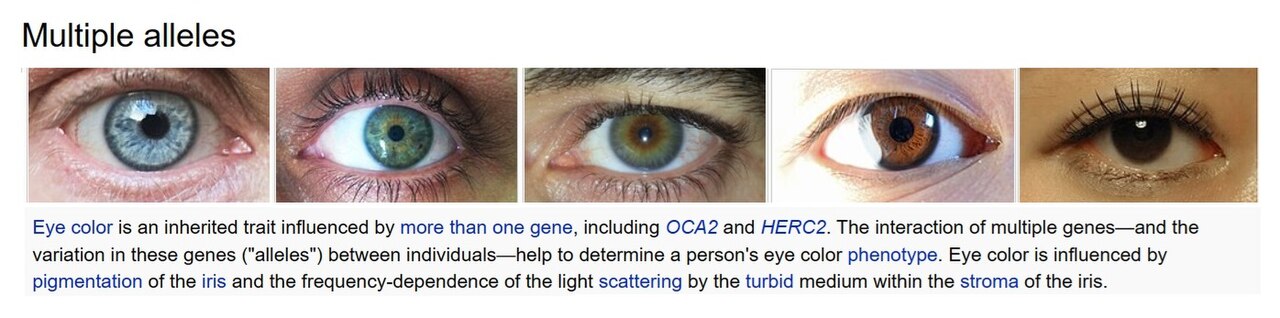
Not every characteristic follows the clean dominant-recessive pattern. Many traits, such as height, are shaped by numerous genes simultaneously, each contributing a small incremental effect. This is why tall parents tend to have tall children—they pass along a bundle of many growth-related alleles—yet there are no sharp boundaries separating tall from short people the way there are for discrete categories like red versus brown hair. The result is a continuous spectrum of variation rather than neat groups. Green and blue eye color, often assumed to be simple single-gene traits, actually follow this more complex polygenic model as well. Beyond genetics alone, the environment plays a decisive role in how traits manifest. A child born with a genetic predisposition toward tallness will remain short if deprived of adequate nutrition. Similarly, the risk of developing cancer or heart disease appears to hinge on a combination of inherited susceptibility and lifestyle choices. These gene-environment interactions make predicting individual outcomes far more intricate than a simple genetic blueprint would suggest.
From Genetic Code to Protein Function
At the molecular level, genes are segments of DNA—long molecules composed of simple repeating units arranged in a specific order. This ordered sequence constitutes the genetic code, a language that cells read to extract instructions for building and maintaining a living organism. The ultimate product of gene expression is protein: specialized molecules, each designed to perform a single task within the cell. Cells themselves function as miniature factories, capable of assembling every component needed to replicate themselves during division. A clear division of labor governs this process: genes supply the informational blueprint, while proteins execute the physical work, whether that means constructing a new cell, repairing damage, or performing some other specialized function. If a cell encounters a new challenge, it must manufacture a new protein tailored to that task. In humans, this machinery operates across roughly one hundred trillion cells, each independently reading its genetic instructions and producing the proteins it needs to sustain life.
Gallery
More in Genetics 1-24
Spotted an error? Know more?
This is a living reference — every entry is fact-audited, and reader corrections feed straight into our audit queue. Suggest an edit · See this site's audit record