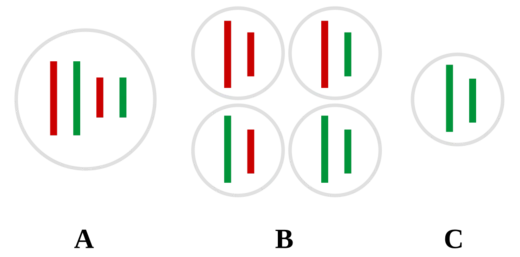
Central dogma of molecular biology
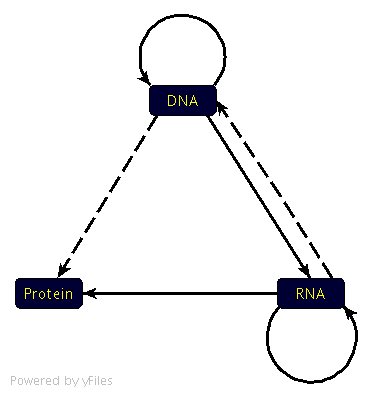
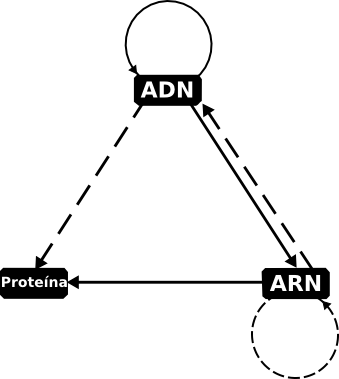
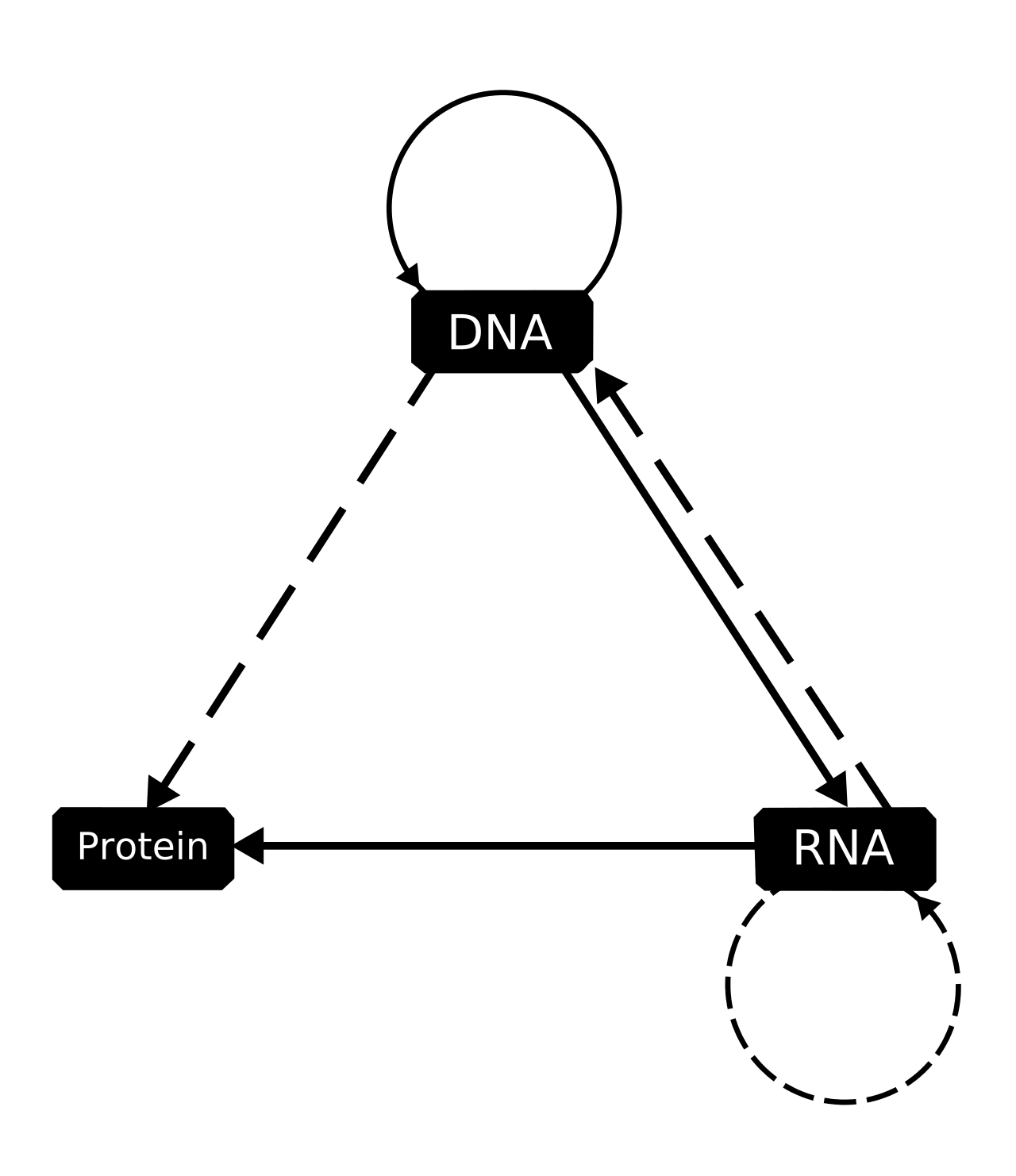
Information flows from nucleic acid to protein, not back—except when it flows from RNA to DNA.

Sbrools · CC BY-SA 3.0
The central dogma of molecular biology is a foundational concept describing the flow of genetic information within biological systems. It was first stated by Francis Crick in 1957 and published in 1958, asserting that once information has passed into protein it cannot get out again. The dogma deals with the residue-by-residue transfer of sequential information, stating that such information cannot be transferred back from protein to either protein or nucleic acid.
- first_stated
- 1957
- published
- 1958
- field
- Molecular biology
- originator
- Francis Crick
- key_principle
- Information cannot flow from protein to nucleic acid
Lore & Background
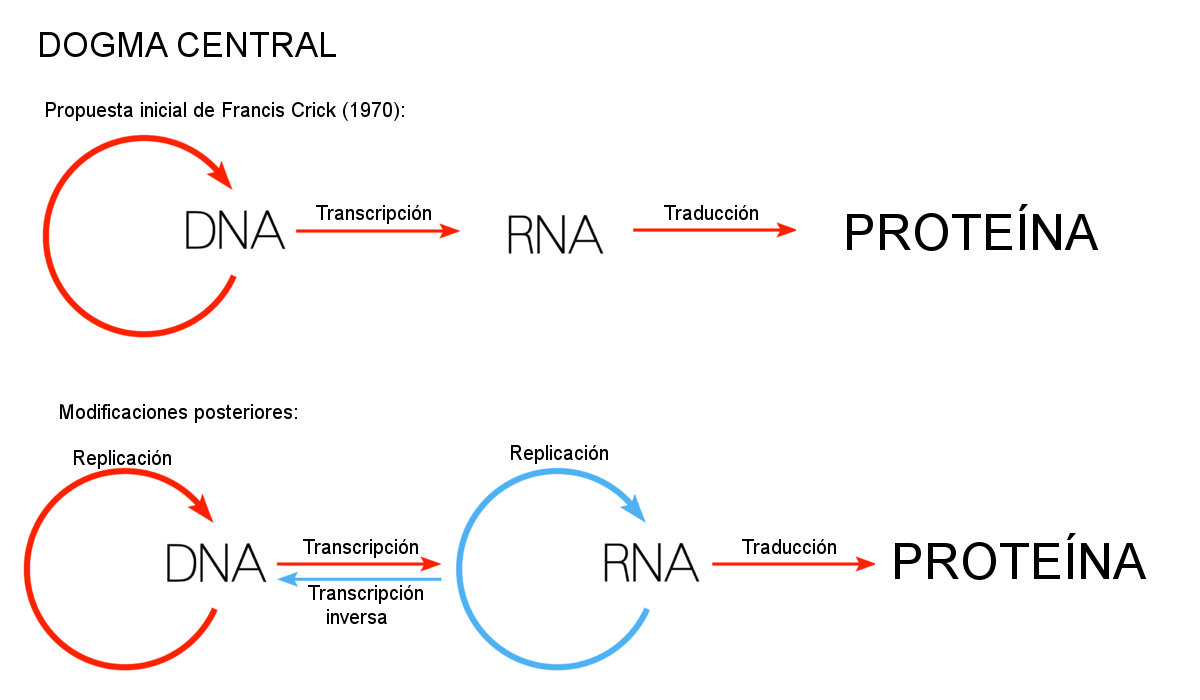
The central dogma was first articulated by Francis Crick in 1957 and published in 1958. Crick's original formulation stated that once 'information' has passed into protein it cannot get out again, meaning transfer from protein to protein or from protein to nucleic acid is impossible. He re-stated it in a 1970 Nature paper, emphasizing that the dogma deals with the detailed residue-by-residue transfer of sequential information and that such information cannot be transferred back from protein to either protein or nucleic acid.
A second, popular but incorrect version of the central dogma was published by James Watson in the first edition of The Molecular Biology of the Gene (1965). Watson's version describes a simplistic DNA → RNA → protein pathway, which differs from Crick's original statement. While Crick's version remains valid today only with the 1970 clarification that reverse transcription is an allowed exception, Watson's version does not.
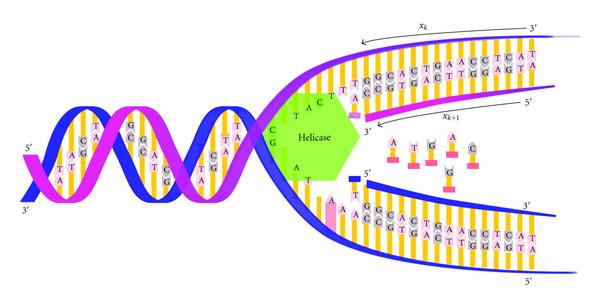
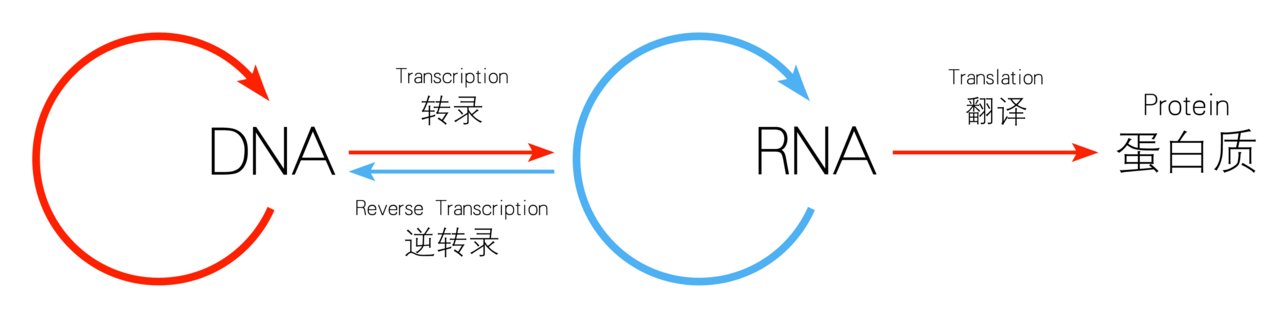
The transfers of information from one molecule to another are faithful, deterministic transfers, wherein one biopolymer's sequence is used as a template for the construction of another biopolymer. General transfers include DNA replication, transcription (DNA to RNA), and translation (RNA to protein). Additional transfers include reverse transcription (RNA to DNA) and RNA replication (RNA to RNA).
Reader's Guide
The central dogma of molecular biology remains a cornerstone of biological understanding, though its precise meaning is often misrepresented. Crick's original formulation—that sequential information cannot flow from protein to nucleic acid—is still considered valid, while Watson's simplified DNA → RNA → protein version is incorrect. The dogma does not preclude reverse transcription or RNA replication, as these involve nucleic acid-to-nucleic acid transfers. Activities such as post-translational modification, nonribosomal peptide synthesis, inteins, and prions are sometimes thought to conflict with the dogma, but they do not involve information transfer from protein to nucleic acid. The concept has shaped research in genetics, virology, and molecular biology, and continues to be a reference point for discussions about information flow in living systems.
Did You Know?
- The central dogma was first stated by Francis Crick in 1957 and published in 1958.
- Crick's original formulation states that information cannot be transferred back from protein to either protein or nucleic acid.
- A popular but incorrect version of the central dogma (DNA → RNA → protein) was published by James Watson in 1965.
- Reverse transcription, the transfer of information from RNA to DNA, is known to occur in retroviruses such as HIV.
Crick's Original Vision and the Watson Simplification
The central dogma was first articulated by Francis Crick in 1957 and formally published in 1958. His formulation was not the familiar 'DNA makes RNA, RNA makes protein' slogan but rather a statement about the irreversibility of information flow: once sequence information has been deposited into a protein, it cannot be retrieved back into nucleic acid or another protein. Crick refined this in a 1970 Nature paper, emphasizing that the dogma concerns the residue-by-residue transfer of sequential information and that such transfer from protein back to nucleic acid is impossible. A widely circulated but technically inaccurate version appeared in James Watson's 1965 textbook The Molecular Biology of the Gene, where he described the central dogma as a simple two-step pathway from DNA to RNA to protein. While Crick's original principle about information irreversibility remains valid, Watson's streamlined two-step description does not capture the full scope of what the dogma actually asserts.
The Molecular Machinery of Transcription and Translation
The transfer of genetic information from DNA to functional protein involves a series of precisely orchestrated steps. DNA replication, carried out by a complex protein assembly called the replisome, copies the parent strand into a complementary daughter strand, ensuring genetic material is passed to progeny cells. Transcription then copies a segment of DNA into a newly assembled messenger RNA molecule, facilitated by RNA polymerase and transcription factors. In eukaryotic cells, the initial product is pre-mRNA, which undergoes processing: a 5' cap and poly-A tail are added, and introns are removed through splicing. Alternative splicing can generate multiple protein variants from a single gene. The mature mRNA then travels to a ribosome, where triplet codons are read, typically beginning with the AUG initiator codon. Transfer RNAs bearing specific amino acids are matched to codons via anti-codons, and the growing polypeptide chain assembles until a stop codon (UAA, UGA, or UAG) terminates the process.
Beyond the Ribosome: Protein Maturation and Folding
The polypeptide chain released from the ribosome is far from a finished product. The mRNA template does not encode all the information needed to specify the mature, functional protein. Correct three-dimensional folding is complex and critical, and for most proteins it requires the assistance of chaperone proteins that guide the nascent chain into its proper conformation. Some proteins undergo internal self-processing, excising segments called inteins and splicing the remaining ends together. Others must be cleaved into multiple subunits without any splicing. Additional maturation steps include cross-linking of polypeptide chains and the attachment of essential cofactors such as heme before the protein can perform its biological role. These post-translational modifications underscore that the central dogma describes the flow of sequence information, but the ultimate functional form of a protein depends on a rich layer of processing that occurs well beyond the ribosome.
Extensions and Exceptions: Reverse Transcription and RNA Replication
While Crick's original dogma holds that information cannot flow backward from protein to nucleic acid, the landscape of nucleic-acid-to-nucleic-acid transfers is broader than the simple DNA-to-RNA pathway suggests. Reverse transcription, catalyzed by enzymes called reverse transcriptases, copies RNA information back into DNA. This process is central to the life cycles of retroviruses such as HIV and also operates in eukaryotic cells during retrotransposon activity and telomere synthesis. RNA replication, the copying of one RNA molecule into another, is a strategy employed by many viruses and is also found in eukaryotes, where RNA-dependent RNA polymerases participate in RNA silencing pathways. RNA editing, in which a protein complex guided by a guide RNA molecule alters an existing RNA sequence, represents yet another form of RNA-to-RNA information transfer. These additional mechanisms expand the picture of sequential information flow without violating Crick's core principle that protein sequence cannot be read back into nucleic acid sequence.
Gallery
More in Genetics 1-24
Spotted an error? Know more?
This is a living reference — every entry is fact-audited, and reader corrections feed straight into our audit queue. Suggest an edit · See this site's audit record