Genetic diversity
Genetic diversity is the total genetic variation within a species.

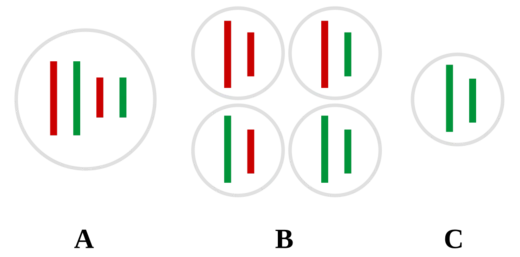
Genetic diversity refers to the full range of genetic traits found within a species’ gene pool. This diversity can be observed across a broad spectrum, from the variety of species themselves down to the differences between individuals of the same species, and it is often linked to how long a species is likely to survive. It is important to note that genetic diversity is not the same as genetic variability; variability describes the potential for genetic traits to change, while diversity is the actual count of those traits. A key function of genetic diversity is that it allows populations to adapt when their environment shifts. When a population has a high degree of variation, there is a greater chance that some individuals carry allele variations that happen to be well-suited to new conditions. These individuals are more likely to survive and reproduce, passing on those advantageous alleles, which helps the population persist across many generations.
Within the field of population genetics, several hypotheses explain how genetic diversity arises. The neutral theory of evolution suggests that most diversity comes from the accumulation of neutral mutations—changes that do not affect an organism’s fitness. Diversifying selection proposes that two subpopulations of the same species live in different environments, each favoring different alleles at a particular genetic location; this often happens when a species has a large geographic range relative to how far its individuals can move. Frequency-dependent selection holds that as certain alleles become more common, they become more vulnerable; this is seen in host-pathogen interactions, where a common defensive allele in a host population makes it easier for a pathogen that can overcome that allele to spread.
A 2007 study by the National Science Foundation showed that within-species genetic diversity and overall biodiversity are interdependent. Diversity within a species is necessary to maintain diversity among species, and vice versa. As lead researcher Dr. Richard Lankau explained, removing any one type from the system can break the cycle, allowing a single species to dominate. Genotypic and phenotypic diversity exist in all species at the protein, DNA, and organismal levels, and in nature, this diversity is not random—it is heavily structured and linked to environmental variation and stress. The relationship
- field
- Population genetics, conservation biology
- known_for
- Neutral theory of evolution, diversifying selection, frequency-dependent selection
- key_concept
- Interdependence of genetic diversity and biodiversity
- measurement_examples
- Heritability (h² = Vₐ/Vₚ), adaptive differentiation (Qₛₜ = V₉/(V₉ + 2Vₐ))
Lore & Background
The academic field of population genetics includes several hypotheses and theories regarding genetic diversity. The neutral theory of evolution proposes that diversity is the result of the accumulation of neutral substitutions. Diversifying selection is the hypothesis that two subpopulations of a species live in different environments that select for different alleles at a particular locus. Frequency-dependent selection is the hypothesis that as alleles become more common, they become more vulnerable, as seen in host–pathogen interactions.
Reader's Guide
Genetic diversity is fundamental to the survival and adaptability of species. It allows populations to adapt to changing environments; with more variation, some individuals are more likely to possess alleles suited to new conditions. The interdependence between genetic and species diversity is delicate: changes in species diversity lead to environmental changes and adaptation of remaining species, while loss of genetic diversity leads to loss of biological diversity. Neutral genetic diversity consists of genes that do not increase fitness, while adaptive genetic diversity consists of genes that increase fitness and are responsible for adaptability. Identifying adaptive genetic diversity is important for conservation because the adaptive potential of a species may dictate whether it survives or becomes extinct, especially as climate changes. Species with low neutral genetic diversity may still possess high adaptive genetic diversity, as seen in some Arabidopsis species, but measuring overall genetic diversity remains important for conservation planning.
Did You Know?
- A study found that genetic diversity and biodiversity are dependent upon each other; if any one type is removed, the community can become dominated by a single species.
- Neutral genetic diversity consists of genes that do not increase fitness and are not acted upon by natural selection.
- The inability of koalas to adapt to fight Chlamydia and the koala retrovirus has been linked to their low genetic diversity.
- A genetic bottleneck can occur when a population goes through a period of low numbers, resulting in a rapid decrease in genetic diversity.
More in Genetics 1-24
Spotted an error? Know more?
This is a living reference — every entry is fact-audited, and reader corrections feed straight into our audit queue. Suggest an edit · See this site's audit record