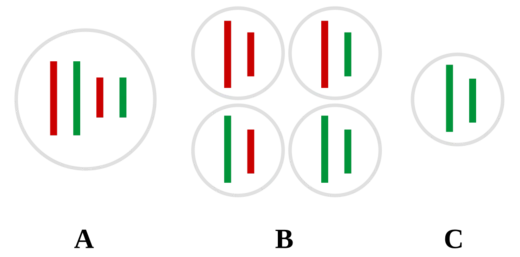
Gene flow
Gene flow transfers genetic material between populations, reducing divergence.

In population genetics, gene flow—also called migration or allele flow—describes the movement of genetic material between distinct populations. When this exchange occurs at a high enough rate, the allele frequencies of the two groups become equivalent, effectively making them a single population. Research shows that just one migrant per generation is enough to stop populations from drifting apart genetically. However, populations can still diverge due to natural selection if the selective pressures are strong enough, even while they continue to exchange alleles.
Gene flow is a key process for spreading genetic diversity across populations. Migrants alter the distribution of this diversity by changing allele frequencies—the proportion of individuals carrying a particular gene variant. High levels of gene flow reduce genetic differences between groups, making them more alike. This homogenizing effect has been thought to limit speciation and range expansion, because mixing gene pools prevents the buildup of genetic variation needed for adaptation and differentiation. In some cases, dispersal that leads to gene flow can also introduce new, positively selected genetic variants into a population’s gene pool—a process known as adaptive introgression.
Several factors influence the rate of gene flow between populations. It tends to be lower in species with limited mobility, in fragmented habitats, when populations are far apart, or when population sizes are small. Mobility is especially important: highly mobile individuals are more likely to disperse. Although animals are generally more mobile than plants, pollen and seeds can travel long distances via animals, water, or wind. When gene flow is blocked, inbreeding can increase, measured by the inbreeding coefficient (F). For instance, many island populations experience low gene flow due to geographic isolation and small sizes. The Black-Footed Rock Wallaby, living on isolated islands off Australia, has several inbred populations where the lack of gene flow has led to high inbreeding rates.
**Measuring gene flow** Gene flow can be estimated directly by tracking individual dispersal and reproductive success, but this method works only for certain organisms. More often, indirect methods are used, comparing allele frequencies across population samples. The more genetically different two populations are, the lower the
- known_for
- Transfer of genetic material between populations; one migrant per generation can reduce divergence under certain models
- key_concept
- F_ST (fixation index) measures genetic differentiation; F_ST = 1/(4N_e m + 1) under the island model
- barrier_example
- Great Wall of China (physical); wind-pollinated Ulmus pumila showed higher genetic differentiation across the wall than insect-pollinated Vitex negundo
Lore & Background
Gene flow can be measured directly by observing dispersal and reproductive success, or indirectly by comparing allele frequencies among populations. The degree of genetic differentiation is often quantified using F_ST, which ranges from 0 to 1. Under the island model with specific assumptions, one migrant per generation (N_e m = 1) yields F_ST ≈ 0.2, but this is not a universal invariant. With no migration, F_ST does not automatically reach 1; it increases over time depending on population size and drift, approaching 1 only as a theoretical limit. The formula F_ST = 1/(4N_e m + 1) relates effective population size (N_e) and migration rate (m) to genetic differentiation under the island model.
Barriers to gene flow can be physical, such as impassable mountain ranges, oceans, deserts, or man-made structures. Studies of the Great Wall of China found that wind-pollinated Ulmus pumila showed higher genetic differentiation across the wall than insect-pollinated Vitex negundo, contrary to earlier assumptions.
Reader's Guide
Gene flow is a central concept in population genetics, describing the movement of genetic material between populations. Its significance lies in its ability to counteract genetic drift and maintain genetic homogeneity, with as little as one migrant per generation sufficient to prevent populations from diverging due to drift. However, selection can still cause divergence even when gene flow occurs, if selection pressure is strong enough. Gene flow is constrained by factors such as low dispersal ability, habitat fragmentation, large distances between populations, and small population sizes. When gene flow is impeded, inbreeding increases, as seen in island populations like the Black Footed Rock Wallaby. Measuring gene flow via F_ST provides a quantitative framework for understanding population structure, with values typically below 0.25 indicating some ongoing migration. The concept has practical applications in conservation biology, where genetic rescue and assisted gene flow can mitigate inbreeding depression and loss of diversity in small populations. Barriers to gene flow—whether physical, reproductive, or behavioral—can lead to speciation, as in allopatric speciation from geographic isolation or sympatric speciation from reproductive barriers. Gene flow also plays a role in adaptive introgression, introducing novel genetic variants under positive selection into a population's gene pool.
Did You Know?
- It takes only one migrant per generation to prevent populations from diverging due to drift.
- When there is less than one migrant per generation, the inbreeding coefficient rises rapidly, leading to fixation and complete divergence (F_ST = 1).
- The Great Wall of China has hindered gene flow in native plant populations, with wind-pollinated Ulmus pumila showing less genetic differentiation across the wall than insect-pollinated species.
- In laboratory experiments with Drosophila melanogaster, crossing two bottleneck strains reversed the effects of inbreeding and improved survival across two generations.
More in Genetics 1-24
Spotted an error? Know more?
This is a living reference — every entry is fact-audited, and reader corrections feed straight into our audit queue. Suggest an edit · See this site's audit record