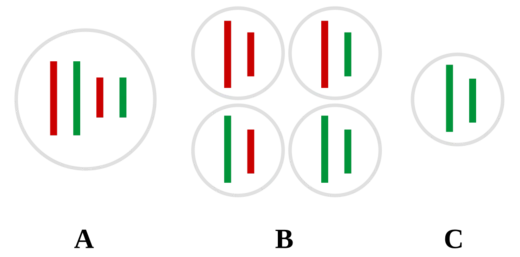
Founder effect
Loss of genetic variation from a small founding population.

The founder effect describes how a new population started by just a few individuals from a larger group can lose much of its genetic variety. Sewall Wright first fully outlined this concept in the 1930s, and Ernst Mayr later popularized the term in 1942. Because of this lost variation, the new group can become genetically and physically different from the original population. In some extreme cases, this process may help create a new species.
When a small group of migrants settles a new area, they are not a perfect genetic sample of their source population. The new colony is often tiny, making it highly vulnerable to genetic drift, inbreeding, and low genetic diversity. A population bottleneck can also produce a founder effect, even if it does not strictly form a new population.
A founder mutation is a change in DNA that appears in one or more founding individuals of a distinct population. This mutation can be passed to later generations. Any organism—from a virus to a mammal like a goat or human—whose descendants carry the mutation can show the founder effect. These mutations start on a specific haplotype, which is a contiguous segment of a chromosome, not the entire chromosome. Over generations, recombination shortens the shared haplotype among carriers, allowing scientists to roughly estimate the mutation's age.
The founder effect is a type of genetic drift. It happens when a small group splits off and forms a new population. The new colony may have less genetic variation, and random allele sampling in reproduction can quickly push alleles toward fixation. The increase in homozygosity is given by Δf = 1/(2N), where f is the inbreeding coefficient and N is population size. This inbreeding makes the colony more likely to go extinct. The loss of heterozygosity per generation due to genetic drift in any small population is Δh = -1/(2N), where h is heterozygosity. If the loss from a bottleneck is known, the same equation can estimate the founders' population size.
When a new colony is small, its founders can strongly shape the population's genetics for many generations. In slow-reproducing species like humans, the population stays small for many generations, amplifying drift until it reaches a certain size. The post-bottleneck population can be calculated with N(t) = K / (1 + b e^(-rt)), where t is generations, r is growth rate, K is equilibrium size, e is
- field
- Population genetics
- first_outlined_by
- Sewall Wright (1930s)
- based_on_work_of
- Sewall Wright
- type
- Genetic drift
- key_consequence
- Loss of genetic variation, increased homozygosity, vulnerability to extinction
Lore & Background
The founder effect occurs when a small group of migrants—not genetically representative of the population from which they came—establish in a new area. The new colony may have less genetic variation than the original population, and through random sampling of alleles during reproduction, can rapidly move toward fixation. The increase in homozygosity can be calculated as Δf = 1/2N, where N is population size, making the colony more vulnerable to extinction. The per-generation loss of heterozygosity due to genetic drift is Δh = -1/2N, a formula that applies to any small population, not just founder effects.
Reader's Guide
The founder effect is a type of genetic drift that occurs when a small group splinters off from a larger population and forms a new colony. This random sampling of alleles can cause the new population to become distinctively different from the parent population, both genetically and phenotypically. The effect is particularly significant in humans, where slow reproduction rates keep the population small for many generations, amplifying drift. While Ernst Mayr and Sewall Wright argued that the founder effect was critically important for speciation, experimental research has yielded equivocal results, and speciation by genetic drift is now considered a rare instance of peripatric speciation. Serial founder effects, as seen in human migration out of Africa, explain patterns of genetic diversity decreasing with geographic distance. The concept also applies to island ecology, as studied after the 1883 eruption of Krakatoa and on the volcanic island of Surtsey.
Did You Know?
- The founder effect was first fully outlined by Sewall Wright in the 1930s; Ernst Mayr popularized the term in 1942 but did not originate the concept.
- A founder mutation is a mutation that appears in the DNA of founders and can be passed down. It starts on a specific haplotype—a contiguous segment of a chromosome—not the entire chromosome, and this shared haplotype sho
More in Genetics 1-24
Spotted an error? Know more?
This is a living reference — every entry is fact-audited, and reader corrections feed straight into our audit queue. Suggest an edit · See this site's audit record