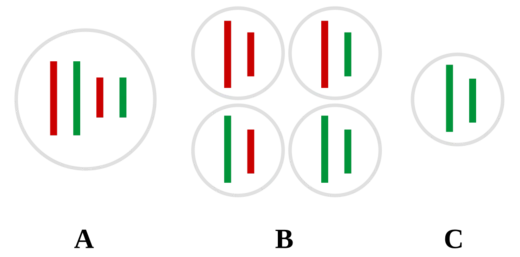
Dominance (genetics)
One allele masks another's effect in a heterozygous genotype.

Dominance in genetics is the phenomenon where one variant (allele) of a gene on a chromosome masks or overrides the effect of a different variant of the same gene on the other copy of the chromosome. The masking variant is termed dominant, and the masked variant is recessive. This concept is central to Mendelian inheritance and classical genetics, often illustrated with letters and Punnett squares, where uppercase letters denote dominant alleles and lowercase letters denote recessive alleles.
- field
- Genetics
- key_concept
- Dominance, including complete dominance, incomplete dominance, and co-dominance
- associated_figure
- Gregor Johann Mendel (promulgated the idea in the 1860s)
- related_terms
- Autosomal dominant, autosomal recessive, X-linked dominant, X-linked recessive, Y-linked, epistasis
- example_trait
- Seed shape in peas (round allele R dominant over wrinkled allele r)
Lore & Background
Gregor Johann Mendel, often called 'The Father of Genetics', promulgated the idea of dominance in the 1860s, though it was not widely known until the early twentieth century. Mendel observed discrete phenotypes in garden peas—such as round versus wrinkled seeds—and found that when lines with different phenotypes were crossed, only one parental phenotype appeared in the offspring. When those hybrid plants were crossed, the original two phenotypes reappeared in a characteristic 3:1 ratio, with the more common phenotype being that of the hybrid parents. Mendel reasoned that each parent contributed one allele, making the hybrids heterozygotes, and that one allele masked the other. He introduced the notation of capital and lowercase letters for dominant and recessive alleles, still in use today.
Reader's Guide
Dominance is a foundational concept in genetics, explaining how traits are expressed in offspring. It underpins Mendelian inheritance patterns, such as the 3:1 ratio in monohybrid crosses and the 9:3:3:1 ratio in dihybrid crosses. The phenomenon is not absolute; incomplete dominance produces an intermediate phenotype (e.g., pink snapdragon flowers from red and white parents), while co-dominance shows both alleles' contributions (e.g., ABO blood type IA and IB alleles both expressed). Dominance also varies by trait and by allele combination. The historical debate between Fisher and Wright highlights differing views on whether dominance arises from natural selection or metabolic necessity. Understanding dominance is crucial for predicting inheritance of genetic disorders, such as autosomal dominant or recessive conditions, and for interpreting patterns in plant and animal breeding. The concept remains a core teaching tool in biology, using simple letter notation to illustrate complex genetic interactions.
Did You Know?
- Dominance is not inherent to an allele; one allele can be dominant over a second, recessive to a third, and co-dominant with a fourth.
- In the ABO blood group system, the IA and IB alleles are co-dominant to each other and both dominant over the recessive i allele.
- Mendel introduced the notation of capital and lowercase letters for dominant and recessive alleles, still in use today.
- Y-linked traits are typically considered dominant in males because there is no homologous allele on the X chromosome to mask them, though the concept of dominance/recessivity is not applied in the same way as for autosom
More in Genetics 1-24
Spotted an error? Know more?
This is a living reference — every entry is fact-audited, and reader corrections feed straight into our audit queue. Suggest an edit · See this site's audit record