Rocky Reefs
Where the sea meets stone, life clings, creeps, and thrives in three dimensions.

Rocky Reefs are consolidated marine substrates—granite, basalt, gneiss, limestone, or other bedrock—exposed at the intertidal and extending into the upper subtidal zone. Unlike sandy or muddy bottoms, they provide a hard, permanent surface for attachment, creating three-dimensional topography (crevices, overhangs, boulders, and ledges) that supports one of the highest species densities in any marine habitat. They are a defining feature of temperate and tropical coastlines worldwide.
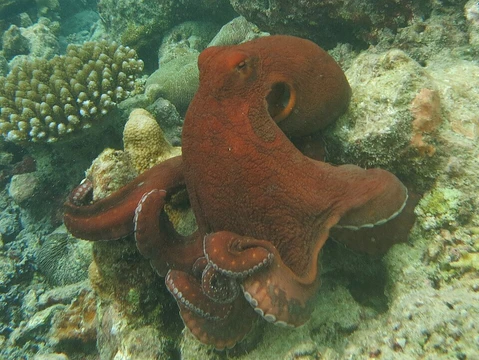
Ecologically, Rocky Reefs function as structural keystone habitats: they anchor kelp and macroalgae, shelter invertebrate and fish assemblages, and serve as foraging and denning grounds for mobile predators such as octopuses, wrasses, and sea urchins. Their stability over geological timescales makes them long-term refugia for sessile organisms and a baseline against which disturbance (storms, warming, bleaching) is measured.
- Habitat type
- Consolidated bedrock, intertidal to upper subtidal
- Global distribution
- Coastal margins worldwide (temperate, subtropical, tropical)
- Typical depth range
- Intertidal to ~30 m (upper subtidal)
- Key structural feature
- Crevices, overhangs, and boulder fields providing attachment and shelter
- Biodiversity status
- Among the highest species richness per unit area in marine benthic habitats
- Primary stressors
- Wave energy, temperature fluctuation (intertidal), ocean acidification
Lore & Background
Rocky Reefs are not a single formation but a continuum of microhabitats stacked vertically by the tide line. The splash zone, the mid-intertidal, the low-intertidal, and the upper subtidal each host distinct assemblages, creating a zonation pattern visible to any observer walking a shoreline at low water. Barnacles, mussels, and limpets dominate the upper bands; kelp forests, anemones, and dense invertebrate communities take over below the mean low-tide mark. This vertical stratification is one of the most studied patterns in marine ecology and a classic example of how a single physical variable—time spent submerged—slices a habitat into ecological compartments.
Horizontally, a Rocky Reef is a mosaic. A single boulder may carry a forest of coralline algae on its sun-facing side while its shaded crevice shelters a community of polychaetes, isopods, and juvenile fish. The interplay of wave exposure (high-energy vs. sheltered), light, and current velocity creates a patchwork of microclimates. In temperate regions, canopy-forming kelps such as Laminaria or Macrocystis drape the upper subtidal, turning the reef into a vertical forest with its own light gradient, detrital rain, and associated fauna. In tropical settings, the same hard substrate is colonized by corals, sponges, and a denser fish assemblage, yet the structural logic—hard surface, crevices, overhangs—remains the same.
For mobile predators, the reef is a hunting ground and a refuge in equal measure. Octopuses, in particular, exploit the crevice network: they den in tight gaps beneath boulders, forage across the open rock face at night, and re-enter shelter before the tide turns. The reef's permanence means that these den sites can be reused across seasons, and the three-dimensional architecture allows a single animal to partition space—den, foraging zone, and escape route—within a few metres of rock.
Reader's Guide
Rocky Reefs occur wherever consolidated bedrock meets the sea, from the high-energy Atlantic coasts of Europe to the sheltered bays of the Indo-Pacific. The intertidal band—roughly the zone between mean high and mean low water—is the most accessible and biologically distinct, with zonation driven by desiccation tolerance. Below the mean low-tide line, the upper subtidal (typically to about 10–30 m, depending on light and kelp canopy depth) is where the richest invertebrate and fish assemblages concentrate.
Substrate preference is straightforward: any consolidated rock. Granite, basalt, gneiss, and limestone all support the same structural communities, though the mineral composition can influence which coralline algae and biofilm communities colonise the surface first, setting the stage for later colonists. Crevices, boulder gaps, and overhangs are the critical microhabitats; a flat rock face with no shelter supports far fewer species than an equally sized boulder with a 2 cm gap beneath it.
Seasonal movement is modest for most reef-dwelling invertebrates, but mobile predators such as octopuses shift their foraging range with water temperature and prey availability, often moving to slightly deeper or more sheltered crevices in colder months. In temperate kelp-reef systems, the canopy itself is seasonal: kelp growth peaks in spring and early summer, and the associated fish and invertebrate assemblage tracks that productivity pulse.
Ecologically, Rocky Reefs are significant because they are long-lived, structurally complex, and resistant to the kind of sediment disturbance that reshapes soft-bottom habitats. They serve as nursery grounds for juvenile fish and invertebrates, as foraging arenas for pelagic and benthic predators, and as the attachment substrate that anchors the entire benthic food web. Their loss—through quarrying, coastal engineering, or warming-driven algal die-off—removes a habitat that cannot be quickly re-established.
Did You Know?
- A single intertidal boulder the size of a car can harbour hundreds of invertebrate species in its crevices, making Rocky Reefs among the most species-dense habitats on Earth per square metre of substrate.
- Octopuses and other denning cephalopods can reuse the same crevice across multiple seasons, effectively treating a gap in the rock as a permanent home rather than a temporary shelter.
More in Distribution & Habitat
Elsewhere in Big blue octopus
Spotted an error? Know more?
Reader corrections go straight into our review queue. Suggest an edit · How this site is sourced