Mantle
One tissue layer that builds the shell, breathes for the animal, and powers the jet.

The mantle is the principal soft-tissue layer enveloping the visceral mass of every mollusc, from the smallest limpet to the largest squid. As documented in the Wikipedia article 'Mantle (mollusc)' and standard invertebrate-zoology references, it is a mesodermally derived tissue that forms the outermost body wall, encloses the mantle cavity, and—where a shell is present—secretes the shell's organic and inorganic layers. In shelled bivalves and gastropods the mantle is a thin, ciliated epithelium; in cephalopods it balloons into the dominant muscular body of the animal.
Its functional portfolio is broad: respiration (housing the ctenidia or gills), excretion, reproduction, sensory reception, and, in cephalopods, jet propulsion. No other invertebrate phylum combines shell secretion, a dedicated respiratory chamber, and a muscular locomotory organ in a single tissue layer, making the mantle one of the most integrative anatomical structures in the marine invertebrate body plan.
- Taxonomic scope
- All classes of Mollusca (Bivalvia, Gastropoda, Cephalopoda, Polyplacophora, Monoplacophora, Scaphopoda)
- Tissue origin
- Mesodermal (body-wall) derivative
- Primary secretory role
- Shell formation (conchiolin, nacre, calcite/aragonite) in shelled taxa
- Respiratory housing
- Mantle cavity contains ctenidia (gills) in most aquatic species
- Cephalopod function
- Muscular jet-propulsion chamber and main body cavity
- Sensory structures hosted
- Ocelli (simple eyes) in many bivalves and gastropods; chromatophores and photophores in cephalopods
Lore & Background
The mantle is among the oldest continuously functioning structures in the molluscan lineage. Fossil evidence from the Cambrian (e.g., *Kimberella*-grade and early bivalve-like forms) and the extensive shell record of the Paleozoic indicate that the mantle's secretory epithelium was already producing mineralised shell by the early Ordovician. The Wikipedia 'Mollusc' anatomy section and palaeontological surveys (e.g., Smith, 1994, *Journal of Paleontology*) confirm that the mantle cavity and its ciliated epithelium predate the diversification into the major living classes, making it a plesiomorphic (ancestral) feature of the phylum.
In bivalves such as *Mytilus edulis* or *Pinctada* oysters, the two mantle lobes are the living factory of the shell: their epithelial cells lay down alternating layers of conchiolin (a protein), aragonite or calcite crystals, and, in nacreous shells, the iridescent nacre. The mantle edge—the thin, living rim where secretion is actively occurring—is only a few cell layers thick, yet it is the sole site of new shell growth. If the mantle edge is abraded, the bivalve can repair the damage, but the scar is permanent, a feature exploited in pearl-culture and in reading the growth history of wild oysters.
In cephalopods the mantle has been repurposed into a hydraulic engine. The octopus (*Octopus vulgaris*), the common cuttlefish (*Sepia officinalis*), and the giant squid (*Architeuthis dux*) all use a powerful circular and longitudinal muscle layer in the mantle to compress the mantle cavity and expel water through a funnel or siphon. The Wikipedia 'Cephalopod' locomotion section and experimental biomechanics studies (e.g., Hochquist et al., 2001, *Journal of Experimental Biology*) describe this as a variable-stiffness jet that can be modulated in force, direction, and duration—something no other invertebrate achieves with a single soft-tissue organ.
Reader's Guide
Mantle edge (bivalves/gastropods): The thin, living rim of the mantle where shell secretion is actively occurring. In a 10 cm mussel it is a sub-millimetre-wide band of ciliated epithelial cells. Remarkable because it is the *only* site of new shell deposition; remove it and the shell stops growing.
Mantle cavity: The enclosed space between the mantle and the visceral mass, present in every mollusc. It houses the ctenidia (gills), the anus, and the reproductive/urinary pores. In a 2 cm limpet it is a slit a few hundred micrometres wide; in a 3 m giant squid it is a chamber the size of a human torso. Its invariance across all classes makes it the single most conserved anatomical feature in the phylum.
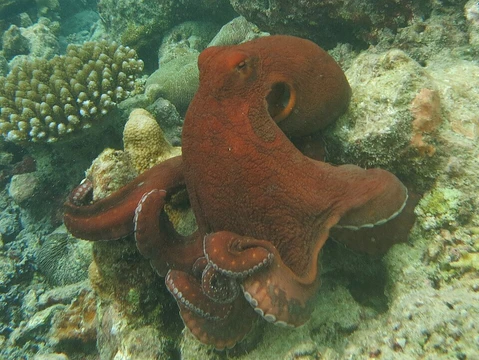
Mantle muscle (cephalopods): A thick, multi-layered ring of circular and longitudinal muscle surrounding the mantle cavity. In *Octopus vulgaris* it constitutes the bulk of the animal's visible body. Remarkable because it converts hydraulic pressure into directed jet thrust—a mechanism with no parallel in other invertebrate locomotion.
Funnel / siphon (cephalopods): A muscular extension of the mantle that directs the expelled jet. In *Sepia officinalis* it is a short, flexible tube; in *Architeuthis* it is a long, finned structure. It lets the animal steer the jet without turning its body.
Ocelli (bivalves/gastropods): Simple light-sensing pits embedded in the mantle surface, often near the shell margin. In *Mytilus* they are a few hundred micrometres across. They are the only 'eyes' in an animal that has no brain—yet they still detect the shadow of a predator.
Did You Know?
- The mantle is the only molluscan tissue that can secrete a mineralised shell; no other invertebrate phylum has a homologous structure that performs the same function.
- In the giant squid (*Architeuthis dux*), the mantle muscle is the largest single muscle in the animal and is proportionally among the most powerful jet-propulsion organs known in the animal kingdom.
- The mantle edge of a bivalve oyster is only a few epithelial cell layers thick, yet it is the sole site where nacre (the iridescent inner shell layer) is produced, one crystal plate at a time.
- In the nautilus (*Nautilus pompilius*), the mantle still secretes the external shell, but the animal does not use the mantle for jet propulsion the way a squid does; it relies on a slower, less forceful water pulse.
More in Anatomy & Physiology
Elsewhere in Big blue octopus
Spotted an error? Know more?
Reader corrections go straight into our review queue. Suggest an edit · How this site is sourced