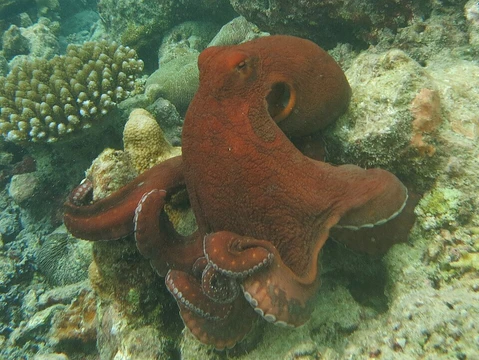
Shell crushing
Eight arms, one beak, and enough grip strength to split a crab in half.

Shell crushing is a feeding behavior of the common octopus (Octopus vulgaris) in which the animal applies sustained compressive force through its sucker-lined arms to fracture the hard carapaces and shells of crustaceans, gastropods, and bivalves. Documented in both wild foraging observations and controlled laboratory feeding trials, the behavior represents one of the most mechanically demanding prey-processing tasks in the cephalopod repertoire and a frequently cited example of problem-solving in invertebrate cognition.
Unlike soft-bodied prey that can be enveloped and drawn into the buccal cavity, hard-shelled invertebrates require the octopus to generate and direct force against a rigid structure. The animal must grip, reposition, and re-apply pressure iteratively until the shell or exoskeleton fails, a process that can take minutes to tens of minutes depending on prey size and species. The behavior is not a reflexive tearing action; it involves deliberate arm coordination, sensory feedback from suckers reading the shell's geometry, and the strategic use of the keratinous beak as a secondary fracture tool.
- Subject
- Octopus vulgaris (common octopus)
- Behavior class
- Prey processing / mechanical feeding
- Taxonomic order
- Octopoda
- Primary method
- Sucker-mediated compressive force; beak-assisted fracture
- Typical target prey
- Crustaceans, gastropods, bivalves
- Evidence base
- Wild foraging observations; laboratory feeding trials
- Cognitive relevance
- Demonstrates tool-free mechanical problem-solving and iterative force application
Lore & Background
In the intertidal and subtidal rocky habitats where Octopus vulgaris forages, hard-shelled invertebrates constitute a significant portion of the diet. Crabs, whelks, mussels, and other armored prey are abundant in these environments, and an octopus that cannot open them is effectively skipping a major food source. The shell-crushing response is therefore not a curiosity but a core ecological adaptation: it converts an otherwise inaccessible energy source into consumable tissue.
The mechanics are deceptively simple in description but complex in execution. The octopus wraps two or more arms around the prey, anchors the body against a substrate or uses the remaining arms to brace, and then contracts the circular and radial musculature of the arms to draw the suckers inward. The grip is not a passive clamp; the suckers actively modulate pressure, and the animal can feel the micro-fractures propagating through the shell through the chemosensory and mechanosensory cilia on the sucker pads. When the shell reaches a critical stress point, the octopus may rotate the prey, shift its grip to a new axis, or insert the beak into a hairline crack to lever the fragments apart.
What distinguishes shell crushing from simple biting or tearing is the iterative, feedback-driven nature of the task. The octopus is solving a physical engineering problem in real time: identifying the weakest plane in a three-dimensional shell, applying force along the correct vector, and adjusting when the first attempt fails. Laboratory observations have shown that individuals can learn to preferentially target the suture lines of bivalves or the articulation points of crab legs, suggesting that the behavior is refined through experience rather than being purely hardwired. This makes shell crushing a frequently cited case in discussions of cephalopod intelligence, as it requires the integration of tactile, proprioceptive, and visual information to coordinate multiple limbs in a goal-directed mechanical task.
Reader's Guide
In a laboratory feeding trial, the octopus is presented with a live crab or a whelk on a flat substrate. The animal approaches, probes the prey with one or two arms, and then wraps two to four arms around the shell or carapace. The remaining arms anchor the octopus's body against the glass or rock, creating a stable frame against which the gripping arms can exert force. The suckers close around the shell's surface, and the arm musculature contracts to draw the prey inward. The pressure is sustained for several seconds, then released, then reapplied—sometimes after a repositioning of the grip to a different axis on the shell.
The octopus can feel the shell's geometry through the mechanosensory cilia on the sucker pads, and it uses this feedback to locate stress concentrations: the suture line of a bivalve, the joint between a crab's leg and body, the thin apical region of a gastropod. When the shell begins to fracture, the octopus may insert its beak into the emerging crack and lever the halves apart, a secondary mechanical action that reduces the force required from the arms.
The entire sequence can last anywhere from a few seconds for a small prey item to many minutes for a large crab. What makes the behavior stand out as evidence of cephalopod cognition is its iterative, feedback-driven structure. The octopus is not applying a fixed, stereotyped bite; it is reading the shell's response, adjusting its grip vector, and re-attempting along a new axis. The task requires integrating tactile, proprioceptive, and visual information to coordinate multiple limbs in a goal-directed mechanical sequence, and the individual can modify its strategy across attempts, suggesting experiential learning rather than a purely reflexive motor program.
Did You Know?
- The suckers on an octopus's arms contain both chemosensory and mechanosensory cilia, meaning the animal can literally feel the micro-fractures propagating through a shell through its grip.
- Shell crushing is distinct from the octopus's well-known use of external tools (such as coconut shells for shelter); it is a purely internal, body-based mechanical strategy that requires no external object.
- The keratinous beak of the octopus, which is structurally similar to a parrot's beak, can be used as a secondary fracture tool after the arms have weakened the shell, reducing the total force the arms must generate.
- The behavior is observed across multiple octopus species and is not limited to a single genus, suggesting it is a broadly conserved feeding strategy within the order Octopoda.
More in Behavior & Intelligence
Elsewhere in Big blue octopus
Spotted an error? Know more?
Reader corrections go straight into our review queue. Suggest an edit · How this site is sourced