Escape behavior
Eight arms, one mind, zero commitment to staying put.

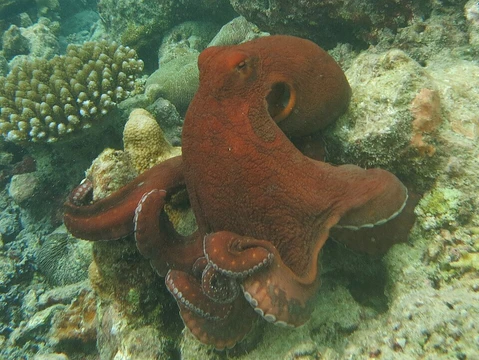
Escape behavior in *Octopus vulgaris* (the common octopus) encompasses a suite of rapid, multi-modal defensive responses that allow the animal to avoid predation in near-real-time. Unlike vertebrate flight responses that rely on a centralized motor plan, the octopus orchestrates jet propulsion, chromatophore-driven camouflage, ink expulsion, and extreme body compression through a distributed nervous system in which roughly two-thirds of its neurons reside in the arms themselves. The result is an escape repertoire that is simultaneously fast, flexible, and context-sensitive.
Because *O. vulgaris* inhabits rocky reefs, seagrass beds, and artificial structures from the Mediterranean to the western Atlantic, its escape toolkit has been observed in both wild and captive settings. Researchers such as Roger Hanlon, Godfrey Lerner, and Peter Godfrey-Smith have documented these behaviors in controlled experiments and field observations, making the species one of the best-studied examples of invertebrate problem-solving and anti-predator cognition.
- Species
- Octopus vulgaris (Cuvier, 1797)
- Class
- Cephalopoda
- Order
- Octopoda
- Habitat
- Temperate and tropical coastal waters; rocky reefs, seagrass, artificial structures
- Arms
- 8 (each with a local neural plexus)
- Key escape mechanisms
- Jet propulsion, body compression, chromatophore camouflage, ink expulsion, object manipulation
Lore & Background
In the wild, *Octopus vulgaris* spends much of its daylight hours wedged into a crevice no wider than its mantle, arms splayed outward to seal the entrance. When a predator—typically a moray eel, grouper, or large wrasse—approaches, the octopus does not simply run. It first attempts to remain invisible: chromatophores expand and contract in waves that match the substrate's mottled brown-and-green pattern, while papillae on the skin raise and flatten to replicate the rough texture of surrounding rock. This active camouflage can last seconds to minutes, buying time while the predator's attention drifts.
If the threat closes in, the octopus transitions to active escape. It draws seawater into its mantle cavity and expels it forcefully through the siphon, generating a jet that can propel the animal several body-lengths in under a second. Crucially, the octopus can compress its soft, boneless body to pass through gaps far smaller than its relaxed diameter—a maneuver that has no vertebrate analogue. In laboratory settings, individuals have been filmed squeezing through apertures less than one-tenth the width of their fully extended mantle, their arms trailing behind like ribbons.
As a last resort, the octopus can eject a dense cloud of melanin-rich ink from its ink sac. The ink forms a pseudo-morph—a dark, arm-like shape that mimics the animal's body—while the octopus itself jets away in the opposite direction. In some documented cases, the animal will also detach a single arm (autotomy) to distract the predator, regenerating the lost limb over weeks to months. Together, these layered defenses illustrate a cognitive architecture in which threat assessment, motor planning, and sensory integration are distributed across a body plan with no single 'brain' in the vertebrate sense.
Reader's Guide
Jet propulsion. The octopus draws seawater into its mantle cavity and expels it through the siphon in a single powerful stroke, generating forward or backward thrust. Observed in both wild encounters with moray eels and captive trials where a visual stimulus triggers a 0.3–0.5 s burst. The problem it solves: creating immediate distance from a closing predator. What makes it notable: the jet is generated by a muscular hydrostat with no rigid skeleton, and the animal can modulate thrust direction by angling the siphon, allowing it to reverse, rotate, or change trajectory mid-stroke.
Body compression and gap traversal. The octopus relaxes its mantle musculature and threads its soft body through apertures as small as a fraction of its relaxed diameter, arms trailing behind. Documented in controlled mazes and natural reef crevices. The problem it solves: reaching a refuge that a rigid-bodied predator cannot follow. What makes it notable: the maneuver is voluntary and reversible; the animal does not tear tissue, and the same arms that trail behind can re-engage the substrate to pull the body through.
Chromatophore camouflage and startle. The octopus rapidly shifts skin color and texture to match the substrate, or flashes a high-contrast startle pattern to freeze a predator's strike. Observed in field video and in Hanlon's laboratory work on *O. vulgaris*. The problem it solves: reducing detectability or disrupting the predator's targeting. What makes it notable: the control is local—each chromatophore is driven by its own radial muscle and neural input, so the pattern is generated in parallel across the skin rather than by a single central command.
Ink expulsion and pseudo-morph. The octopus ejects a melanin cloud that coalesces into a dark, arm-shaped blob while it jets away. Documented in both wild and captive settings. The problem it solves: creating a visual decoy that the predator attacks instead of the animal. What makes it notable: the pseudo-morph's shape is not random; it resembles the octopus's own body plan, suggesting the animal 'knows' what shape to present to the predator's visual system.
Did You Know?
- Roughly two-thirds of an octopus's neurons are located in its arms rather than its brain, meaning each arm can process sensory input and execute motor responses semi-autonomously during an escape.
- In a classic experiment, captive *Octopus vulgaris* individuals were filmed squeezing through a gap roughly one-tenth the width of their fully extended mantle, with no tissue damage observed afterward.
- The ink cloud an octopus ejects is not merely a smudge; it can form a structured pseudo-morph with arm-like projections that mimics the animal's own silhouette, giving the predator a false target to strike.
- Octopuses have been documented using objects—such as coconut shells or broken shells—as portable shelters, and in some cases manipulating objects to block or seal an escape route behind them.
More in Behavior & Intelligence
Elsewhere in Big blue octopus
Spotted an error? Know more?
Reader corrections go straight into our review queue. Suggest an edit · How this site is sourced