Rostrum
The only hard thing about an octopus, and the one that does all the killing.

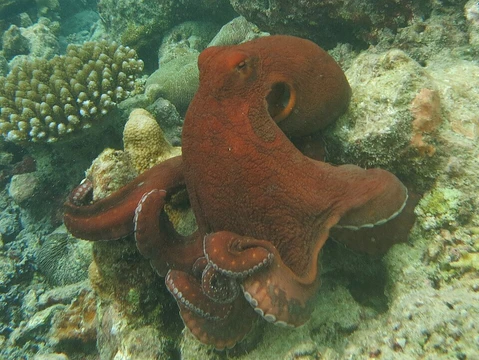
The rostrum—commonly called the beak—is the sole rigid, chitinous structure in the otherwise entirely soft body of a cephalopod such as the common octopus (Octopus vulgaris). Seated at the centre of the arm-and-web membrane, it functions as a cutting and tearing instrument for subduing hard-bodied prey such as crabs, mussels, and other gastropods. In a body that possesses no skeleton, no shell, and no mineralised tissue anywhere else, the rostrum is the one point of absolute hardness.
Across all Cephalopoda—octopods, squid, cuttlefish, and nautiluses—the rostrum shares the same basic architecture: an upper mandible (maxilla), a lower mandible (mandible), and a chitinous radula behind them. It does not regenerate if lost, making it a permanent, non-replaceable tool that the animal depends on for every meal.
- Structure type
- Chitinous beak (rostrum)
- Anchor species
- Octopus vulgaris (common octopus)
- Composition
- Chitin (cross-linked protein-polysaccharide)
- Location
- Central arm/web membrane, oral cavity
- Primary function
- Cutting, tearing, and processing prey
- Regeneration
- Does not regrow after loss
- Taxonomic range
- All Cephalopoda (Octopoda, Squilomorpha, Sepiida, Nautiloidea)
Lore & Background
In the soft, boneless architecture of Octopus vulgaris, the rostrum stands as a singular exception: a dense, parrot-shaped hook of chitin that would be unrecognisable as part of the same animal if not for the fact that it sits in the middle of a web of muscular arms. The beak is not attached to any jaw joint or powered by its own musculature; it is shifted and driven by the surrounding arm tissue, which means the entire feeding apparatus is, in a sense, an extension of the arm itself. This integration is unique among invertebrate predators, most of which dedicate specialised jaw or chelicera structures with their own muscle groups.
The beak's hardness is striking relative to the rest of the octopus. The mantle, arms, and siphon are all composed of muscle, connective tissue, and water; the rostrum is the only part that resists compression. In the wild, a discarded or digested octopus beak can persist in the stomach of a predator long after every other tissue has been broken down, and fishers and marine biologists have long used recovered beaks as evidence of octopus predation in a given area. The structure is, in practical terms, the octopus's fossil record in the gut of another animal.
Because the beak cannot be regrown, an octopus that loses it—through injury, predation, or disease—faces starvation. No other invertebrate with a comparable soft-body plan shares this vulnerability; a crab that loses a cheliped can moult and regrow it, but the cephalopod's single chitinous tool is gone for life. This makes the rostrum not just an anatomical feature but a critical survival bottleneck.
Reader's Guide
Upper mandible (maxilla): The upper half of the beak, a curved, parrot-like hook of dense chitin. In Octopus vulgaris it is roughly 2–3 cm long, a small fraction of the animal's 20–30 cm mantle length, yet it is the single hardest structure the octopus possesses. It interlocks with the lower mandible to shear through the shells of crabs, snails, and other hard-bodied prey.
Lower mandible (mandible): The lower, slightly broader counterpart that receives the upper hook. Together the two mandibles form a pincer-like cutting edge. Unlike the jaws of a fish or the chelicerae of a crab, the cephalopod beak has no muscles of its own; it is moved by the surrounding arm musculature, which is why a beakless octopus cannot feed.
Radula: A tongue-like band of chitinous teeth on the roof of the mouth, just behind the beak. It rasps and positions prey while the mandibles cut. In octopods the radula is relatively simple compared to that of a nautilus, whose radula is the most complex of any invertebrate.
What makes the whole complex remarkable among invertebrates is that it is the sole mineralised structure in an animal that otherwise has no skeleton, no shell, and no hard tissue. Lose it, and the octopus starves; there is no regrowth.
Did You Know?
- The rostrum is the only hard structure in the entire body of a soft-bodied cephalopod; the rest of the animal is muscle, connective tissue, and water.
- The cephalopod beak has no dedicated musculature of its own; it is positioned and driven entirely by the surrounding arm tissue, a design unlike the independent jaw mechanisms of fish, crustaceans, or arachnids.
- Unlike a crab's lost claw or a lizard's lost tail, a cephalopod's rostrum does not regenerate. Loss of the beak is effectively a death sentence by starvation.
More in Anatomy & Physiology
Elsewhere in Big blue octopus
Spotted an error? Know more?
Reader corrections go straight into our review queue. Suggest an edit · How this site is sourced