Problem-solving
Eight arms, three hearts, and a brain that solves problems no one taught it to solve.

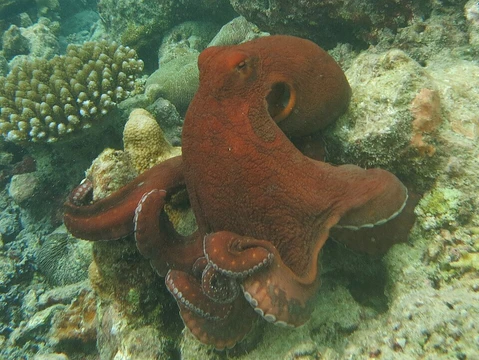
Problem-solving in octopuses (order Octopoda) refers to the capacity of these decentralized-neurology mollusks to manipulate novel objects, navigate unfamiliar spatial layouts, and extract concealed food without prior instruction. It stands as one of the most striking examples of cognition in an invertebrate lineage, because octopuses lack a centralized forebrain and instead distribute roughly two-thirds of their ~500 million neurons across eight arms, each of which can process sensory input and execute motor plans semi-independently.
The canonical experimental record—puzzle-box jar-opening, coconut-shell manipulation, maze navigation, and tool use with crab carapaces—collectively demonstrates that octopuses can form, retain, and transfer solutions across contexts. Because most common species live only one to three years, the speed with which they acquire and generalize novel solutions carries particular weight in comparative-cognition literature.
- Taxon
- Phylum Mollusca, Class Cephalopoda, Order Octopoda
- Neuron count (typical adult)
- ~500 million
- Neuron distribution
- ≈ 2/3 in arms, 1/3 in central brain
- Hearts
- 3 (two branchial, one systemic)
- Typical adult lifespan
- 1–3 years (species-dependent)
- Key experimental paradigms
- Puzzle-box (Neill, 1950s); coconut opening (Mather & Hanlon, 1984); maze navigation (Roth, 1966)
Lore & Background
The puzzle-box tradition began in the 1950s when W. J. Neill presented Octopus vulgaris with a screw-top jar containing a visible prey item. Octopuses that had never encountered a jar would initially thrash, suck, and probe; within a handful of trials many individuals learned to rotate the lid counterclockwise and extract the reward. What made the result notable was not merely that they learned, but that they transferred the solution to differently shaped containers and to lids that required a different torque direction, suggesting a flexible motor schema rather than a single conditioned reflex.
In 1984, Mather and Hanlon reported that captive Octopus vulgaris could be taught to split open a coconut shell to reach a hidden food reward, and—critically—that wild octopuses collected off the coast of Sulawesi, Indonesia, were found carrying intact coconuts to their dens, implying that the behaviour had a natural substrate. In the laboratory, trained octopuses could re-open a coconut after a delay of several days, indicating short-term retention of the solution.
Roth's 1966 maze work added a spatial dimension: octopuses navigated a water-filled T-maze and a more complex multi-arm apparatus, choosing the correct arm to reach a food source. Performance improved across trials, and animals could reverse the correct arm on subsequent runs, a form of rule reversal that is difficult to explain with simple stimulus-response chaining. Together these lines of evidence position octopus problem-solving as a genuine, if short-lived, cognitive achievement in a lineage that diverged from vertebrates over 500 million years ago.
Reader's Guide
Puzzle-box jar opening. An octopus is presented with a screw-top or twist-cap container holding a visible prey item. In the first trials the animal probes, sucks, and thrashes at the lid. Over subsequent trials—often within a single session—it learns to rotate the cap in the correct direction, extract the reward, and in some cases re-seal the container. The behaviour is notable because the octopus has no prior experience with manufactured lids, yet it generalises the motor solution to differently shaped jars and to caps requiring the opposite rotation direction.
Coconut-shell manipulation. In Mather and Hanlon's 1984 experiments, captive Octopus vulgaris learned to split a coconut shell to reach a hidden food reward. Trained animals could re-open a coconut after a multi-day delay. Wild octopuses off Sulawesi were observed carrying intact coconuts to their dens, suggesting the behaviour has a natural ecological basis and is not purely an artefact of captivity.
Maze navigation. In Roth's 1966 apparatus, an octopus swam through a water-filled T-maze or multi-arm maze to reach a food source. Performance improved across trials, and when the correct arm was reversed, the animal could re-learn the new rule. This rule-reversal capacity is difficult to account for with simple associative learning and is taken as evidence of a flexible internal representation of the spatial layout.
Tool use and shelter modification. Octopuses have been documented dragging crab carapaces to their dens and wearing them as mobile shelter, a form of tool use that solves the problem of predation risk while foraging. The animal selects a carapace of appropriate size, carries it with its arms, and can discard it if the fit is poor—behaviour that implies evaluation of a solution's adequacy rather than blind attachment.
More in Behavior & Intelligence
Elsewhere in Big blue octopus
Spotted an error? Know more?
Reader corrections go straight into our review queue. Suggest an edit · How this site is sourced