Shell carrying
A soft-bodied hunter drags a borrowed shell across the reef like a living shield.

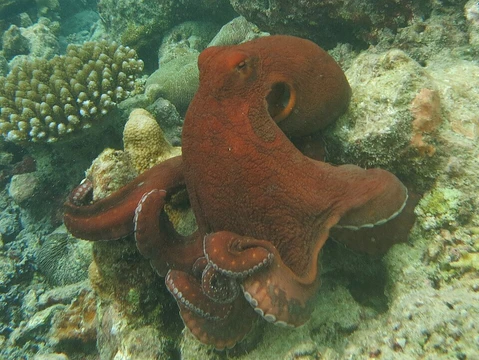
Shell carrying is a documented behavior in which an octopus selects an empty bivalve shell—most commonly a mussel or cockle shell—grips it with one or more arms, and transports it as a portable shelter. The octopus can retreat fully inside the shell when threatened, closing its mantle over the opening to seal itself in. The behavior has been observed in multiple octopus species in both wild and captive settings and is widely cited in the cephalopod-cognition literature as an example of object manipulation and forward planning.
The significance of shell carrying lies in what it implies about the animal's cognitive architecture. The octopus must assess whether a shell fits its body, carry it across the substrate, and deploy it in a moment of danger. Because cephalopods lack a hard exoskeleton of their own, the act of appropriating an external object as a body-part surrogate is a striking instance of tool-like behavior in a non-vertebrate.
- Behavior
- Shell carrying (shell use / portable shelter)
- Taxon
- Octopus (Order Octopoda, Class Cephalopoda)
- Primary shells used
- Bivalve shells (mussels, cockles); occasionally gastropod shells
- Function
- Portable shelter; predator avoidance; substrate mobility with cover
- Documented context
- Wild observations and captive (aquarium) settings across multiple species
- Cognitive significance
- Object manipulation; size assessment; forward planning
Lore & Background
In the intertidal and shallow-subtidal zones where octopuses forage, the absence of a hard carapace is a constant vulnerability. Shell carrying addresses that vulnerability in a way that is both economical and flexible: the octopus does not build a permanent den but instead carries a detachable one. Field and aquarium observations describe individuals selecting a shell whose aperture matches their mantle width, then gripping the shell's outer surface with two or more arms while the remaining arms continue to explore the substrate. The animal can set the shell down, reposition it, or discard it if it no longer fits.
The behavior is not limited to a single species. It has been recorded in Octopus vulgaris, Octopus bimaculoides, and other members of the family Octopodidae, suggesting it is a generalized capacity within the group rather than an idiosyncratic quirk. In captivity, keepers and researchers have documented octopuses choosing among several shells presented in an enclosure, rejecting ones that are too small or awkwardly shaped, and preferring shells with a smooth, rounded interior that allows the animal to curl fully inside.
Cephalopod biologists and philosophers of mind have pointed to shell carrying as a case where an invertebrate demonstrates a form of practical reasoning: the animal anticipates a future threat (a predator, a current, a lack of cover) and secures a resource now to solve that problem later. Because octopuses have no social learning in the way vertebrates do, the behavior is understood to emerge from individual experience and innate problem-solving circuits rather than from observation of conspecifics.
Reader's Guide
An octopus encounters an empty bivalve shell on the substrate. It probes the shell with one or two arms, testing the aperture width against its own mantle. If the fit is adequate, it grips the shell's outer surface with two to four arms, lifts it, and drags it across the rock or sand. The animal may set the shell down, reposition it, or carry it a short distance before committing to use.
When a threat appears—a passing fish, a shift in current, or a human hand near the waterline—the octopus retreats into the shell, curling its mantle and webbed arms over the opening to form a near-seal. It can remain inside for minutes or longer, emerging only when the stimulus passes. The shell is not a permanent home; the octopus discards it once the immediate need is over.
What makes this behavior a notable datum in cephalopod cognition is the sequence of decisions compressed into a few seconds: assess object size, test fit, carry, deploy, and release. No vertebrate brain is required. The octopus solves a spatial-mechanical problem (finding a container that matches its body) and a temporal one (securing shelter before the threat arrives) using only local sensory input and motor planning. Because the behavior appears across multiple species without evidence of social transmission, it is read as an instance of individual, experience-driven problem solving rather than learned convention.
Did You Know?
- The shells most commonly carried are bivalve valves—mussel and cockle shells—whose concave interior naturally matches the octopus's soft mantle shape.
- An octopus can reject a shell that is close in size but awkward in curvature, preferring one that allows it to seal the aperture completely with its webbed arms.
- Because octopuses lack a rigid skeleton, shell carrying is one of the few ways they can create a mobile, detachable shelter without building a permanent den.
- The behavior has been documented in multiple octopus species, supporting the view that it is a generalized capacity within the order Octopoda rather than a species-specific trick.
More in Behavior & Intelligence
Elsewhere in Big blue octopus
Spotted an error? Know more?
Reader corrections go straight into our review queue. Suggest an edit · How this site is sourced