Fry
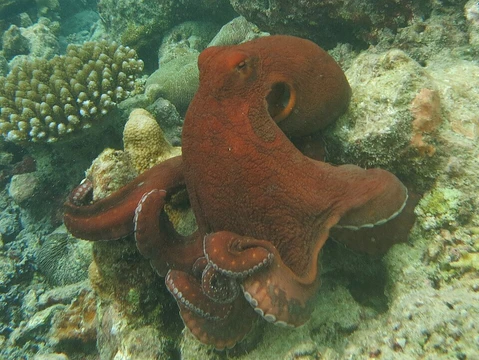
A few millimetres of glass, adrift in a world of teeth.

Fry is the earliest free-swimming life stage of a marine fish, beginning immediately after the yolk sac has been fully resorbed and the organism can feed exogenously. It sits between the egg (or yolk-sac larva) and the juvenile stage in the standard ichthyological life-cycle sequence, and it represents the single most vulnerable window in the animal's existence.
Because fry are tiny, energetically constrained, and often lack the sensory or defensive apparatus of later stages, they experience the highest per-capita mortality of any phase. In wild populations the vast majority of eggs never survive past this window, making fry the critical bottleneck through which a species' recruitment is ultimately determined.
- Stage position
- Post-hatching / pre-juvenile (between yolk-sac larva and juvenile)
- Typical body length
- A few millimetres (species-dependent; commonly 2–10 mm)
- Duration
- Days to a few weeks, highly species- and temperature-dependent
- Primary mortality driver
- Predation (visually hunting larvae, small pelagics, invertebrates)
- Key physiological milestone
- Complete yolk-sac resorption and onset of exogenous feeding
- Typical habitat
- Nursery habitats – seagrass meadows, mangrove roots, shallow coral-reef lagoons, estuarine turbid water
Lore & Background
In marine ichthyology the term 'fry' designates the brief interval in which a newly independent fish must acquire its first exogenous food, complete the initial rounds of fin-ray and scale development, and establish a functional visual and lateral-line sensory system. The transition from yolk-sac larva to true fry is marked by the disappearance of the residual yolk sac and the opening of the mouth to a size that can capture live prey. During this window the organism's morphology is still plastic: the notochord is replacing the vertebral column, the operculum is fusing, and the first pigmentation patterns (camouflage or aposematic markings) begin to appear.
Ecologically, fry are the stage most tightly coupled to 'nursery habitat' theory. Many reef and estuarine species release their eggs into open water, but the resulting larvae drift until they settle into structurally complex, low-predation environments—seagrass blades, mangrove pneumatophores, or the crevices of a fringing reef. The quality and availability of these nurseries directly set the upper bound on how many fry will survive to the juvenile stage, which is why degradation of seagrass and mangrove ecosystems is consistently linked to collapsed recruitment in commercial and recreational fisheries.
In aquaculture, the fry stage is the most technically demanding and economically sensitive phase. Rearing tanks must supply appropriately sized live or artificial feed at the precise moment the yolk sac is exhausted, maintain near-perfect water quality because the organisms have no physiological buffer, and manage density to prevent cannibalism. A single day of suboptimal conditions can wipe out an entire cohort, which is why hatcheries treat the fry phase with the same intensity that a hospital treats a neonatal intensive-care unit.
Reader's Guide
Day 0 – Hatching and yolk-sac phase (≈ 1–5 days, temperature-dependent): The embryo hatches as a yolk-sac larva. It is sessile or barely motile, drifting with the current. The yolk sac is its sole energy source. Mortality risk: desiccation if stranded, immediate predation by any small visual hunter, bacterial infection in stagnant microhabitats.
Early fry (≈ days 2–7): The yolk sac is fully resorbed. The mouth opens to a functional size; the first exogenous feed (typically nauplii, rotifers, or micro-crustaceans) must be captured. The notochord is ossifying into vertebrae. The lateral line and inner ear are completing. Behaviour shifts from passive drift to short, erratic burst-swimming. Mortality risk: starvation if feed is unavailable, cannibalism at high densities, predation by larger larvae and small invertebrates.
Late fry (≈ weeks 1–3+): Fin rays extend and the pectoral, pelvic, dorsal, and anal fins become functional, enabling sustained swimming and basic manoeuvring. Scales begin to form. Pigmentation (camouflage or warning) appears. The fish transitions from open-water or pelagic drift to a structured nursery habitat. Behaviour becomes more territorial and less random. Mortality risk: still extreme—predation by juvenile fish, crustaceans, and cephalopods; environmental stress (temperature, salinity, dissolved oxygen); disease from accumulated pathogens in dense aggregations.
Transition to juvenile: The fry reaches a size (species-specific, often 10–30 mm) at which it can defend itself, forage more broadly, and disperse to adult habitat. This is the end of the 'fry' window and the beginning of the juvenile stage.
Did You Know?
- In many marine species, fewer than 1 in 10,000 eggs survive to reach the juvenile stage; the fry window accounts for the single largest fraction of that loss.
- The term 'fry' is also used in cooking (pan-fried fish), but in ichthyology it refers strictly to the post-hatching, pre-juvenile life stage—a usage that predates the culinary one.
- Some reef fish release millions of eggs in a single spawning event, yet the number of fry that successfully settle into a nursery habitat in a given season may be in the low hundreds.
- In aquaculture, the fry-to-juvenile transition is often called the 'first-feeding window,' and a delay of even 12–24 hours in providing appropriately sized live feed can reduce survival by tens of percentage points.
More in Life Cycle & Reproduction
Elsewhere in Big blue octopus
Spotted an error? Know more?
Reader corrections go straight into our review queue. Suggest an edit · How this site is sourced