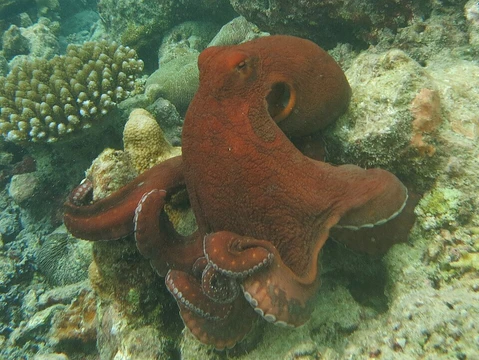
Play behavior
A solitary invertebrate that picks up a sponge, turns it over, and does it again—just to see what happens.

Play behavior in octopuses refers to the spontaneous, non-goal-directed manipulation and exploration of objects—sponges, shells, novel items—observed primarily in captive and semi-captive settings. Unlike the rigid foraging or escape responses that dominate most invertebrate behavioral literature, octopus play involves repeated, variable interactions with objects that serve no immediate survival function, making it one of the clearest behavioral signatures of a flexible, internally motivated cognitive state in an invertebrate.
Because octopuses are largely solitary, lack vocal communication, and do not form stable social groups, their play is almost entirely object-directed rather than social. This makes the common octopus (Octopus vulgaris) and the giant Pacific octopus (Enteroctopus dofleini) particularly valuable study subjects: their play sequences can be filmed, quantified, and compared across individuals without the confounding variables of group dynamics. Researchers treat these sequences as behavioral windows into a decentralized, highly plastic nervous system that solves novel problems without a centralized 'play instinct' hard-wired by social learning.
- Taxon (class)
- Cephalopoda
- Order
- Octopoda
- Most-studied species
- Octopus vulgaris (common octopus)
- Total neurons (approx.)
- ~500 million
- Neuron distribution
- Two-thirds in the arms; one-third in the central brain
- Hearts
- 3 (two branchial, one systemic)
- Blood pigment
- Hemocyanin (copper-based, blue)
Lore & Background
The common octopus possesses the most complex nervous system of any invertebrate, with roughly 500 million neurons distributed across a central brain and eight semi-autonomous arms. Each arm contains its own neural ganglion capable of processing tactile and chemical information independently, meaning an octopus can simultaneously 'think' with its arms while its central brain coordinates a different task. This architecture is the substrate on which play behavior emerges: an arm can engage a novel object in a sequence of grasps, rotations, and releases that the central brain neither initiates nor fully directs, producing behavior that looks—functionally—like experimentation or curiosity.
In captive settings, researchers have documented octopuses retrieving a sponge or a small shell, holding it aloft with one or two arms, rotating it, transferring it to another arm, setting it down, and then repeating the cycle. The sequences are variable in length and order, they occur when the animal is not feeding or hiding, and they persist even when the object is replaced with an unfamiliar one. This repeatability without reinforcement, combined with the absence of a conspecific audience, distinguishes octopus play from the more rigid, stimulus-bound responses seen in crustaceans or molluscs.
The broader significance is that octopus play provides one of the few naturalistic behavioral assays for invertebrate cognition that does not rely on operant conditioning. An octopus that spontaneously manipulates a novel object in a flexible, self-directed sequence is demonstrating something closer to the cognitive flexibility seen in vertebrate play than to a fixed behavioral repertoire, and that distinction has made octopus play a touchstone in comparative cognition research.
Reader's Guide
Object retrieval and rotation. In a tank or tide-pool setting, an octopus extends one or two arms to grasp a novel object—a sponge, a small shell, a piece of plastic. It lifts the object off the substrate, rotates it slowly, and examines it with its suckers. This is not feeding: the object is not brought to the mouth. The sequence is repeated two to six times before the object is released.
Arm-to-arm transfer. After initial manipulation, the octopus passes the object from one arm to another, sometimes involving three or four arms in a relay. Each transfer is deliberate and slow, and the object is held aloft rather than pressed to the ground. This transfer behavior is distinct from the rapid, forceful grasps used in prey capture or jet-propulsion.
Novelty-directed exploration. When a previously unseen object is introduced, the octopus approaches it, touches it with a single arm, withdraws, and then re-approaches with a different arm or a different grip. The number of approaches increases with object novelty and decreases as the object becomes familiar, a pattern consistent with a novelty-driven exploration strategy rather than a fixed stimulus-response rule.
Release and re-engagement. After a manipulation bout, the octopus sets the object down, withdraws into its den, and—minutes later—re-emerges to pick the same object up again. This re-engagement without any external trigger is the behavioral hallmark most often cited as evidence of self-directed, play-like motivation in a solitary invertebrate.
More in Behavior & Intelligence
Elsewhere in Big blue octopus
Spotted an error? Know more?
Reader corrections go straight into our review queue. Suggest an edit · How this site is sourced