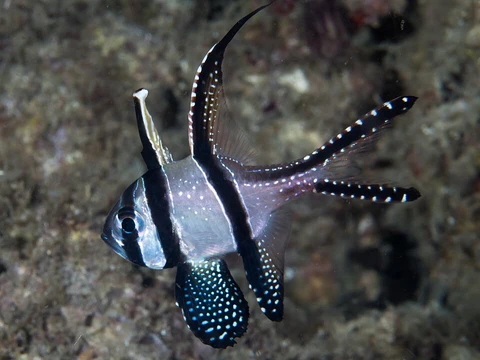
Anal fin
The ventral stabilizer that keeps a reef fish from rolling mid-turn.

The anal fin (also called the anal fin or uroanal fin) is a paired or unpaired median fin located on the ventral surface of most bony and cartilaginous fish, positioned posterior to the pelvic fins and anterior to the caudal fin. As described in the Wikipedia article on fish anatomy and the general morphology sections of FishBase, it is one of the primary median fins used for stability, fine maneuvering, and, in many species, burst propulsion.
Unlike the paired pectoral and pelvic fins, the anal fin is a single, unpaired structure arising from the ventral midline. Its ray count, spine presence, and relative size vary dramatically across teleost orders, making it a key character in ichthyological taxonomy and a visible diagnostic feature in reef-fish identification.
- Structure type
- Unpaired median fin (ventral midline)
- Position
- Posterior to pelvic fins; anterior to caudal fin
- Typical composition
- One or more anterior spines followed by soft (pliable) rays
- Primary function
- Lateral stability, pitch control, and assistive propulsion
- Taxonomic use
- Ray/spine counts are standard characters in teleost systematics
- Present in
- Virtually all teleosts; reduced or absent in some elasmobranchs
Lore & Background
In teleost morphology, the anal fin occupies a narrow window on the lower body wall between the pelvic-fin origin and the caudal peduncle. FishBase species records consistently list anal-fin spine and soft-ray counts as a fixed morphometric field, underscoring its role as a stable taxonomic character. In many reef-associated families—Pomacentridae, Labridae, Gobiidae—the anal fin is relatively small, bearing one or two stout spines and a modest fan of soft rays that the fish darts to correct yaw and roll during tight coral navigation.
In contrast, some families deploy a much larger anal fin. The cichlids of the Great Lakes and African rift lakes, for example, can carry an anal fin with a dozen or more soft rays that functions almost as a secondary propulsive surface during sustained cruising. Among elasmobranchs, the anal fin is either absent (sharks) or reduced to a single small lobe (rays), reflecting the fundamentally different hydrodynamic strategy of those groups.
Behaviorally, the anal fin is not merely a passive stabilizer. Ethological observations cited in general fish-behavior literature note that many damselfish and gobies flare their anal fins during territorial displays, and in a few species the fin is modified in males for reproductive functions. In seahorses (Syngnathidae), the anal fin is vestigial or absent entirely, a clear case of evolutionary reduction tied to the loss of active swimming.
Reader's Guide
The first thing the eye catches is position: a low, ventral fan sitting squarely on the midline, well behind the pelvic fins and a short distance ahead of the caudal peduncle. In a typical reef teleost like Pterapogon kauderni, the anal fin is small—roughly one-third the length of the dorsal fin—and bears a single stout anterior spine followed by a modest series of soft rays (commonly cited in the low teens). The membrane between rays is thin and slightly translucent, taking on a faint yellowish or silvery cast depending on lighting.
Unlike most cardinalfish, where the anal fin is proportionally larger and more laterally compressed, the goby's anal fin is short and rounded, optimized for micro-stabilization rather than sustained thrust. The spine, when extended, is noticeably harder and more opaque than the soft rays behind it, a tactile difference a handler can feel through a wet glove.
Scale texture immediately anterior to the fin origin is cycloid and smooth in gobies, contrasting with the ctenoid, rougher scales found on labrids. In those, the anal-fin base sits on a slightly raised bony ridge, and the fin membrane may carry faint dark submarginal lines that become visible only when the fish is agitated or displaying. Ray count is the single most reliable field character: a quick ventral glance and a count of spines versus softs will separate a pomacentrid from a gobiid faster than any color pattern.
Did You Know?
- In seahorses and pipefish (family Syngnathidae), the anal fin is either vestigial or entirely absent, a rare loss among teleosts.
- Anal-fin spine and soft-ray counts are standard, mandatory fields in FishBase species records, making the fin a cornerstone of teleost taxonomy.
- In many damselfish, the anal fin is flared and held erect during territorial displays, a behavior distinct from the dorsal-fin displays seen in wrasses.
- The anal fin is unpaired and median, unlike the pectoral and pelvic fins, placing it in the same morphological category as the dorsal and caudal fins.
More in Description
Elsewhere in Banggai cardinalfish
Spotted an error? Know more?
Reader corrections go straight into our review queue. Suggest an edit · How this site is sourced